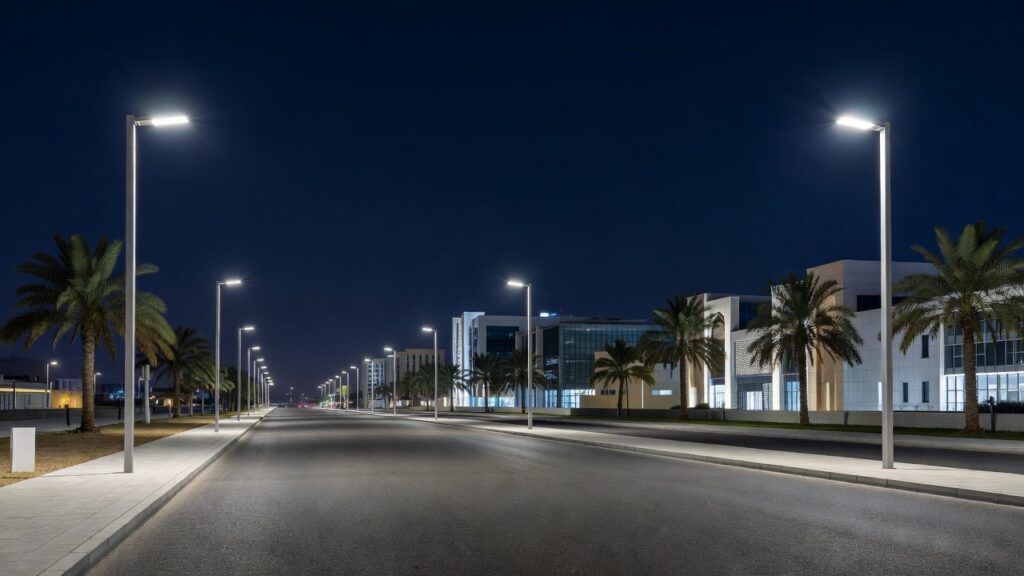
The tender covers supply, installation and replacement of LED lighting in existing public networks throughout Kuwait’s governorates, with companies able to obtain documents directly from the Central Agency for Public Tenders under approved regulations and conditions. Officials said the initiative aims to reduce electricity consumption while lowering operating and maintenance costs. It also seeks to improve lighting quality on roads and streets in various parts of the country.
According to the Times Kuwait, the project forms part of the Ministry of Electricity, Water and Renewable Energy’s ongoing efforts to modernize infrastructure and boost operational efficiency by shifting from traditional systems to energy-saving LED technology. The second phase will extend the operational lifespan of fixtures, enhance traffic safety and raise the efficiency of public lighting services. This builds on the ministry’s broader energy conservation strategy that incorporates advanced technologies for sustainable development.
A related deployment by the same ministry installed 362 solar streetlights on Boubyan Island to create an autonomous, high-performance system with remote management capabilities, a Sunna Design project summary reported. Kuwait’s total primary energy consumption reached 43 million tonnes of oil equivalent in 2024, rising at six percent annually since 2021, International Energy Agency data shows. Electricity demand has increased notably, driven by households and industry, the agency assessment found.
The country registers among the world’s highest per capita electricity consumption levels at roughly 16,500 kilowatt hours, World Bank figures indicate, which places added emphasis on efficiency improvements in public services. Public street and area lighting can account for up to 40 percent of municipal electricity use, a Clean Energy Ministerial factsheet noted. The LED conversion therefore targets a sector with substantial potential impact on overall demand.
A World Bank analysis determined that LED lights deliver 40 to 60 percent greater energy efficiency than traditional technologies while providing superior illumination and lower long-term costs. Such upgrades also cut carbon emissions and reduce maintenance because the units last significantly longer than conventional bulbs. In Kuwait, these steps complement plans to expand electricity generation capacity to 32 gigawatts by 2035, a Kuwait Institute for Scientific Research outlook projected.
Project listings indicate that bids must be submitted by July 28, 2026, allowing interested parties several weeks to prepare compliant offers for the nationwide work. The ministry has pursued parallel lighting enhancements, including updates along Arabian Gulf Street using the latest specifications, according to its published notices. These combined actions reflect sustained focus on integrating efficient solutions into the national infrastructure network.