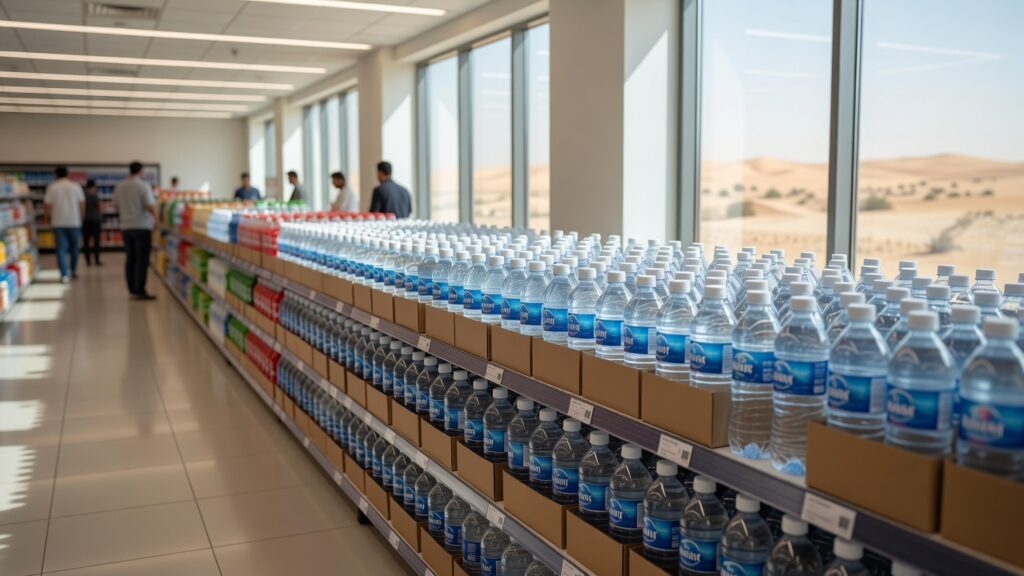
Kuwait’s Ministry of Social Affairs confirmed on July 25 that restrictions limiting bottled water purchases to a maximum of five cartons per invoice at central markets and cooperative branches stay in effect. The ministry’s Cooperative Sector issued instructions to the Union of Consumer Cooperative Societies to enforce the cap without any leniency for customers. Cooperatives have been told to monitor all transactions closely and to take immediate action against violations as part of efforts to ensure fair access for everyone.
The ministry stated that water factories continue to produce large quantities and supply the market regularly, eliminating any basis for concerns about availability. According to the ministry, the measure is aimed at stopping panic buying and excessive stockpiling that could create unnecessary pressure on supplies. Shoppers received a direct call to buy only what they need and to ignore unverified information that might encourage hoarding behavior.
Mariam Al-Awad, Director of the Cooperative Sector at the Ministry of Social Affairs, first introduced the limit through a circular in February amid exceptional circumstances. Al-Awad directed uniform application across all outlets to prevent any potential disruption at the retail level. The policy has been maintained since then as a precautionary step even after initial concerns eased.
A Ken Research analysis values the Kuwait premium bottled water market at 1.1 billion U.S. dollars in 2025 with growth projected at a compound annual rate of 6.75 percent to reach 1.5 billion dollars by 2031. The assessment links this expansion to heightened health consciousness, rising incomes and strong consumer preference for premium packaged water in an arid environment. High per capita water consumption rates have long characterized Kuwait according to historical data compiled by the Water Action Hub.
Mordor Intelligence forecasts the broader GCC bottled water market to rise from 8.92 billion dollars in 2025 to 10.48 billion dollars in 2026 with Kuwait forming part of the 25 to 30 percent regional share alongside Qatar, Bahrain and Oman. Extreme summer temperatures that frequently surpass 50 degrees Celsius help sustain demand for reliable bottled supplies in the emirate. Market saturation and modest population growth at around 4.3 million people limit further acceleration in Kuwait specifically.
The ministry’s July 25 statement stressed the need for continued public cooperation to sustain stable market conditions without artificial shortages. Enforcement remains focused on cooperative societies where the majority of household purchases occur. Officials indicated that the sustained limit has supported equitable distribution since its introduction earlier in the year.