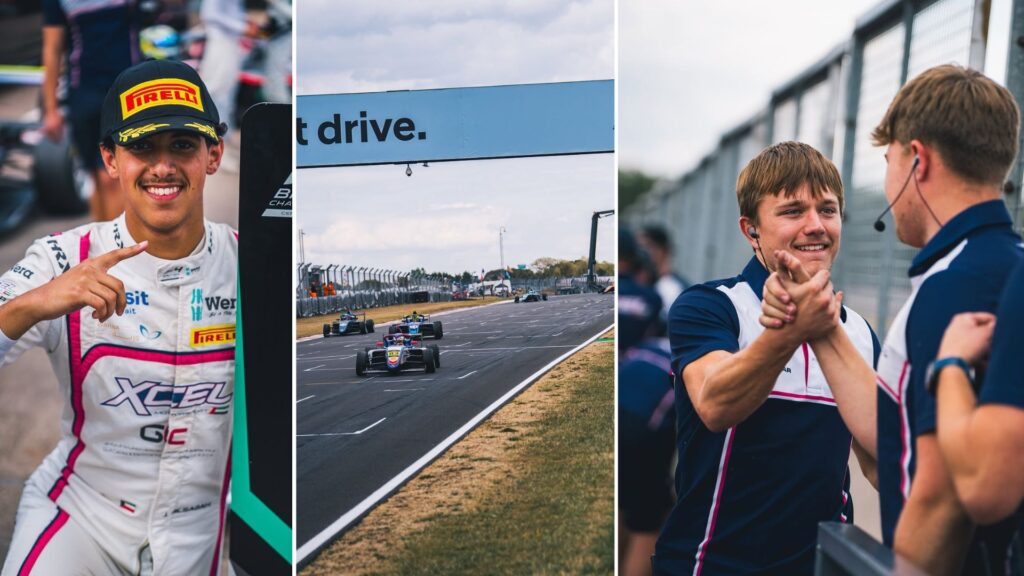
Jaber Athbi Al-Sabah’s back-to-back British F4 victories turn years of local motorsport infrastructure into a test of whether Kuwait can build a repeatable route from karting to the international grid.
Kuwait already owns the hardware. Kuwait Motor Town says its Arifjan complex covers 2.6 million square metres, with a 5.609-kilometre FIA Grade 1 circuit, seven tracks and nine racing disciplines. It is the kind of infrastructure that gives a country almost every physical ingredient required to create a motorsport culture rather than simply import one.
The harder measure is what leaves the gates. Circuits can host events, track days and championships without necessarily producing drivers capable of winning abroad. That is why a British Formula 4 result at Donington Park on 22 August matters beyond one trophy. At 16, Kuwait’s Sheikh Jaber Athbi Al-Sabah won for the second consecutive round, converting the infrastructure story into something more difficult to manufacture: competitive evidence.
From access to a pathway
Sheikh Jaber’s route began unusually late by elite karting standards. A profile published in April traced his start to a racing simulator at 12, followed by karting at Kuwait Motor Town, then competition in Rotax and IAME before he moved into Formula 4 with Xcel Motorsport. The same account described KMT as playing a major role in giving him the point of entry into racing.
Four years later, the progression is visible on timing screens. At Thruxton in July, Sheikh Jaber took his first British F4 victory after qualifying on pole by just 0.007 seconds. Then came Donington. Starting second in Race 1, he beat Tommy Harfield into Redgate, stayed ahead as the front three compressed late in the race and set the fastest lap on the final tour. The championship’s own report recorded it as his second overall victory and fourth Rookie Cup win of 2026.
The result also arrived in the language drivers themselves use when momentum becomes tangible. In his 22 August Instagram update, Sheikh Jaber wrote: “2 more races tomorrow, let’s hope to continue the moments and maximise points”. The video alongside it was less polished and more revealing: a young driver describing a good launch, control from the front and a result that now needed to be repeated.
The missing middle
There is one limit to the Kuwait story. Kuwait Motor Town can provide the first kilometres, but it is not yet a self-contained single-seater ladder. Sheikh Jaber’s progression required a move into the system of Dubai-based Xcel Motorsport, a team founded in 2015 that operates from karting through Formula 4, followed by competition in the UAE and Britain. The international bridge still sits outside Kuwait.
That distinction matters because neighbouring markets are formalising precisely that middle layer. Qatar’s federation has built an FIA-recognised development programme spanning karting, circuit racing, fitness, mental conditioning and international exposure, while Saudi Arabia now operates its own FIA-certified F4 championship. The regional contest is moving from owning circuits to owning pathways, with the Qatar programme explicitly structured around career progression.
A result Kuwait can build around
Sheikh Jaber therefore matters most not as an exception to celebrate, but as a test case to reproduce. His route links a Kuwaiti first touch, a Gulf development team and one of Europe’s most competitive entry-level single-seater championships. It also gives younger drivers at KMT something infrastructure alone cannot provide: a visible next step.
British F4 heads to Croft on 5 and 6 September with nine races remaining. Sheikh Jaber arrives there as one of 12 race winners this season and inside the overall championship’s top ten. For Kuwait, the larger result will not be decided at Croft, Silverstone or any single circuit. It will be decided by whether the next 12-year-old who starts at Motor Town can see a route that no longer has to be invented from scratch.