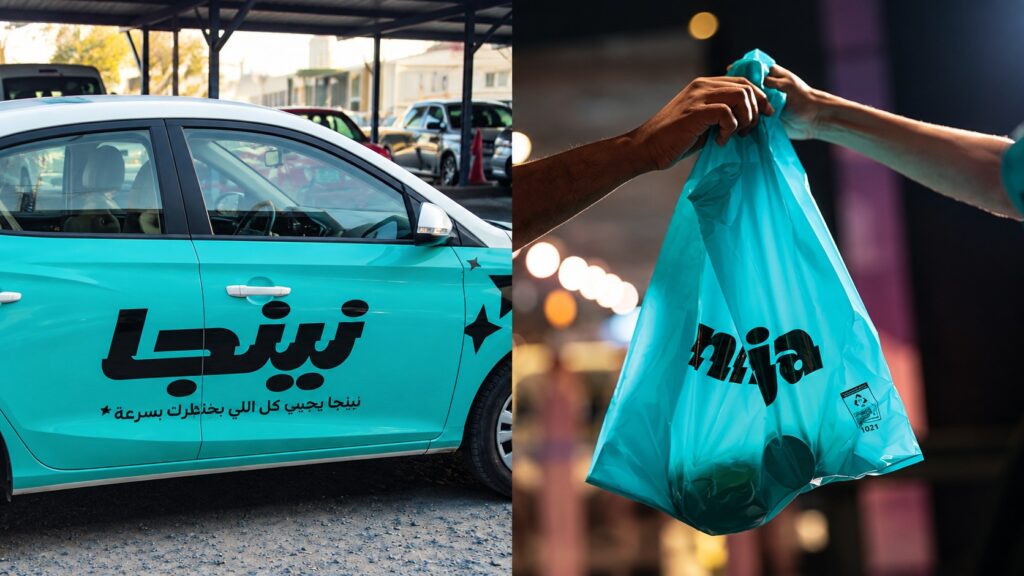
Ninja’s grocery operation, Talabat’s investment in local warehouses and the co-ops’ move into delivery point to a contest over who handles the household shop, and who pays to bring it to the door.
The competition for Kuwait’s grocery spending is spreading beyond supermarket aisles. Ninja sells groceries through its own local storefront, established delivery platforms are investing in warehouses, and cooperative societies are developing ways to send orders directly to customers.
These businesses are approaching the same purchase from different directions. A delivery platform can add grocery stock to its network. A supermarket or co-op can add delivery to an existing shop. Both routes put more of the shopping process, from choosing products to collecting payment, inside an app.
That shift involves more than replacing a trolley with a screen. When customers shop in person, they select the items and take them home. With delivery, somebody else performs those tasks. The commercial question is how those extra costs are covered, particularly when the order is small.
Ninja brings its own stock into the contest
Ninja’s Kuwait storefront is organised around groceries and household goods, with the available service tied to a delivery address. Its local operation includes dark stores, premises used to hold stock and prepare online orders rather than receive shoppers. In a public account of the Kuwait rollout, Ninja’s Tarek Kridly described establishing those stores and putting branded delivery cars on the road.
The model gives an operator responsibility for a larger part of the transaction than simply carrying an order from an independent retailer. Stock has to be bought or sourced, stored, picked and dispatched. Fresh products also bring expiry dates and temperature requirements into the calculation.
Ninja has raised substantial capital for its regional business. An announcement shared by investor Altea Partners in July 2025 reported a $254 million round led by Riyad Capital, valuing the company at $1.5 billion. Kuwait was among the markets named in that announcement.
Those figures explain the financial scale behind the platform. They do not establish its share of Kuwait’s grocery market: the announcement did not disclose a Kuwait allocation, local sales or local profitability. The distinction matters when comparing a regional fundraising headline with the business conducted through individual neighbourhood stores.
The co-ops are moving onto the same screen
Kuwait’s cooperative societies are also entering this space. In December 2025, Arab Times reported that several societies had begun working with a local delivery platform under the supervision of the Ministry of Social Affairs and the Union of Cooperative Societies.
The report identified Farwaniya Cooperative Society as the first participant in that initiative. Delivery Companies Committee chairman Abdulaziz Al-Faleh said the platform offered its services to participating cooperatives without charge. That statement concerned the cooperatives’ arrangement with the platform; it did not establish that every customer delivery would be free.
This introduces a different route into online grocery shopping. A co-op can retain its role as the seller while another business supplies the ordering or delivery service. Customers do not necessarily have to change retailer to change how they receive their shopping.
The initiative therefore complicates any account of app-based grocery services simply replacing traditional retail. Some of those traditional retailers are becoming participants in the delivery market themselves.
A delivery platform becomes a grocer
The regional investment numbers show why groceries have become a substantial part of the delivery business. In its August 2026 results announcement, Talabat described a $120 million programme for the year covering grocery infrastructure, subscription benefits and new services.
Part of that spending is intended to increase the density of Talabat mart’s dark stores and expand supply-chain capacity. Talabat reported deploying close to $58 million across the programme during the first half. These are group figures, covering several countries, rather than a Kuwait investment total.
The same disclosure reported that customers using more than one product category accounted for 75% of second-quarter gross merchandise value. That is a share of spending, not a claim that three-quarters of customers buy groceries. It nevertheless shows the commercial importance of customers whose orders extend across categories.
For the platforms, the grocery shop opens another source of transactions beyond restaurant meals. For retailers, the arrival of platforms holding their own inventory adds a competitor that combines the shopfront, stock and delivery operation.
Speed has a cost, and a limit
Ninja’s Kuwait FAQ states that delivery fees depend on distance from the nearest hub and basket value. Its minimum order also varies with distance. Those conditions expose the underlying economics more clearly than a headline promise about delivery time: where the customer lives and how much they buy affect the transaction.
The trade-off is not unique to Kuwait. In its 2026 North American grocery research, McKinsey found that 52% of surveyed grocers identified reducing last-mile costs as a leading priority for improving online profitability; 45% pointed to increasing basket size.
Its consumer research also found that 90% preferred a wider, supermarket-like selection delivered the same day over a narrower range arriving within 30 minutes. That finding cannot be applied directly to Kuwaiti shoppers. It does, however, challenge the assumption that the shortest delivery time is always the service customers value most.
Kuwait’s emerging grocery contest brings those choices together: a rapid top-up order, a larger supermarket shop and delivery from an existing co-op need not follow the same pricing or fulfilment model. The unresolved question is how much grocery spending each captures once product prices, minimum orders and delivery charges are counted together. Neither a funding valuation nor a delivery-time promise answers it.