Kuwaiti researchers are developing the breeding techniques, feed and farming systems needed to produce more seafood locally. Turning that work into regular supplies for shops and restaurants could create opportunities across the food industry.
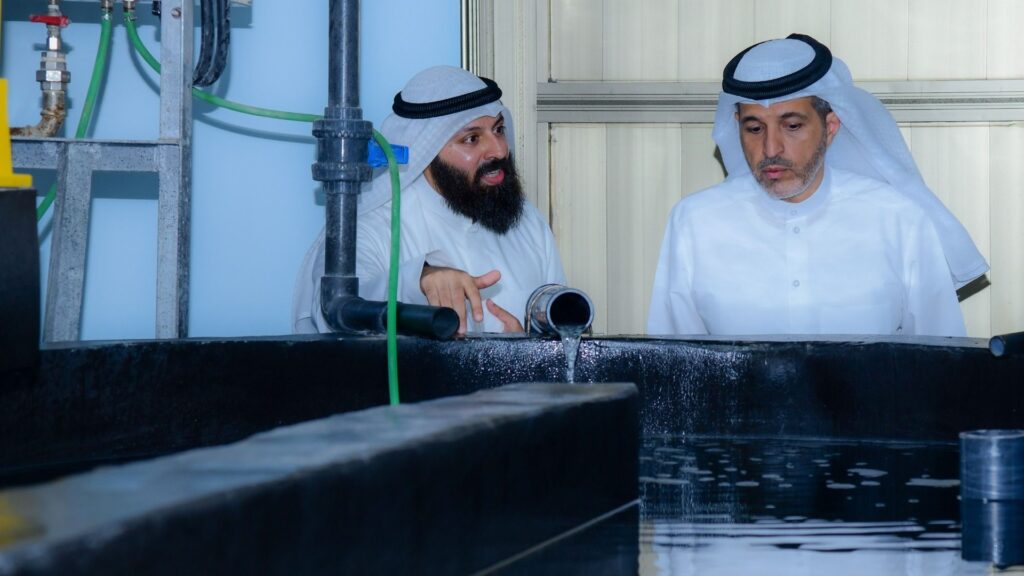
A fish farm needs a reliable supply of young fish long before it can sell its first harvest. That early stage is the focus of the marine hatchery opened by the Kuwait Institute for Scientific Research (KISR) at its research station in Salmiya. The facility brings breeding, larval rearing and the production of fingerlings, or juvenile fish, under one roof. If it can supply farms consistently, operators in Kuwait could source more of their young fish locally and plan when to stock tanks and bring their harvests to market.
At the opening, KISR Director General Dr Faisal Salman Al-Humaidan said local sources meet about 30 percent of Kuwait’s fish needs, with imports supplying the balance. The hatchery addresses one part of that gap by giving local producers a place to source young fish and access techniques tested in Kuwait. How much seafood reaches the market will also depend on what happens after the fish leave Salmiya. Farmers need to raise them to saleable size at a cost that works, and buyers need to know when the next delivery is coming. KISR’s hatchery announcement
From successful breeding to regular production
The work on sheem, a fish familiar to Kuwaiti shoppers, shows how those stages fit together. A KISR project led by researcher Amani Al-Yaqout produced young sheem in captivity in 2024 and raised the fish to commercial size in low-salinity water. Musaed Al-Roumi led the sheem culture team. The project also involved Salia, a Kuwaiti fish and shrimp farming company that helped fund the larval breeding phase and worked with KISR researchers to test the approach at its own facilities. That gave the researchers a chance to see how the method worked beyond the institute’s tanks. KISR’s sheem project update · KISR’s January 2025 research bulletin
By November 2026, Al-Yaqout told Al Rai that a fourth batch of farmed sheem had reached the Kuwaiti market, with 550 kilograms sold through Kazma. She also said KISR was preparing a fifth batch of young fish to supply farmers. Those two developments illustrate what a hatchery can contribute at either end of production. One batch gives buyers a locally farmed product to sell. The next gives farmers the stock they need to raise another harvest. Al Rai’s interview with Amani Al-Yaqout
Making seafood farming work in Kuwait
At KISR’s Kabd Research and Innovation Station, Dr Sherain Al-Subiai and her team have been tackling a different production problem. Their shrimp project adapted a system known as biofloc to Kuwait’s low-salinity groundwater. The system uses microorganisms to help manage water quality as the water is reused. In July 2025, KISR reported its fourth consecutive annual harvest at Kabd. The shrimp reached a market weight of about 20 grams, and the institute said it sold locally farmed shrimp in the Kuwaiti market for the first time. KISR’s Kabd shrimp harvest announcement
Feed is another part of making that system work commercially. In a 2026 study co-authored by Al-Subiai, researchers tested diets containing 10 percent and 20 percent fishmeal in juvenile whiteleg shrimp raised in low-salinity groundwater. The lower-fishmeal diet performed similarly on survival and overall yield during the trial, while shrimp on the higher-fishmeal diet grew faster and reached a higher final weight. For a producer, the trade-off is practical. A cheaper feed ingredient can make sense if the savings hold up once growth rates and the time needed to reach market size are taken into account. The peer-reviewed feed study
The opportunity around the farm
An aquaculture business needs suppliers well before it has seafood to sell. Tanks require pumps, aeration, filtration and monitoring equipment. Farms need feed suited to the species they raise, technicians who can maintain the equipment and access to testing when fish stop feeding or water conditions shift. Those are business opportunities for local suppliers and service firms, especially where several farms can use the same technical expertise.
Disease monitoring is one example. A project listed by the Kuwait Foundation for the Advancement of Sciences and led by Ameer Mohammed, with Jassim Aljuraidan, Fahad Asiri and Abbas Fairouz, proposed using measurements such as temperature, salinity and acidity to flag conditions that could precede disease outbreaks. The project outlined plans to test the approach in KISR tanks. For a farm operator, the value of an early warning would be the time it provides to investigate a change before it affects a larger share of the stock. KFAS’s disease-prediction project listing
Bringing the harvest into everyday supply
A restaurant can put locally farmed fish on a regular menu when it knows the size of fish it will receive, how much it can order and when the delivery will arrive. Supermarkets need much the same information, along with handling, packaging and a dependable cold chain. As farms get better at planning harvests, distributors can coordinate those orders across buyers. That gives producers a clearer sense of what to raise and buyers a clearer sense of what they can sell.
For Kuwait, the food-security gain would come from having another dependable source of seafood alongside imports and wild catch. The hatchery in Salmiya, the sheem trials and the shrimp work in Kabd each address a different point in that supply chain. The measure of progress will be whether a farmer can order the next batch of fingerlings with confidence and whether the buyer taking this week’s harvest can place the same order next week.