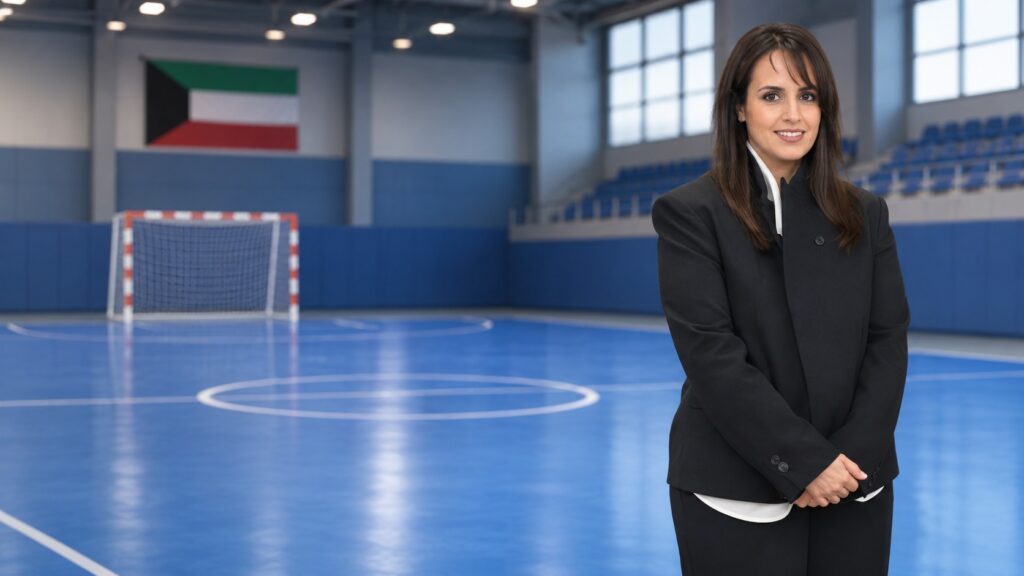
The Kuwait FA board member has set out a programme centred on restoring outdoor league competition, bringing more teams into futsal and creating additional opportunities for women and girls to play.
Dalal Yousef Al Mudhaf has identified the return of a women’s league on grass pitches as a priority for her Kuwait Football Association board term, placing regular outdoor competition alongside the country’s established futsal programme.
In an interview published by Al Qabas in May 2026, after her election, she also outlined ambitions to increase the number of futsal teams and strengthen opportunities for youth and senior national-team players.
The proposal addresses a specific part of the women’s game: where players compete regularly and how those competitions connect to national teams. It is a more concrete programme than representation in the boardroom alone.
More teams and a return to outdoor competition
In the Al Qabas interview, Al Mudhaf described discussions with clubs that could return to competition and the possibility of involving additional teams, including through private-sector participation.
She also proposed incentives for leading teams and individual match awards. Her stated priorities combined a larger futsal field with the restoration of outdoor league football and more competition for younger players.
These were plans for the board term running to 2030. The interview establishes her intended direction, rather than confirming that a relaunched outdoor league has already begun.
The emphasis is on the competition structure itself. More participating teams and organised fixtures would create additional places for players to compete, while age-group activity would address an earlier stage of development.
A board role with an identifiable agenda
The KFA’s official board record lists Al Mudhaf among the members serving from 20 May 2026 under president Sheikh Ahmad Al Yousef Al Sabah.
That institutional role gives her proposals a clear setting. They were presented at the beginning of a new federation term, with women’s competition among the areas she intended to develop.
The proposals also build on work that predates her appointment. Kuwait’s women’s football history includes organised futsal, national-team development and support from FIFA. Restoring outdoor league competition would add to that existing structure.
For players, the distinction concerns the forms of competition available to them. A national-team programme, a school activity and a club league each serve a different purpose. A league gives clubs a recurring schedule around which to organise their teams.
Futsal provides an established foundation
FIFA’s February 2022 report on Kuwait’s women’s futsal league recorded 36 matches involving six clubs and 102 players during the season held from October 2021 to January 2022.
Al Fatat defeated Kuwait Sport Club 5–2 in the final. The title match drew 1,100 spectators, with tickets sold and the match televised. Those figures belong to that season and should not be read as current participation totals.
They show that Kuwait already has experience of staging women’s club competition with a schedule, an audience and a public profile.
FIFA also recorded opportunities for coaches and referees alongside players. This matters when considering league expansion: a competition depends on the people preparing teams, organising fixtures and officiating matches, as well as those taking part on the court.
The earlier futsal season provides a concrete reference point for the structure Al Mudhaf wants to broaden.
The development programme was always wider than one league
FIFA’s 2019 account of women’s football in Kuwait described a programme that included the national futsal league, university competition, festivals and activities for younger players.
The report credited the Women’s Football Committee, then led by Fatema Hayat, and support from FIFA Forward and FIFA’s Women’s Football Division.
It also described Kuwait’s selection as one of three pilot countries for a four-year women’s football strategy. The work involved a national plan and discussions with stakeholders, placing league competition within a wider development effort.
That history helps explain the relevance of Al Mudhaf’s outdoor-football proposal. The issue is how different opportunities fit together over time, from early participation to club competition and national-team preparation.
A festival can introduce a player to the sport; an organised competition gives her a reason to train and return. The two are complementary parts of a development system.
Schools add another route into the game
The launch of FIFA Football for Schools in Kuwait in February 2024 brought another entry point. FIFA reported that 19 women in Kuwait participated in educator training, within a total of 38 across Kuwait, Bahrain and Oman.
The initiative combined teacher development with activities for children. Its purpose extended beyond identifying elite players, making football accessible through education and equipping teachers to continue the work.
FIFA also described Kuwait’s intention to link the schools programme with talent development under the federation’s Vision 2030. That connection places early participation and later progression within the same planning discussion.
The link becomes relevant to any expansion of club competition. Children introduced to football need subsequent opportunities appropriate to their age and experience if they choose to continue.
Al Mudhaf’s stated agenda brings attention to that next stage: competitions, teams and opportunities to play beyond an introductory session.
The proposed return to grass pitches gives the programme a clear objective. Alongside futsal and school football, an outdoor league would create another organised setting in which Kuwait’s women players could train, compete and prepare for national-team opportunities.