The Kuwait International Hunting, Falcons & Camping Exhibition runs at Sahara Arena from 29 September to 3 October, bringing an enduring part of Kuwaiti life into focus ahead of the cooler months.
Kuwait’s next outdoor gathering starts inside an exhibition hall. The Kuwait International Hunting, Falcons & Camping Exhibition is scheduled from Tuesday, 29 September, to Saturday, 3 October at Sahara Arena, bringing together three pursuits closely associated with the country’s desert traditions.
The five-day event at Sahara Resort in Subhan, beside Murouj, appears on the official Visit Kuwait events calendar. Its timing places it ahead of the cooler months, when attention turns towards outdoor gatherings and trips beyond the city.
There is a wider story behind the equipment. Falconry depends on knowledge passed between people, while Kuwait’s camps have long served as places for families and friends to gather. An exhibition combining the two sits at the meeting point of specialist interests and a much broader social tradition.
Five days at Sahara Arena
Organised by UCS Group Events, the exhibition is advertised around hunting, falcons and camping supplies. The published invitation gives opening hours of 10am to 10pm, with a later start of 1pm on Friday. The schedule spans weekday visits and the Friday-Saturday weekend, rather than concentrating the event into a single day.
One participating business, Tamr w Hrdh, shared an invitation to the exhibition on 26 September, telling followers it would be there for five days from 29 September. The food business’s presence adds another dimension to an event whose title might otherwise suggest an audience made up entirely of equipment buyers and falconers.
That distinction matters in Kuwait, where a trip to the desert can involve the preparations for a shared meal as much as the journey itself. The invitation is a specific example of a food exhibitor taking part, although a complete public exhibitor directory was not available at the time of writing.
The knowledge behind the bird
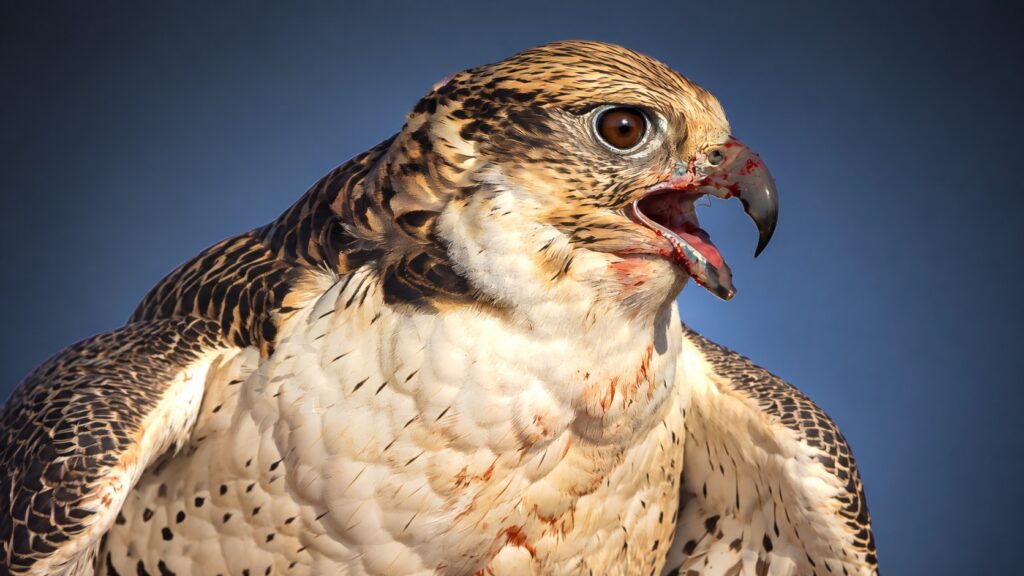
Falconry brings a different kind of expertise to the exhibition’s mix. Its tools are part of a relationship between the handler and the bird, built through training, care and repeated practice. Understanding that relationship requires more than recognising the silhouette of a falcon or the appearance of traditional equipment.
UNESCO’s account of falconry as living heritage describes a practice more than 4,000 years old that developed from a means of obtaining food into a social and recreational activity. Knowledge continues to pass through families, mentors and clubs, while the wider community includes breeders, veterinary specialists and makers of traditional equipment.
The same account places the protection of birds, their quarry and their habitats within the modern practice. That makes falconry a useful lens through which to understand the exhibition: there are skills and responsibilities behind the objects on display, alongside the cultural associations that make the subject immediately recognisable across the Gulf.
For a general reader, the heritage lies in the continuity of that knowledge, including the methods used to breed, train and care for birds. It is sustained through everyday practice as well as formal recognition.
Why camping means more than a tent
Kuwait’s camping tradition has a similarly strong social dimension. In a December 2025 report carried by Kuwait Times, KUNA described camps across the north and south of the country as places for hospitality, sport, traditional games and time away from the pace of the city.
The distinction between a brief excursion and a seasonal camp helps explain the breadth of activity surrounding the desert. A family gathering needs places to sit, prepare food and receive visitors. Specialist hunting and falconry add their own requirements. These activities share an outdoor setting, but involve different routines and kinds of preparation.
That preparation has a visible commercial history. In October 2021, Kuwait Times reported from the tent souq in Al Rai, where makers and sellers were preparing for the return of camping after the previous season’s pandemic cancellation. Its reporting described family compounds with separate tents for cooking, washing and gathering, alongside spaces for recreation. The scale of those arrangements helps explain why camping supplies extend well beyond the tent itself.
The exhibition brings those interests together before the main winter period. Its September dates are exhibition dates; they should not be read as an announcement of the start of Kuwait’s licensed camping season. The previous season, covered in KUNA’s report, ran from 15 November 2025 to 15 March 2026.
An organiser working across land and sea
UCS Group’s involvement also connects the exhibition to Kuwait’s wider calendar of outdoor events. Earlier this year, the company organised the Kuwait Marine Show at Al Khiran Marina, with dates announced for 28–31 January.
In Al Rai’s January coverage, UCS Group chief executive Abdel Fattah Samara described a show encompassing boats, yachts, fishing equipment and marine activities. That was a separate event, but it establishes the organiser’s work across several parts of Kuwait’s outdoor leisure sector.
At Sahara Arena, the advertised focus turns to hunting, falcons and camping. The connection between the two shows is the network of businesses serving people who spend their leisure time beyond the city’s indoor spaces, whether on land or at sea. The September exhibition gives that land-based side of the calendar a defined five-day slot.
For visitors planning this week’s trip, the confirmed destination is Sahara Arena at Sahara Resort, with the exhibition scheduled through Saturday, 3 October. Friday’s later opening is the main timing detail to note. The organiser is publishing updates through Kuwait Int Outdoor Expo and UCS Group Events, and can confirm admission arrangements and individual exhibitor participation before visitors travel.