Kuwait’s pastry team has qualified for the 2027 Pastry World Cup finals in France, with a creation inspired by the country’s landmark film connecting culinary competition with its maritime heritage.
Kuwait’s pastry team is heading to Lyon for the 2027 Coupe du Monde de la Pâtisserie, bringing a distinctly Kuwaiti reference to an international competition built around taste, technical skill and artistic presentation.
The team’s qualification follows work inspired by Bas Ya Bahar, the film that brought Kuwait’s pearl-diving past to cinema audiences. The French Embassy in Kuwait congratulated the chefs and praised their interpretation of the film through pastry, according to Al Qabas’s report on the achievement.
The finals will take place on 22 and 23 January at Eurexpo Lyon during Sirha Lyon. For Kuwait, the immediate milestone is a place in that final field. The cultural detail behind the qualification gives the story another dimension: a work of Kuwaiti cinema has become the starting point for an entirely different creative discipline.
A Kuwaiti film becomes a pastry reference
Directed by Khalid Al Siddiq and released in 1972, Bas Ya Bahar, known in English as The Cruel Sea, portrays the hardships of pearl divers and their families before oil transformed Kuwait’s economy.
The Bahrain Authority for Culture and Antiquities’ account of the film describes a father who, having suffered through pearl diving himself, tries to prevent his son from following the same path. The sea provides a livelihood, but also exposes families to danger, uncertainty and loss.
That background gives the team’s reference more substance than a general maritime theme. Boats, waves and the sea belong to a particular social history, one in which work and family life were closely bound to the risks of diving.
Adapting that material to pastry changes how the story is encountered. Cinema communicates through characters, dialogue and movement; a culinary display has to establish its subject through form, composition and materials. The team’s choice connects the visual possibilities of pastry with a story already rooted in Kuwait’s cultural memory.
The French Embassy’s recognition focused on that connection between cultural identity and culinary skill. It also places an older Kuwaiti artwork in a contemporary setting, introducing it to audiences whose first point of contact may be food rather than film.
The organisation behind Kuwait’s participation
The team participates under Kuwait Gastronomy & Culinary Arts, with Chef Sadiqa Ismael supervising its pastry work, according to reporting on the qualification.
KGCA says it was established in 2025 by local professionals and industry leaders to create a national platform for culinary arts, hospitality and specialty coffee. Its stated activities include structured training, mentorship and professional collaboration.
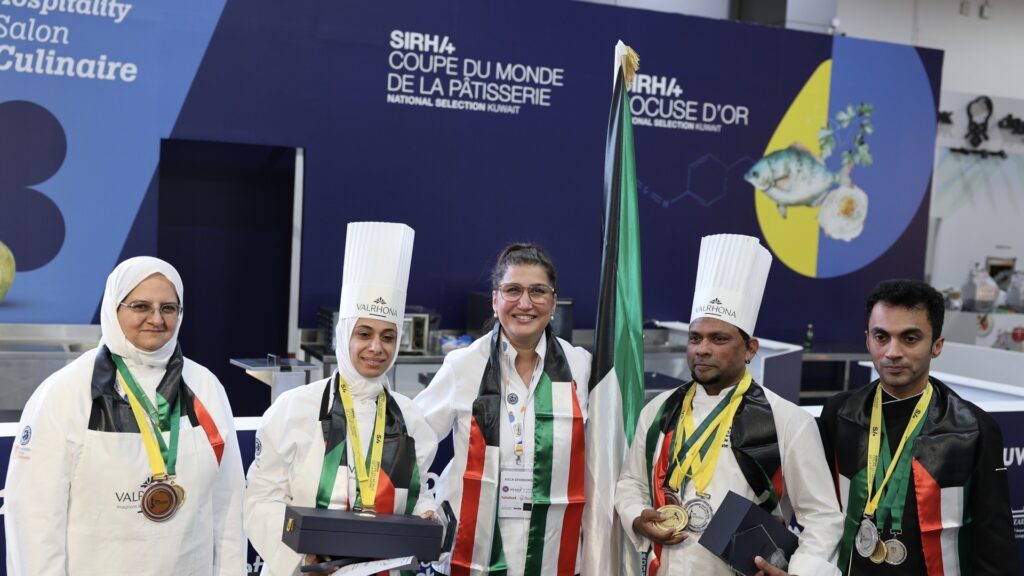
The organisation’s own event records document Kuwait’s national-team selection for both the Pastry World Cup and Bocuse d’Or. Photographs from that selection show chefs receiving medals and certificates beneath the competitions’ branding, providing a record of the domestic process behind the international participation.
Sadiqa’s background combines professional training abroad with work in Kuwait. Her published biography lists a Grand Diplôme in French Cuisine and Pastry from Le Cordon Bleu London in 2013, followed by a Diploma in French Pastry and Bakery Arts from Ferrandi Paris in 2018.
She also describes nine years at Dar Hamad as a consultant chef and menu developer, alongside cooking programmes on Kuwaiti television and Fatafeat. That experience brings both pastry training and familiarity with Kuwaiti food to her role within the association.
A professional pathway beyond the home kitchen
The qualification comes amid a wider discussion among Kuwaiti chefs about how to turn individual ability into a sustained professional career.
In a November 2025 KUNA report carried by Kuwait Times, Chef Faisal Al-Nashmi identified a lack of institutional guidance as a central challenge. He called for structured qualifications and an organisation able to connect chefs with training, employment and collaboration.
Sadiqa, speaking in the same report, described how formal education had developed her technical skills and helped her reinterpret traditional Kuwaiti dishes while preserving their flavours.
The discussion extended beyond restaurant kitchens. Chef Sheikha Al-Mohammad spoke about the specialist knowledge required in aviation catering and called for clearer training pathways. The examples showed how culinary careers can involve food development, consulting and technical work as well as cooking for diners.
International competitions provide one visible setting for those skills. A national selection brings chefs into a shared programme, while a final places their work against a defined set of tasks. Kuwait’s qualification gives that professional discussion a concrete next appointment in Lyon.
What awaits the team in Lyon
The 2027 final’s published programme brings together 20 countries and 60 competitors. Teams combine specialists in sugar, chocolate and ice cream, with tasting challenges alongside artistic showpieces.
The tasting programme includes an interpretation of the frozen dessert Vacherin, a contemporary Saint-Honoré incorporating a local product or national speciality, and chocolate creations presented in a street-food format.
Sugar, chocolate and carved-ice showpieces must also come together as a coherent display. The “Heritage & Cultures” theme applies specifically to the Show Chocolat challenge, although teams may extend it across their work.
The competition’s international structure has developed through national and continental selections, with the final held every two years. Kuwait’s next task is to prepare for the January programme, where the chefs will need to carry their ideas through both the tasting and artistic requirements.
Their Bas Ya Bahar-inspired work has already drawn attention to the cultural story behind the team. In Lyon, the focus will turn to what they produce for the judges.