Minister of Commerce and Industry Osama Boodai issued a ministerial decree on March 2 2026 capping all food commodity prices at levels prevailing before February 28 2026 for a one-month period. Any increases require the minister’s special authorization with violations subject to penalties under Law No. 10 of 1979 the Arab Times reported. The decree takes effect one month after issuance upon publication in the Official Gazette.
The decree establishes the prevailing retail prices for all food items prior to February 28 2026 as the maximum ceiling that retailers cannot exceed without obtaining special ministerial approval. Enforcement falls to relevant authorities once the text appears in the Official Gazette. Central Statistical Bureau data placed Kuwait’s overall annual inflation rate at 1.92 percent in February 2026 marking the lowest level since July 2020 even as food and beverage prices had risen 5.10 percent over the previous year according to Trading Economics.
The decision was issued alongside a prohibition on the export of all food commodities for the same period to safeguard domestic supplies according to Kuwait Times. This occurred amid concerns over regional instability that had threatened supply chains in the preceding months. The ministry framed the paired measures as necessary to maintain consumer protection and market stability as reported by multiple outlets including Times Kuwait.
Penalties for non-compliance draw from Law No. 10 of 1979 which addresses supervision of trade in goods and the setting of certain prices according to Lexis Middle East documentation. Related consumer protection provisions allow for fines up to 20 000 Kuwaiti dinars imprisonment for up to two years or both. Repeat offenses within five years result in doubled sanctions a summary from Arazaq Law indicated.
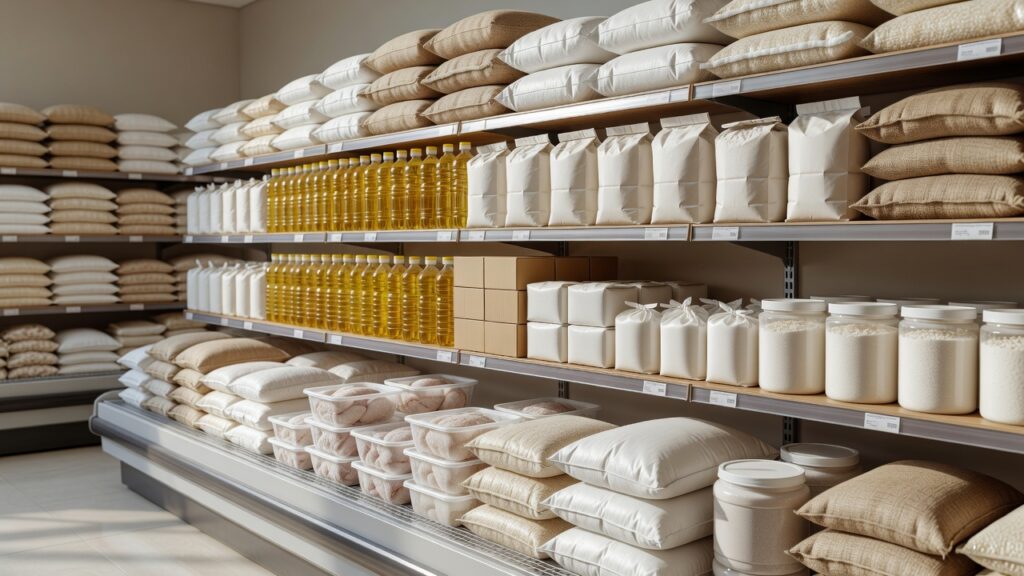
In April 2026 the Ministry of Commerce and Industry introduced an emergency package to cover additional import costs for essential goods such as rice flour vegetable oils sugar frozen poultry and infant formula. Kuwait Times reported that the policy applied retroactively to shipments arriving from March 10 2026 in response to disrupted shipping routes. The intervention targeted price gouging risks as regional tensions persisted.
Food inflation subsequently climbed to 6.32 percent in April 2026 according to Trading Economics citing official statistics. The initial one-month cap sought to limit the pass-through of such pressures to household budgets across the retail sector. Government agencies have sustained monitoring of compliance at outlets nationwide since the decree’s implementation.
The decrees numbered 20 and 21 of 2026 formalized both the price stabilization and export restrictions simultaneously through the Ministry of Commerce and Industry. Businesses received warnings against exceeding the fixed rates during this window. Publication in the Official Gazette provided the legal foundation for inspections and consumer complaints under the established trade supervision framework.