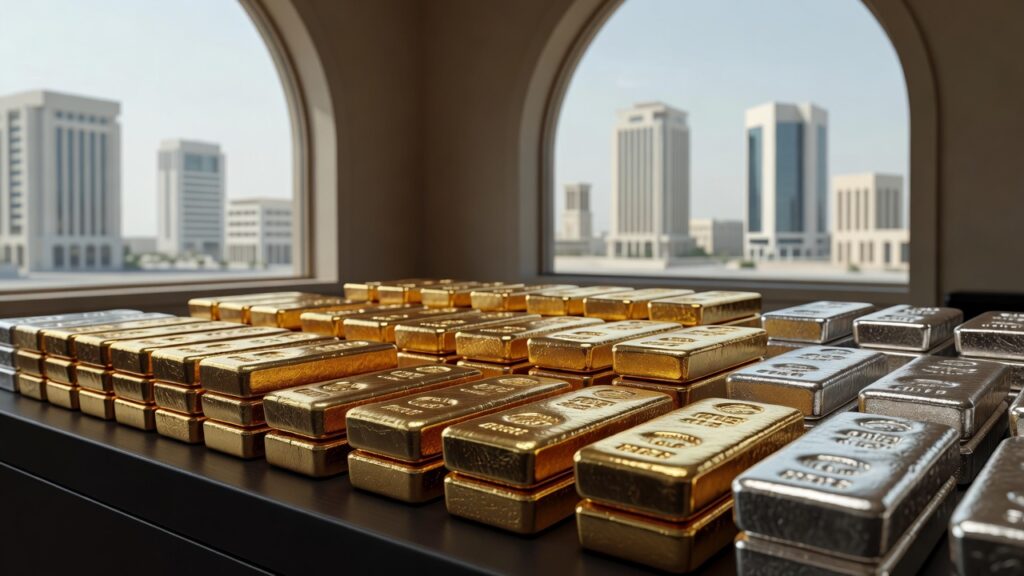
A report issued by Kuwait’s Dar Al-Sabaek Company detailed local precious metals pricing on July 26, 2026, with 24-karat gold quoted at approximately KD 40.800 per gram, equivalent to around $132. The same assessment listed 22-karat gold at KD 37.400 per gram or roughly $121 while one kilogram of silver stood near KD 684, about $2,222. Dar Al-Sabaek’s analysis tied these figures directly to international benchmarks, where global gold closed the week at $4,054 per ounce after posting limited gains.
The Dar Al-Sabaek report noted that gold had recovered from recent session losses yet continued to face downward pressure as expectations grew for interest rates to remain elevated longer than previously anticipated. This outlook has diminished the metal’s appeal as a non-yielding asset amid competing influences from monetary policy and commodity markets. The company highlighted how rising oil prices, fueled by Middle East tensions, had become the dominant factor shaping trading sentiment during the period.
According to the report, gold experienced notable declines in preceding months after the confrontation between the United States and Iran, with investors shifting focus toward the inflationary consequences of higher energy costs rather than traditional safe-haven buying. Prices eventually stabilized in a range between $4,050 and $4,065 per ounce following a nearly 2 percent drop in the prior session. The assessment emphasized that participants balanced geopolitical risks against prospects for tighter policy from major central banks.
Dar Al-Sabaek’s document indicated that markets now await the US Federal Reserve meeting scheduled for this week, where rates are widely expected to hold steady. Investors nonetheless anticipate possible increases in coming months should inflationary signals from energy and other inputs persist. The report added that sustained rises in oil and related costs elevate production and transportation expenses, reinforcing broader price pressures across asset classes.
Historical records maintained by Dar Al-Sabaek show that Kuwaiti gold prices have fluctuated through 2026, trading above KD 41 per gram for 24-karat at points in mid-July before settling at current levels. The firm’s ongoing collaboration with local banks, including initiatives for raw gold trading services launched in prior years, has expanded access to physical bullion markets for both investors and consumers. Such infrastructure has supported continued activity in the local sector even as external conditions evolve.
Data from price trackers aligned with Dar Al-Sabaek’s observations confirm that Kuwait gold rates have remained elevated relative to levels seen in earlier years when global prices hovered well below current thresholds. The company report framed the local market as closely synchronized with these worldwide movements while noting caution among participants over potential supply disruptions tied to regional developments. Monitoring of US policy decisions and energy market trends will likely remain central to near-term pricing dynamics in Kuwait.