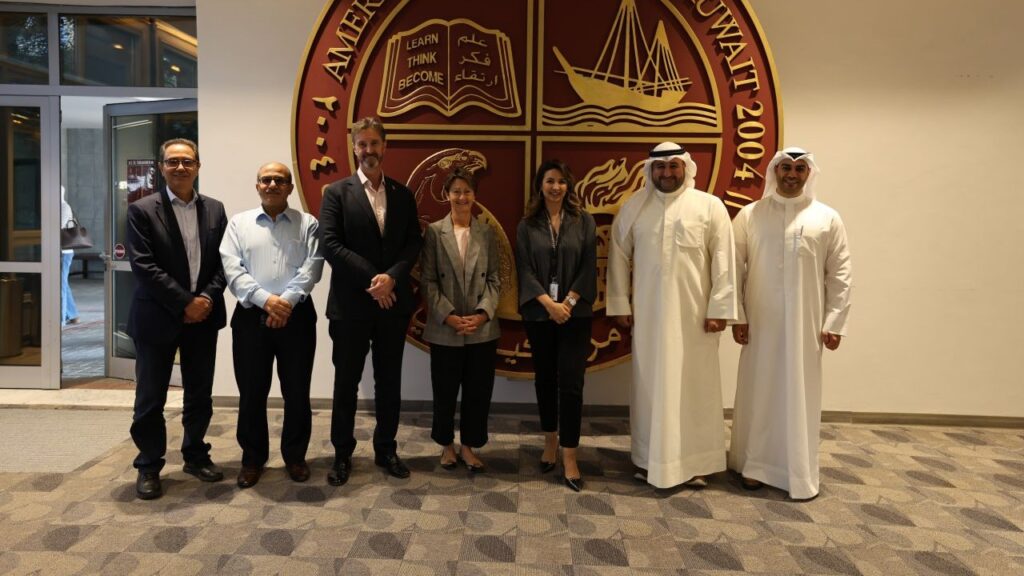
A guest session at the American University of Kuwait and her work mentoring startup founders reveal a practical thread in Taiba Al-Humaidhi’s teaching: how people make decisions when the answers are uncertain.
A former British Army helicopter pilot might seem an unusual guest for a university entrepreneurship course. For Taiba Al-Humaidhi, his experience offered a way into a question that every founder eventually faces: how do you make a decision when the information is incomplete and other people depend on the outcome?
On 28 October, Al-Humaidhi invited Dougie Lord to her Managing Entrepreneurial Ventures class at the American University of Kuwait. The session explored the connections between military leadership and running a business, including adapting plans, managing risk and maintaining trust within a team.
“We often talk about entrepreneurship as a story of ideas, but it is really a story of discipline,” Al-Humaidhi said in AUK’s account of the session.
The visit comes alongside her work mentoring entrepreneurs at Kuwait Digital Startup Campus. Together, those activities offer a view of entrepreneurship education that extends beyond explaining how to start a company. They focus on the judgement needed to manage one.
A lesson in decisions under pressure
Lord’s career provided experience from both public service and commercial organisations. He served in the British Army before moving into the private sector, where his work included international business development at QinetiQ.
For students, the relevance lay in the responsibilities running through those different roles. A leader has to allocate resources, explain decisions and respond when circumstances change. Preparing thoroughly does not remove uncertainty; it establishes a basis for deciding what to do when the original plan no longer fits.
The comparison has limits. A startup operates under different conditions from a military organisation, with different obligations and consequences. But examining another profession can make familiar business concepts more concrete. Risk management becomes a decision someone had to take, rather than a heading in a presentation.
That gives the classroom discussion a useful starting point: what can be prepared in advance, what must be reconsidered as events unfold, and who takes responsibility for the result?
Asking founders to examine their assumptions
Al-Humaidhi’s recent mentoring work puts similar questions before people already developing businesses.
In a post on her LinkedIn profile, she described joining the Kuwait Digital Startup Campus accelerator as a mentor. During individual 25-minute sessions, founders outlined their ventures and the problems occupying their attention. She described her role as questioning their reasoning and helping them reach their own conclusions.
The distinction matters. A mentor can offer experience, but the founder remains responsible for deciding whether that experience applies to their particular business. A recommendation that suits one company may depend on resources, customers or timing that another does not have.
Her account also places the work at a specific stage of company development: entrepreneurs trying to move beyond early ideas and prepare for further growth. At that point, questions about customers, spending and priorities become increasingly connected. Choosing one direction means committing time and money that cannot simultaneously be used elsewhere.
Read alongside the AUK session, the mentoring offers a consistent theme. Both settings ask people to explain how they arrive at a decision, rather than simply present the decision itself.
Returning to AUK with experience from business
Al-Humaidhi’s connection to AUK predates her teaching. She was part of its inaugural business administration graduating cohort, according to AACSB’s profile of her work.
Her subsequent career included work at Zain Kuwait and involvement in ventures including Floward and Serve Bakery. Through Lei Wa Lakom, she also developed a platform connecting women with experiences and perspectives from other women.
That background gives her teaching several points of reference: working within an established organisation, building a venture and creating opportunities for people to learn from practitioners. The recent guest session brings those interests back into the institution where she studied.
On her personal website, Al-Humaidhi describes an interest in how people think and how their decisions shape their lives over time. Her academic work has also addressed the difficulty of measuring practical financial capability.
A study co-authored with Faisal AlReshaid and Kenda Alzayed, published online in December 2025, developed and validated a financial literacy questionnaire for young people in Kuwait. It used responses from 1,064 participants and identified four domains covering consumption behaviour, information literacy, financial practices and investment behaviour.
The research concerns financial literacy rather than startup performance. Its relevance here is narrower: it treats capability as something to examine through distinct behaviours and practices. It does not establish that a classroom session or mentoring programme improves business outcomes.
The next test is outside the classroom
The accelerator provides a setting in which those business decisions will face further scrutiny.
According to the Kuwait Digital Startup Campus programme, participants receive support across growth, finance, legal matters and fundraising. Its development phase calls for measurable progress, with examples including customers, revenue and partnerships.
The programme also includes preparation for investor questions and due diligence. Its published schedule lists a demo day and pitch competition for 13 December 2026, bringing participating businesses before investors and other stakeholders.
That creates a concrete next step for founders: explaining what they have built, what evidence supports their plans and where further investment would go. The programme’s stated milestones are intended outcomes, rather than proof that every participant has achieved them.
For Al-Humaidhi’s students and the entrepreneurs she mentors, the settings differ, but the underlying question connects them. An idea can begin a business. The decisions that follow determine what is actually built, and those decisions must eventually stand up to examination beyond the classroom.