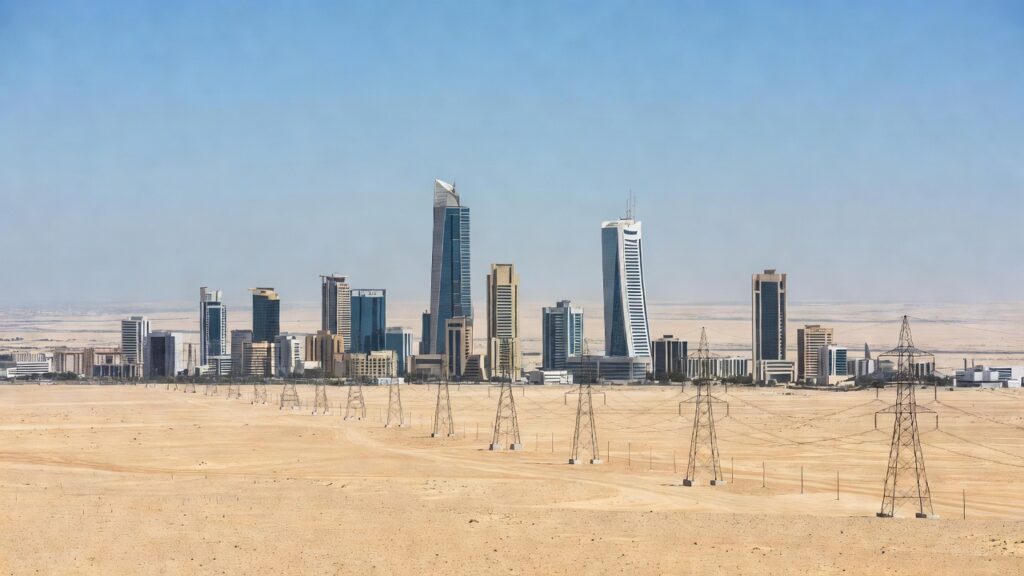
Kuwait’s electricity grid remained stable this week despite temperatures reaching 49 degrees Celsius, the Ministry of Electricity, Water and Renewable Energy reported on Tuesday. The ministry said peak demand was met without outages or load shedding, contrasting with disruptions recorded during previous extreme heat events. Officials credited proactive maintenance and public conservation efforts for the outcome.
The Ministry of Electricity, Water and Renewable Energy said in a statement that all generating stations operated at optimal levels throughout the period of intense heat. According to the ministry, recent upgrades to transmission networks and generation capacity enabled the system to handle increased loads driven by widespread air conditioning use. The statement noted that technical teams monitored the grid continuously to prevent any failures.
Arab Times reported that the stability arrived as the Meteorological Department under the Directorate General of Civil Aviation recorded highs of 49C in multiple locations across the country on Tuesday. The ministry had issued appeals for reduced consumption during peak afternoon hours, a measure that helped preserve reserve margins. Similar calls were made in 2025 when peak load hit 16,350 megawatts, according to Times Kuwait archives.
Ministry figures placed current summer demand significantly above the previous year’s levels at equivalent temperatures, yet no interruptions occurred. In 2024, widespread power cuts affected parts of Kuwait when temperatures exceeded 50C, previous Arab Times coverage showed. The Ministry of Electricity, Water and Renewable Energy has since accelerated deployment of smart meters and preparatory maintenance to address such vulnerabilities.
A PwC Middle East review of GCC government digital transformation identified Kuwait’s smart metering program as an active reform area aimed at improving demand management and reducing outage risks. The ministry has also advanced renewable energy projects to diversify supply, an initiative highlighted in its pre-summer briefings. These steps form part of longer-term planning to accommodate population growth and rising energy needs.
The Directorate General of Civil Aviation’s historical weather data indicates that temperatures above 45C are common in Kuwait from May to September, placing consistent pressure on the national grid. The ministry’s Tuesday statement reaffirmed that coordination with regional partners through the GCC interconnection system provides an additional layer of backup. Such linkages have supported supply stability in prior seasons when local generation faced strain.
Ministry officials told Arab Times that public adherence to energy-saving guidelines, including higher thermostat settings and off-peak appliance use, remains essential for sustained performance. The current heatwave tested these preparations, with the grid demonstrating improved resilience compared with earlier years. Further capacity expansion projects are scheduled to come online in the coming months.