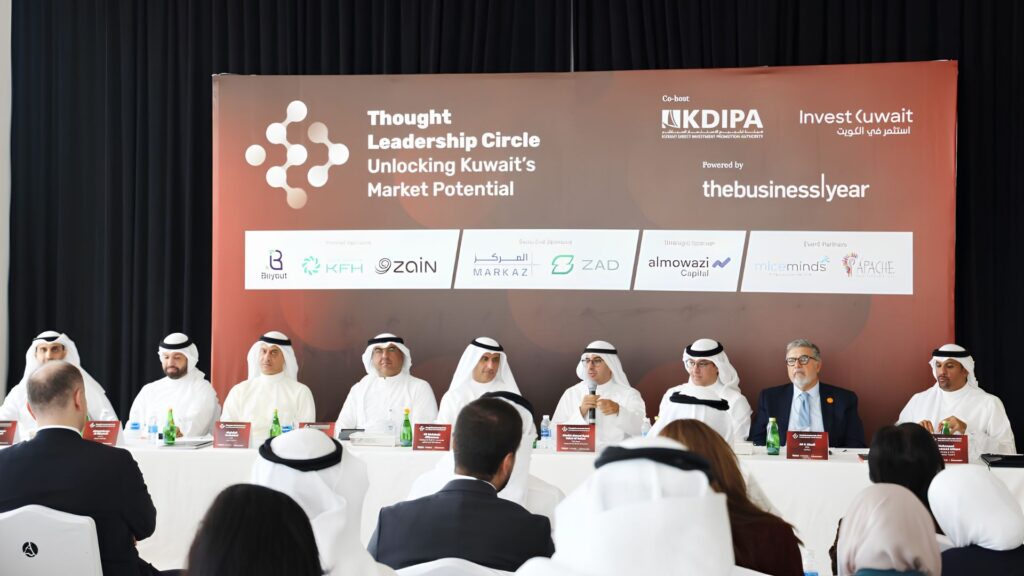
By Mohammed Khan, Kuwait City
When senior government officials, regulators and the heads of some of Kuwait’s largest financial and corporate institutions gathered at Al Hamra Tower this week, the subject was a familiar one: how to build an economy that draws its strength from more than oil. What gave the session its substance was less the ambition, long stated, than the specificity of the conversation about how to deliver it.
The roundtable, the latest edition of a recurring series titled “Thought Leadership Circle: Unlocking Kuwait’s Market Potential,” was co-hosted by the Kuwait Direct Investment Promotion Authority (KDIPA) and the global media group The Business Year, with Kuwait Financial Centre “Markaz” as gold sponsor. Abdulaziz Al-Marzouq, Minister of State for Economic Affairs and Investment, headlined a panel that brought together policymakers, financial institutions and private-sector leaders to examine the reforms underpinning Kuwait’s diversification agenda under Vision 2035.
The discussion settled on a set of concrete priorities rather than generalities: expanding access to the capital markets, helping family-owned businesses institutionalize and list publicly, strengthening the role of fund management in directing capital toward productive sectors, and using public-private partnerships to advance national development. These are the practical mechanics of market deepening, and the fact that the agenda has moved to this level of detail is itself a marker of progress.
Two voices framed the day from different vantage points. For the financial sector, Markaz chief executive Ali Khalil argued that Kuwait’s next phase of growth will depend on widening participation and forging deeper connections between capital and the real economy. That, he said, requires fair and predictable regulation, deeper liquidity, and efficient mechanisms for investors to enter and exit, whether the goal is supporting family businesses across generational transitions, attracting global asset managers, or mobilizing private capital through partnerships with the state. Coming from one of Kuwait’s oldest investment houses, founded in 1974 and managing more than KD 1.45 billion (about USD 4.74 billion) in assets, the emphasis on institutional plumbing carried the weight of experience.
For the corporate and technology side, Zain Kuwait chief executive Nawaf Al-Gharabally offered a vision of the telecom sector as a foundation for the country’s broader transformation. Kuwait’s telecom industry, he noted, has evolved far beyond voice and data into a digital ecosystem serving households, enterprises, SMEs, government entities and emerging digital businesses, an evolution aligned with Zain’s strategy of growing from a traditional operator into a regional technology company.
It is a transformation with a proven regional pedigree. Across the Gulf, the shift from “telco” to “techco” has become one of the defining corporate stories of the decade. In the UAE, the operator formerly known as Etisalat rebranded as e& in 2022 and restructured around distinct technology, enterprise, fintech and digital-lifestyle verticals, a move widely credited with reshaping how a national champion can drive a country’s digital economy. That the same model is now being advanced in Kuwait speaks to a region moving in concert, each market adapting the template to its own strengths. What stands out in the Kuwaiti version, on the evidence of this week’s discussion, is the emphasis on building capability at home.
That emphasis came through most clearly in a concrete example. Al-Gharabally pointed to Zain’s partnership with United Real Estate Company to power the digital infrastructure of Hessah District, one of Kuwait’s most ambitious urban developments, illustrating how Kuwaiti firms are moving into new frontiers such as smart districts, connected workplaces and digitally enabled communities, and doing so as national players building at home. He also highlighted fintech as a key growth area, citing initiatives such as Zain Insure aimed at making financial services simpler, faster and more inclusive, and described an opportunity not merely to digitize existing services but to create a new layer of digital financial capability in Kuwait.
Running beneath both speakers’ remarks was a shared conviction that artificial intelligence will be central to the next phase, powering everything from enterprise operations and customer experience to fintech, healthcare, education and large-scale national projects. That conviction is not confined to the conference room. In a parallel sign of intent, the Kuwait Investment Authority, the country’s sovereign wealth fund, has taken a position alongside NVIDIA, Vistra and the asset manager KKR in a multibillion-dollar AI infrastructure venture, placing national capital directly behind the technology the roundtable identified as its central enabler. Rhetoric and resources, in other words, are beginning to point the same way.
Al-Gharabally closed on a theme that resonated throughout the morning: the value of integrating national private-sector companies as strategic partners in Kuwait’s major development projects. As the country attracts leading global technology firms, embedding Kuwaiti companies alongside them helps localize expertise, strengthen execution and build sustainable national capabilities, ensuring the benefits of growth take root and remain in Kuwait.
It was, in the end, a morning that captured something encouraging about where the country is heading: clear ambitions, capable institutions, and a private sector ready to help build the digital economy of tomorrow. The vision is set, the partnerships are forming, and, increasingly, the capital is moving to match.