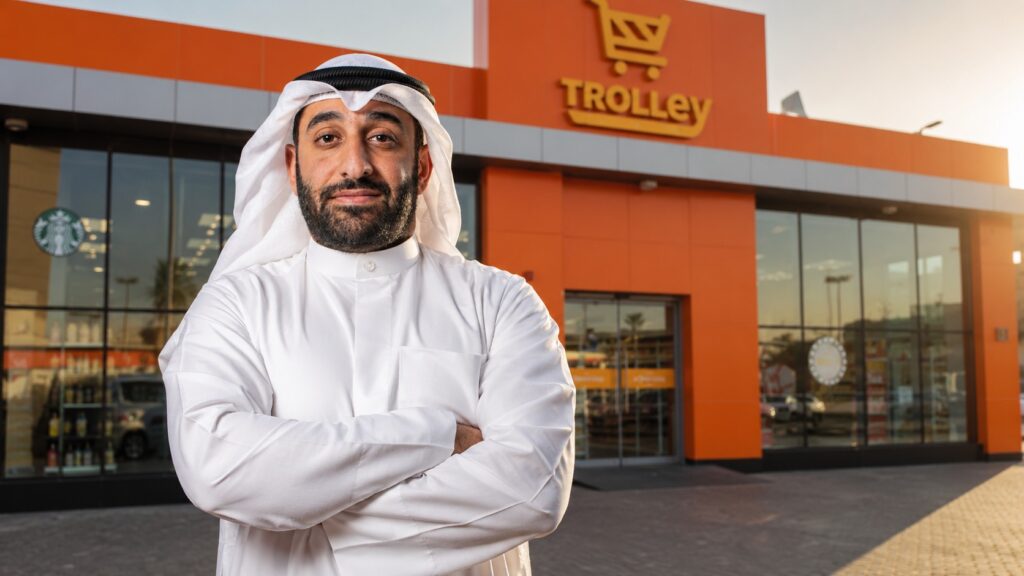
For a decade, listing on Boursa Kuwait was something banks, government-backed entities and infrastructure plays did. Retail investors had almost no access to a growth-oriented consumer company. Then a convenience chain that started as a campus baqala in 2010 priced an all-secondary offering that was covered 15.2 times, drew total demand near KD 904.4 million against a KD 59.5 million raise, and pushed its selling shareholders to upsize the float from 30 to 35 percent. Trolley began trading on the Premier Market on 25 March 2026 under the ticker “TROLLEY” at 618 fils a share, valuing the company at roughly KD 170 million, about USD 552.58 million.
That book did more than reward the Boodai family. It reopened an equity issuance pipeline that had been dormant for years, and it did so with a business model most Gulf investors had never been asked to price on its own terms.
A supermarket multiple for a corner-shop network
The pricing is the most revealing number in the deal. Trolley was valued at 15.5 times projected 2026 earnings, matching regional peer Spinneys. That comparison is doing a lot of work. Spinneys is a premium, fresh-led supermarket operator across the UAE, Oman and Saudi Arabia with roughly USD 993 million in trailing revenue. Trolley is a 249-store network of small-format forecourt and neighbourhood shops in Kuwait and Saudi Arabia. Anchoring one to the other asked investors to accept that a convenience operator deserves the same multiple as a full-basket grocer, on the argument that the channel grows faster and earns more per square metre.
The early numbers support the ask. In the first quarter of 2026, its first as a listed company, Trolley reported revenue of KD 25.9 million, up 29.3 percent, EBITDA of KD 5.0 million at a 19.3 percent margin, and net profit of KD 2.4 million, up 83.4 percent, with return on equity of 27.9 percent against 22.2 percent a year earlier. A 19.3 percent EBITDA margin from a chain of corner shops is not a typo; it is the entire investment case. It sits within touching distance of the sector-leading margin Spinneys carried into its own listing, which is precisely why the multiple held.
The concession: the last comparable priced this way has drifted lower
Here the deal deserves an honest caveat, and it is the one a distribution desk should put in front of any client tempted by the debut pop. The template Trolley was priced against has not held its own valuation. Spinneys made its DFM debut in May 2024 at 1.53 dirhams; by April 2026 it was trading near 1.18 dirhams, below its listing price, having posted a roughly 16 percent decline over the prior year even as revenue and profit kept rising. A strong operator can list at a full multiple, keep growing earnings, and still see its shares de-rate once the IPO scarcity premium fades and the market reprices it as a mature grocer rather than a growth story.
Trolley now carries the same risk in a sharper form. The stock reached an all-time high of 999 fils on 28 April 2026 and has since eased to around 910 fils by mid-June, still well above the 618 fils offer. The gain is real, but the direction of travel from the peak is the same one Spinneys took, and Trolley trades on a thinner track record as a public company.
What the demand actually signalled
The more durable takeaway is structural. The 15x oversubscription reopened Kuwait’s equity issuance pipeline after an extended dormancy and provided a liquidity benchmark for other companies weighing a listing, with heavy GCC institutional participation rather than reliance on Western allocations. International investors still took a quarter of the book, but the anchor was regional capital that increasingly wants to stay home. For a market that had ceded consumer and technology listings to Riyadh and Abu Dhabi, a domestically anchored, 15x-covered consumer float is evidence that Boursa Kuwait can absorb the next one.
The signal was sent under stress, which strengthens it. Boursa Kuwait’s own chief executive framed the listing, completed amid the regional geopolitical tensions of March 2026, as a demonstration of the resilience of Kuwait’s business environment, and noted it brought the exchange to 141 listed companies. A book this size clearing in that month is a harder test than the same book clearing in a calm one.
Trolley’s debut answered the question of whether Kuwait’s retail investors would show up for a homegrown consumer name. They did, at a price built on a Dubai comparable that has since drifted below water. The company now has to prove the multiple with the one thing the order book could not supply: quarters of delivery as a public company, in a category the market is still learning to value.