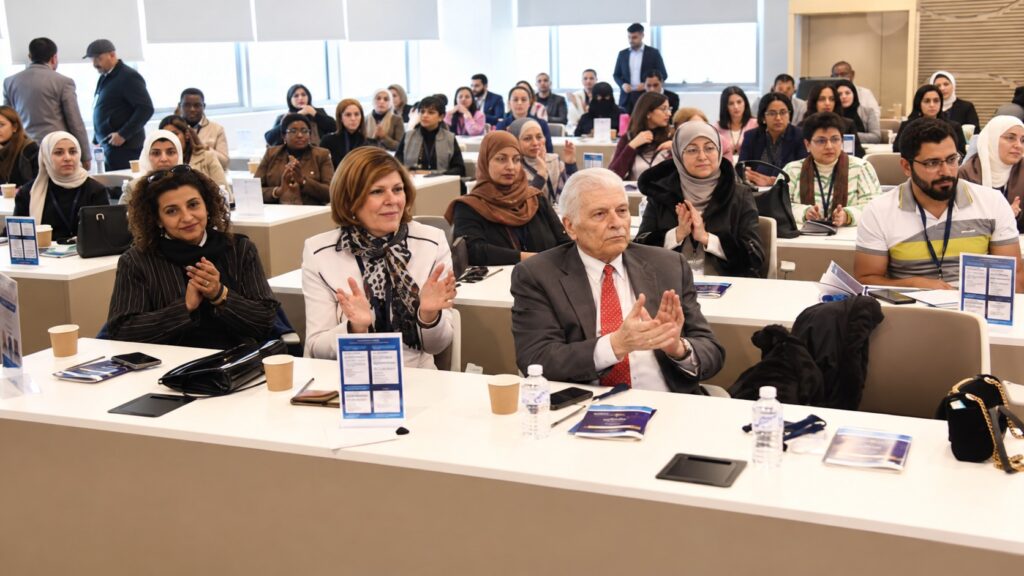
The December meeting puts early identification and independent learning on the agenda, raising questions about language, assessment and the evidence behind educational tools.
Artificial intelligence can generate text quickly. Whether it helps a child become a more confident, capable reader is a different question. That distinction will be central to a Kuwait conference examining dyslexia, early identification and the use of technology in learning.
The Kuwait Dyslexia Association’s second annual conference is scheduled for 13–14 December 2026. Its announced theme connects dyslexia with artificial intelligence, moving from early diagnosis towards more independent learning. The subject brings together families, educators and researchers around a question that requires evidence, not simply enthusiasm for a new tool.
For Kuwait’s schools and parents, the practical issue is how technology fits into support that already involves assessment, teaching and regular observation. A programme that reads text aloud, a system that generates exercises and a tool claiming to identify reading difficulties perform different tasks. They should not be judged as if they were interchangeable.
Identifying a difficulty is different from supporting it
The Kuwait Dyslexia Association’s service description sets out a process involving an initial appointment, assessment, analysis, a report and an individual support plan. It also describes work in Arabic and English. This places the proposed use of AI within a broader educational process, rather than presenting software as a complete response in itself.
An initial screening can indicate that further assessment may be useful. It should not be confused with a full evaluation of an individual learner’s needs. Equally, a helpful classroom tool does not establish why a child is experiencing difficulty or whether other support is required.
The distinction matters for families comparing strong claims. A product may be useful for accessing a passage without having been shown to improve reading ability over time. Another may help a teacher prepare material without being designed to assess a child. The claimed purpose needs to be clear before its performance can be evaluated.
The British Dyslexia Association’s explanation of dyslexia emphasises difficulties associated with reading and spelling and the variation between individuals. That variation is one reason a single demonstration should not be treated as evidence that the same tool will meet every learner’s needs.
The language of the classroom matters
The Kuwaiti association’s provision in both Arabic and English gives the conference a specific local context. A system demonstrated in one language does not automatically establish its suitability in another. The vocabulary, written form and learning material used in a classroom all affect what a tool is being asked to do.
This is particularly important when a product is described broadly as an AI reading assistant. The relevant questions are more precise. Which language and age group were involved in its testing? What reading task was measured? Was the comparison with ordinary teaching, another tool or the learner’s own earlier performance?
These are questions about evidence, not objections to using technology. Without them, a polished demonstration can be mistaken for a finding about learning. With them, educators can identify the actual scope of a result and decide whether it is relevant to the pupils they teach.
Local discussion also gives families and teachers a chance to describe practical needs that may be absent from an international product launch. The starting point should be the task a learner finds difficult and the support required to complete it, rather than the features available in a particular application.
UNESCO puts human judgement at the centre
UNESCO’s guidance on generative AI in education and research calls for a human-centred approach, including attention to privacy, inclusion and the validation of tools for educational use. These concerns are especially relevant when a system processes information about children or makes claims about their learning.
The guidance does not establish that AI is effective for dyslexia. It provides a framework for asking how an educational system should be evaluated and governed. The people responsible for teaching and assessment still need to understand what information is being used and what the output can support.
There is also a difference between making an activity easier and achieving its learning objective. If a task is intended to assess reading, having software read the entire passage changes what is being measured. If the objective is access to subject knowledge, the same assistance may serve a different purpose.
That difference is not a contradiction. It shows why the educational objective must be stated first. The appropriate use of a tool depends on whether a teacher is supporting access, practising a skill or evaluating progress. An application cannot settle that question simply by producing a fluent response.
What useful evidence would look like
UNESCO’s Global Education Monitoring Report discussion of technology asks whether a proposed technology is appropriate, equitable, scalable and sustainable. Applied to reading support, these questions extend beyond whether a system works during a short demonstration.
A useful evaluation would explain who used the tool, for how long and alongside what teaching. It would identify the outcome being measured and distinguish learner progress from time saved by adults preparing materials. It would also make clear where the findings do not apply.
The December conference’s invitation to research, workshops and practical contributions creates room for that kind of discussion. Published expectations for speakers and participants remain organiser projections until the event takes place. The substance will be in the work presented and the evidence available for examination.
For families, the most valuable outcome will be clearer distinctions: screening and diagnosis, assistance and instruction, a demonstration and a measured result. Kuwait’s AI-and-dyslexia discussion will be strongest when it helps people understand those differences and connect technology to a learner’s actual needs.