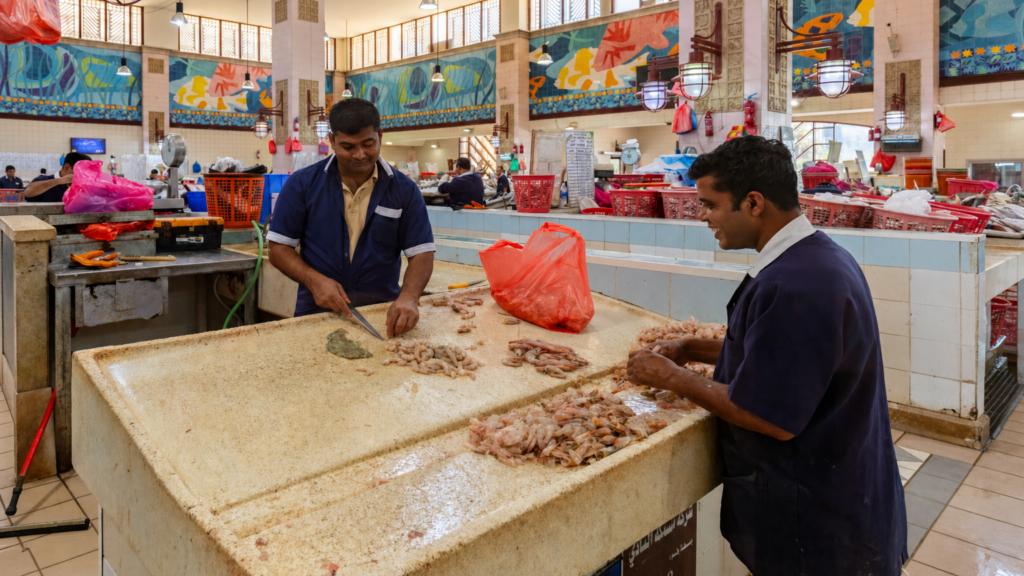
The Ministry of Interior reported that its Counterfeiting and Forgery Crimes Department launched the case after receiving information about commercial fraud in which suspects allegedly altered dates on imported fish to artificially extend shelf life before distributing the products to restaurants, companies and shops. Specialized teams obtained a warrant from the Public Prosecution and conducted raids at the Central Fish Market, where they detained all 27 individuals involved in the scheme. The ministry added that the operation uncovered a network that relied on reprinting labels to disguise the true condition of perishable goods entering the local supply chain.
During the Thursday action authorities took possession of 16 refrigerated transport vehicles that carried the 894 boxes of mislabeled fish, according to the ministry. Investigators also confiscated a computer that had served as the central tool for preparing and printing the counterfeit labels used across the shipments. The ministry stated that all suspects confessed during initial questioning to the date-alteration activities and to hiring an external printing company to generate the false materials, while separate inquiries identified two linked companies that operated solely as registered addresses without any physical business presence.
The ministry noted that the seized fish had been imported and was destined for widespread sale once the new labels masked its actual production timeline and remaining safe storage period. Such practices pose direct risks to consumers who rely on accurate dating for perishable seafood items commonly featured in Kuwaiti diets and commercial food services. Officials processed the evidence and referred the entire matter to prosecutors for further legal steps under commercial fraud statutes.
This case adds to a series of food-safety enforcement actions conducted by Kuwaiti authorities in recent months. The Ministry of Interior detailed a mid-October campaign in Ahmadi Governorate that resulted in the seizure of 773 kilograms of spoiled fish together with multiple arrests at a fish market and dhow harbor, carried out jointly with the Public Authority for Food and Nutrition and other agencies. Similar efforts in September by the Ahmadi Governorate Security Directorate yielded another 500 kilograms of spoiled fish along with 38 apprehensions and the impounding of five judicially wanted vehicles at the Al-Kout Mall market area.
The Public Authority for Food and Nutrition separately reported destroying more than 3.2 tons of deteriorated fish discovered during a July waterfront inspection, filing violation reports against those responsible and coordinating with the Ministry of Interior throughout the process. These repeated operations reflect coordinated oversight among the Ministry of Interior, the Public Authority for Food and Nutrition, the Ministry of Commerce and Industry and municipal bodies to intercept substandard imports before they reach consumers. Data from the involved agencies show that fish and seafood consistently rank among the most frequently inspected categories in routine market sweeps.
Investigators continue to trace any additional distribution channels that may have received earlier batches from the same network prior to the Central Fish Market raid, the ministry said. The operation underscores the technical methods employed in label forgery, including digital design of packaging that mimics legitimate supplier formats. All confiscated materials remain under official custody while the full scope of the distribution is mapped.