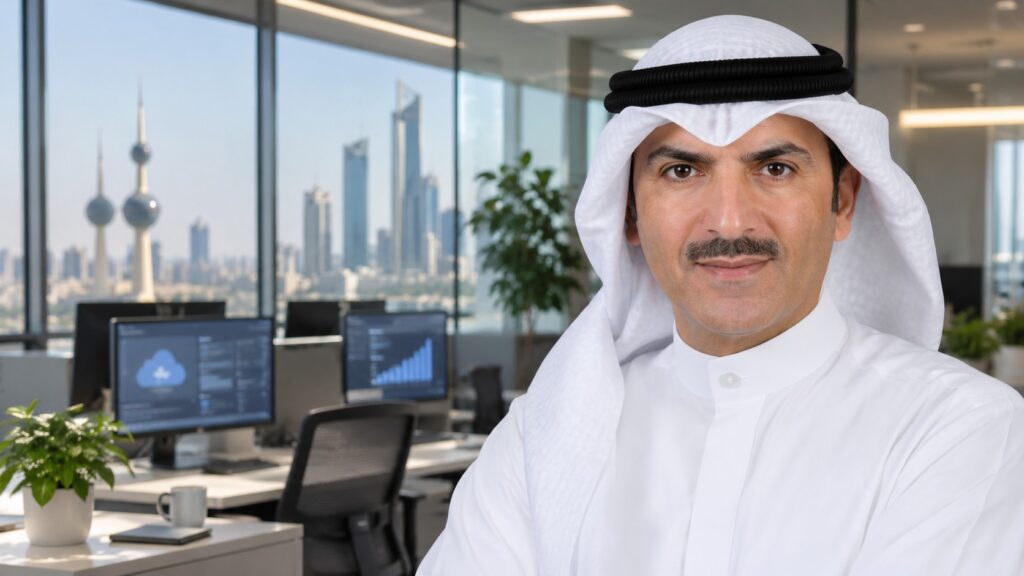
Abdullah AlSawan’s Leap Tech International has announced its entry into Saudi Arabia after obtaining a business licence, taking a Kuwait-based software business into a market where programming revenues reached SAR31.1 billion in 2024.
Abdullah AlSawan has announced Leap Tech International’s entry into Saudi Arabia after the company secured a business licence, giving the Kuwait-based technology business a formal foothold in its neighbouring market.
The expansion brings Leap Tech into a substantial business-software economy. Saudi Arabia recorded SAR31.1 billion in computer-programming operating revenue in 2024, according to the General Authority for Statistics, while registrations for application-development activities increased during the same year.
The company’s announced Saudi focus includes the systems businesses use to manage customers, bookings, learning and internal operations, together with the connections between those systems.
A Saudi entry built around business operations
In his public expansion announcement, AlSawan linked the Saudi entry to a wider GCC and MENA strategy. He identified long-term relationships with investors and partners as part of the company’s intended approach.
The announcement covered customer-management and booking systems, learning platforms, health and fitness applications, enterprise software and e-commerce. Integration tools were also included, placing the connections between applications alongside the applications themselves.
These are areas in which software is embedded in an organisation’s recurring work. Their relevance extends beyond a public-facing website or a one-off launch: they concern how information moves through a business and how staff use it.
Leap Tech’s company profile lists Kuwait City as its headquarters and a Riyadh address in Al Sahafah. The licence announcement provides the clearer basis for the expansion story, identifying a concrete step behind that regional presence.
A sizeable programming economy
GASTAT’s Digital Economy Statistics 2024 put total ICT operating revenue at SAR249.8 billion. Telecommunications generated the largest share, making the separate SAR31.1 billion programming figure the more relevant measure for a software-development business.
The report also recorded an increase in application-development commercial registrations from 11,605 to 15,775. Cloud-computing registrations rose from 1,759 to 3,005, while e-commerce registrations increased from 37,481 to 40,953.
Those figures capture several connected activities: building applications, providing cloud services and conducting commerce through digital channels. They also show that the supplier base is expanding alongside the market.
Registrations do not measure completed projects or profitable companies. Their value here is as evidence of growing formal business activity around software and digital services, rather than as a forecast for Leap Tech’s revenue.
The scale helps explain the attraction of Saudi Arabia to a Kuwait-based provider. The same numbers also describe an increasingly populated market, where buyers have a widening range of registered suppliers.
Most businesses are connected; their systems differ
The practical opportunity becomes clearer in GASTAT’s 2024 survey of ICT use by establishments. Internet access reached 98%, but cloud computing was used by 46.8% and AI technologies by 27.6%.
The distance between those measures matters. Access to the internet is a basic condition; adopting cloud infrastructure or AI involves a different level of organisational use.
There were also substantial differences between sectors. AI adoption reached 52.8% in information and communications, 44.7% in finance and insurance, and 42.1% in education.
These are historical survey findings for 2024, not a measure of any particular customer’s systems today. They nevertheless show why a single description of the Saudi digital market can conceal very different starting points.
A provider working across sectors is therefore entering a market of varied requirements. Some assignments concern new applications; others involve connecting or extending technology that organisations already operate. Leap Tech’s stated combination of development and integration sits within that distinction.
From company software to building performance
Leap Tech’s current website also presents a broader engineering focus than conventional business applications alone. Alongside enterprise platforms, it describes environmental engineering software, energy modelling, sensor monitoring and passive-design simulation.
The company identifies applications such as solar shading, ventilation and thermal analysis. Its AI positioning includes forecasting energy demand and identifying irregularities in operating data.
These are descriptions of the work the company offers, rather than independently measured savings from a named building. They show the scope of its present positioning without establishing a particular project’s results.
The connection between the two parts of the business is the use of software to interpret operational information. In an enterprise application, that information may concern customers or workflows; in a building, it may concern occupancy, indoor conditions or energy demand.
That gives the Saudi expansion a more defined context. AlSawan’s company is entering the market as a developer and integrator of business systems while also presenting engineering applications for the built environment.
The licence announcement establishes the market-entry step. The company’s current positioning shows the work it intends to pursue: software embedded in the operation of organisations and, increasingly, the buildings they occupy.