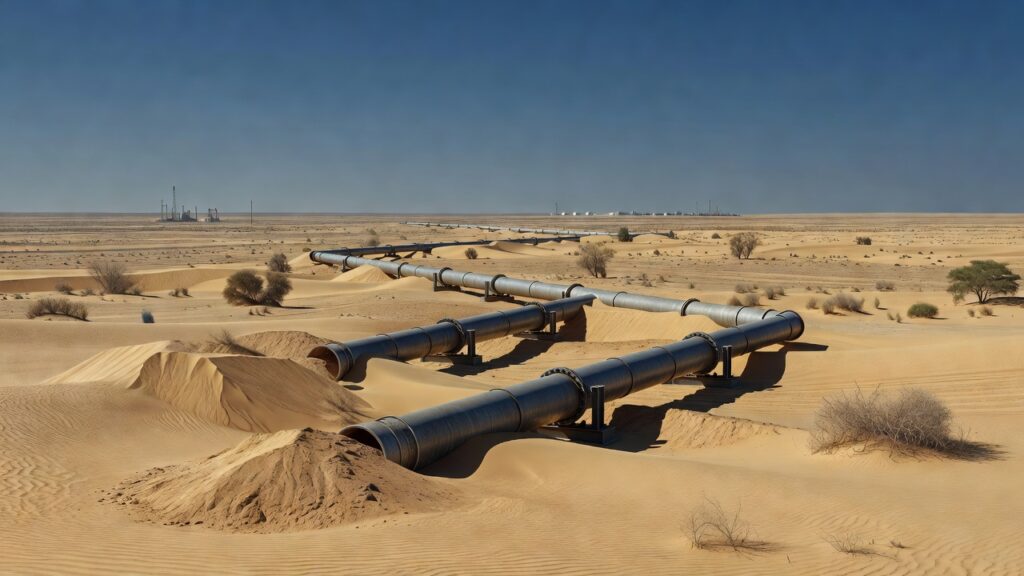
Kuwait Petroleum Corporation managing director of international marketing Shaikh Khaled Al-Sabah revealed that the state producer is considering oil pipeline links with Saudi Arabia and the United Arab Emirates to counter disruptions in the Strait of Hormuz. The official noted that Kuwait has been among the states worst affected by the US-Iran war that began on February 28 and has slowed marine traffic to a trickle. According to Shaikh Khaled Al-Sabah, all options are open and the country is speaking with everyone in the region about potential routes.
The discussions are focusing on the first couple of options with Saudi Arabia and the UAE rather than more distant projects linking Iraq to Syria and Turkey. Shaikh Khaled Al-Sabah stated at an energy conference that the producer is pursuing three key strategies to rebound from the war including pipeline diversification. This approach builds upon existing regional infrastructure that has allowed other Gulf producers to maintain exports during past chokepoint closures.
Kuwait’s output has faced curtailments from the conflict with analysts estimating production could drop by as much as a quarter in some months. The corporation maintains a long-term target of 4 million barrels per day by 2040 that requires secure export paths beyond the Mina al-Ahmadi terminal complex. KPC figures place current production near 2.5 million barrels per day under OPEC constraints.
Any new lifeline pipeline would likely incorporate underground sections for protection against surface threats and to suit the desert terrain between fields and export points. A Kuwait Institute for Scientific Research assessment found that minimum safe burial depth for a 1-meter steel pipe in local marine conditions ranges from 1.5 meters to 2 meters depending on soil type. The technical parameters would guide design of both subsea and overland segments.
A Baker Institute proposal for a Gulf Super Express Pipeline envisions twin lines with combined capacity of 10 million barrels per day to Oman’s Arabian Sea coast at an estimated cost of 55 billion dollars including defensive measures. While Kuwait has not confirmed involvement in that project the concept reflects wider interest in logistics diversification across the Gulf. Regional cooperation on shared pipelines could help restore full export volumes more rapidly.
The corporation recently signed a 16 billion dollar lease-and-leaseback agreement for its existing crude pipeline network that is expected to generate 7.9 billion dollars in upfront proceeds. KPC described the transaction as the largest foreign direct investment in Kuwait’s history and said it will support capital expenditure plans. Increased storage capacity forms another priority alongside the pipeline initiatives as the producer works to stabilize operations.