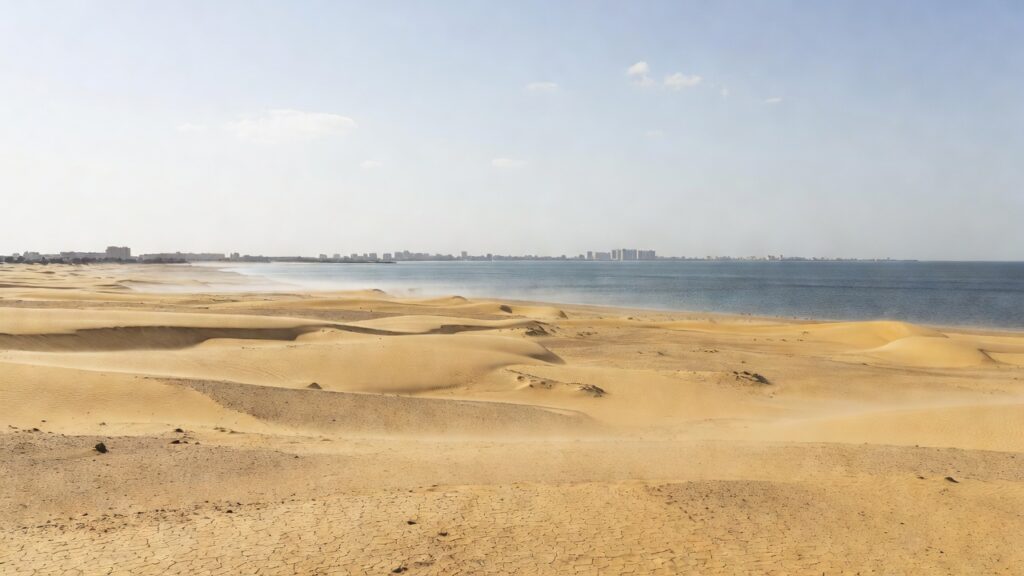
Acting Director Dharar Al-Ali of the Meteorological Department told Kuwait News Agency that a surface low-pressure system combined with a hot humid air mass has gripped the country, driving maximum temperatures between 46 and 48 degrees Celsius while reducing visibility through light fog in coastal zones. The department’s observatory stations logged even higher readings earlier in the period, including 52.8 degrees Celsius in Jahra and 52.3 degrees in Al-Abdali Agricultural, according to data released by the authority. Al-Ali noted that southeasterly winds blowing at 8 to 35 kilometers per hour have sustained the elevated moisture levels, particularly near the shore.
High relative humidity has compounded the heatwave’s effects, with the Meteorological Department recording levels above 90 percent in coastal districts and warning of continued impacts through the weekend. Al-Ali stated that humidity should ease temporarily as winds shift northwesterly and strengthen to 45 kilometers per hour in open terrain, yet southeasterly flows are expected to resume Sunday afternoon and restore humid conditions. The department’s assessment found that daytime highs will settle between 44 and 46 degrees Celsius during that phase while nighttime readings remain warm.
According to the Meteorological Department’s climate records, Kuwait’s summer period from mid-July to early November routinely features sharp rises in both temperature and humidity, with average maximums ranging from 42 to 46 degrees Celsius across most years. The authority has documented extremes such as 51.5 degrees Celsius at Kuwait International Airport during comparable humid spells in prior decades. These historical baselines underscore the intensity of the current pattern, which the department linked to an extension of the Indian monsoon low.
The Meteorological Department has advised residents with respiratory conditions, chronic illnesses, children and the elderly to remain in air-conditioned environments and avoid outdoor exposure during peak heat and humidity hours. Al-Ali urged the public to track developments via the authority’s official website, mobile application and social media channels for real-time forecasts and alerts. Such guidance forms part of the department’s standard protocol when numerical models indicate sustained extreme conditions.
Kuwait News Agency reporting of Al-Ali’s briefing highlighted that winds will turn variable to northwesterly at 8 to 32 kilometers per hour after the weekend, gradually moderating the humid influence as the region enters its autumn transition. The department’s long-term observations place the highest humidity concentrations along the coastal belt from Kuwait Bay southward to Al-Nuwaiseeb, with some inland suburbs also affected during early morning hours. Sea states have remained moderate under these winds, with waves between one and six feet depending on the direction.
In its seasonal summary the Meteorological Department projects a slow decline in temperatures after September 6, although humid air from land and sea breezes will likely persist in coastal areas through early October. Al-Ali’s statements to Kuwait News Agency emphasized the value of updated weather maps in refining daily predictions amid these shifting patterns. The authority’s data continues to monitor the interplay between the residual monsoon effects and approaching autumn fronts.