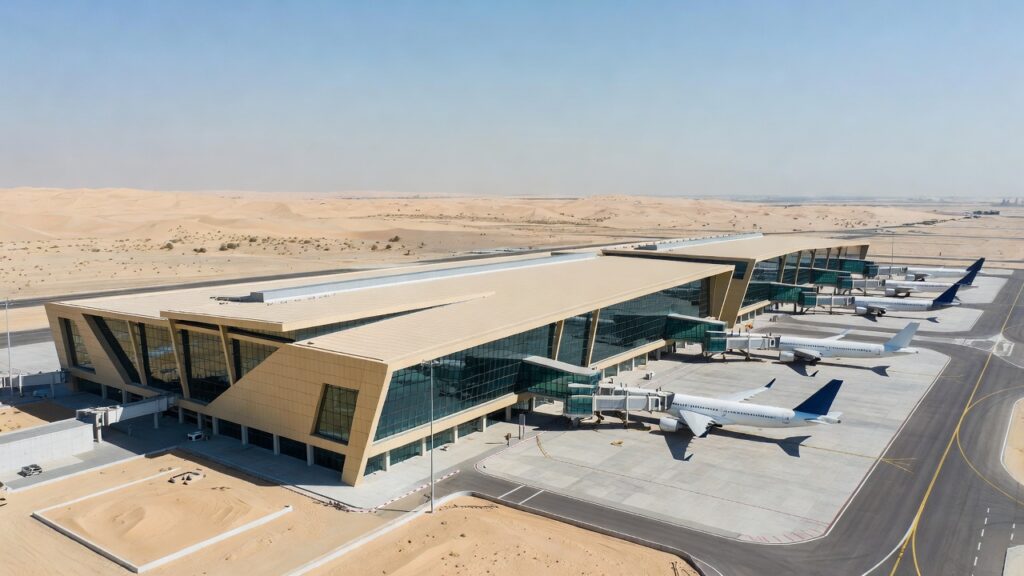
Kuwait signed contracts with Turkish company Limak on May 10, 2026, for completion of the final phases of the new passenger terminal at Kuwait International Airport, with Prime Minister Sheikh Ahmad Abdullah Al-Ahmad Al-Sabah attending the ceremony alongside key ministers. The agreements involve three government entities and mark a step toward accelerating work on the strategic infrastructure project, the Kuwait News Agency reported. Officials at the event included First Deputy Prime Minister and Interior Minister Sheikh Fahad Yusuf Al-Sabah, Defense Minister Sheikh Abdullah Ali Abdullah Al-Salem Al-Sabah, Public Works Minister Dr. Nora Mohammad Al-Mashaan and Amiri Diwan Undersecretary Sheikh Abdulaziz Al-Mishaal Al-Sabah.
The Kuwait News Agency reported that the contracts reflect the state’s commitment to advancing major development initiatives and enhancing infrastructure under Kuwait’s long-term vision. The terminal project forms the centerpiece of a broader airport modernization program that Engineering News-Record valued at $5.8 billion. Limak has served as the main contractor since the site handover in 2016, according to the company’s project records.
Limak’s project update placed physical completion at 84.19 percent by the end of 2025, with structural work, facade installation and roof cladding finished while architectural finishing and systems testing continued. The new terminal, designed by Foster + Partners with support from AECOM for multidisciplinary coordination, features a sand- and dust-proof, blast-resistant facade. Airport Technology data shows construction on the 650,000-square-meter facility began in 2017 under a design-build contract exceeding $4.3 billion.
Once operational the terminal will raise Kuwait International Airport’s capacity to 25 million passengers per year with potential expansion to 50 million, according to figures from both Limak and AECOM. The development is expected to improve passenger services, expand cargo and logistics capabilities and reinforce Kuwait’s position as a regional aviation and trade hub. Multiple project assessments link the work to goals of economic diversification, investment attraction and job creation aligned with the country’s Vision 2035 framework.
The Public Works Ministry has overseen the initiative as part of efforts to modernize civil aviation infrastructure amid a 10 percent rise in air travel over the past decade, AECOM reports show. The terminal will include 51 gates and 96 check-in counters along with advanced processing systems, according to industry descriptions of the project. Coordination among international teams across seven countries has supported design and delivery, the engineering firm stated.
Completion of the full program is scheduled for later in 2026 following the latest change orders, Limak’s timeline indicates. The agreements signed in May build on earlier phases that have already added substantial capacity, with the first stage targeting 13 million passengers annually before scaling up. KUNA noted that the finished facility will contribute to trade, tourism and broader economic opportunities across the Gulf region.