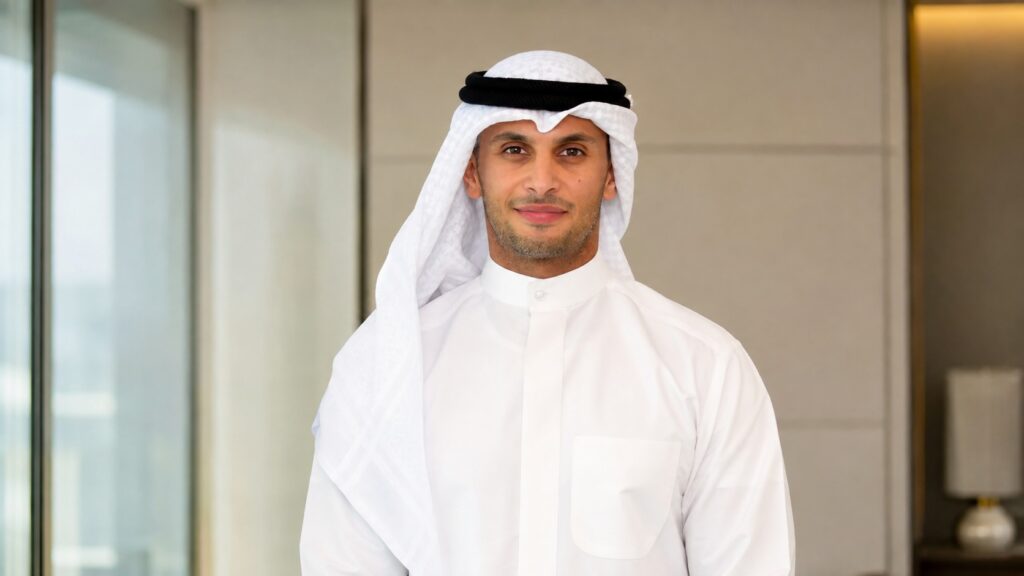
Kuwait’s entire fintech sector has raised $21.8 million since inception. One founder who took none of it placed fifth on a regional list that scores companies partly on how much they raised.
Before he built a payments company, Abdullah Al Dabbous spent five years putting prices on other people’s. In an interview published by the Kuwaiti coding school Coded in July 2016 and republished on StartupQ8, he set out the sequence himself: Arizona State in 2008, a year at Arcapita in London, three and a half years in transaction advisory services at EY, an MBA at INSEAD, then a return to Kuwait. He also described a side venture run while still employed full time, buying and selling physical currency and then building an online platform on top of it. “I have always been a business-minded person looking for opportunities to venture with,” he told the interviewer.
That background is worth holding in mind, because the decision it appears to have shaped is the one that now separates him from almost every founder on the same league table.
The Number That Does Not Fit the League Table
When Forbes Middle East published its Fintech 50 in March 2025, MyFatoorah placed fifth of fifty, behind Tabby, Fawry, Rasan and Wio Bank, and ahead of every other Gulf payment gateway on the list, including HyperPay in sixteenth, PayTabs in seventeenth and Tap Payments in eighteenth. Al Dabbous is recorded as sole founder. The magazine’s stated criteria included capital raised from venture investors and valuation, and it noted that 14 of the 50 companies were founded by solo entrepreneurs.
Set that fifth place against the capital behind it. Tracxn counted 68 active fintech companies in Kuwait as of January 2026, which had raised $21.8 million between them since inception, the largest single raiser having taken $8 million. Tabby, at the top of the same list, closed a $160 million Series E in February 2025 at a $3.3 billion valuation.
Nine Years of Compounding
The growth curve is unusually well documented for a private Gulf company, because Al Dabbous has fed figures to the same publication for most of a decade. In that 2016 interview he put the platform at just over 1,000 registered vendors, saying he had started it in early 2015 and begun approaching merchants that September. Forbes and the company’s own materials date the establishment to 2016, a discrepancy worth flagging rather than smoothing over.
By 2021 the platform was processing $2.9 billion in transactions. By 2023 that had reached $4.5 billion, alongside 83,500 active merchants and more than 500,000 app downloads. The 2025 list recorded 90,000 businesses. In November 2024, Mastercard announced a gateway partnership covering more than 75,000 of his merchants across the GCC, Jordan and Egypt, with Al Dabbous, described in the release as founder and managing partner, pointing to “the fast pace of change in e-commerce” as the driver.
The Two Doors He Did Not Take
Kuwait’s other payments founders answered the same question differently. National Bank of Kuwait acquired 51 percent of UPayments in a deal announced in December 2024, a transaction that drew formal objections from rival fintechs before the Kuwait Competition Authority. Tap Payments, founded in Kuwait, appears on the Forbes list under a Saudi headquarters. From one small market: one company sold control to a bank, one moved its centre of gravity to Riyadh, and one founder did neither.
Where the Reading Breaks Down
Inferring a capital philosophy from a CV is inference, not reporting. Al Dabbous has never publicly explained why he did not raise, and no audited processing volume has been published since 2023; Forbes states that the data on its list was supplied by the companies themselves. Nor is self-funding free. Saudi entry came through a payment licence granted by the central bank in September 2022, seven years after he began signing merchants, in a market where better-capitalised competitors were able to buy their way in faster. Independence bought him control of the pace, and the pace was slower.
What has changed is the market that judges it. Regional startups raised $1.35 billion in the first half of 2026, down 22 percent year on year, with deal count down 41 percent to the fewest in any half since at least 2022 and active international investors down 48 percent, according to MAGNiTT. Mergers and acquisitions fell 56 percent. In 2021, a Gulf founder without a term sheet looked like one investors had passed over. In 2026 he looks like the one who was never exposed to them.