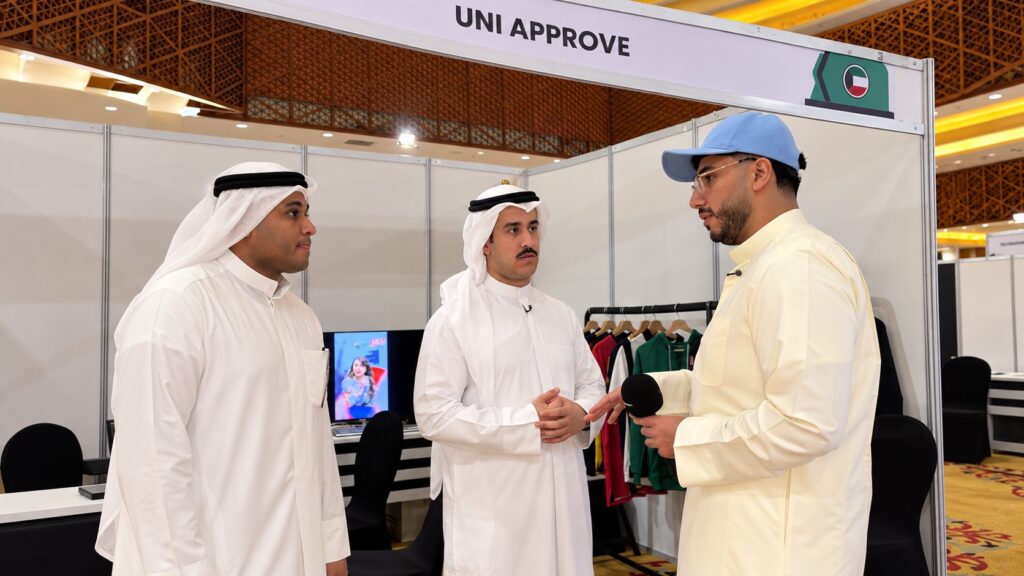
The Kuwait-based education consultancy met students at HigherEd Kuwait as applicants prepare for university choices, English-language tests and the next admissions cycle.
UniApprove’s participation at HigherEd Kuwait brought the practical questions surrounding overseas education into focus, from choosing a university to preparing the applications and English-language tests needed to study abroad.
The consultancy, which has a base in Sharq and a presence in Qatar, works with students considering international university routes. Its attendance gave prospective applicants an opportunity to discuss those plans directly as preparations for the next academic intake gather pace.
Speaking to Diwaniya Media at the event, Faisal, who was attending on behalf of Salisbury FC to support its sponsor UniApprove, described a strong response from students.
“We have loved the engagement that we are getting from the students,” he said.
From choosing a destination to preparing an application
UniApprove’s published services cover course selection, university applications and guidance on the arrangements surrounding overseas study. Its website focuses on the United Kingdom and United States, while its wider company profile also identifies Australia as a destination.
For applicants, those choices involve more than selecting a country. Entry requirements, course content and application procedures determine which options fit their existing qualifications and intended area of study.
The distinction matters because an interest in studying abroad is only the starting point. A student must turn that ambition into a particular course choice, establish the documents required and work towards the relevant submission date.
At HigherEd, Faisal described UniApprove’s assistance as extending beyond university applications, “even as far as helping out with IELTS and helping with tests.”
That places English-language preparation within the wider discussion about admission. Students considering an overseas course may need to address academic qualifications and language requirements alongside each other, with the receiving institution setting the conditions for entry.
A Kuwait office and overseas education connections
UniApprove’s Kuwait office is located in Maryam Tower on Al-Shuhada Street in Sharq. Its published service information includes guidance on scholarships, visas and accommodation, extending the discussion beyond the university application itself.
These stages address different questions. An applicant may identify a suitable course before establishing how it will be funded, where they will live or what arrangements are required before travelling. Receiving an offer does not resolve every part of the move.
The company offers a free initial consultation through its website. Its broader published profile states that its consultancy services are provided without charge to students. That description concerns the consultancy’s support, rather than tuition fees or the other expenses associated with studying overseas.
UniApprove also appears under its full company name on QA Higher Education’s list of trusted representatives. The listing provides a documented connection within the education sector alongside the company’s own description of its work.
Separately, UniApprove states that it holds ICEF Agency Status and that its lead counsellor has completed the British Council’s UK Agent and Counsellor Training Programme. The agency status and individual training are distinct credentials, relating to different aspects of its operations.
What students now need to explain
For applicants considering Britain, the personal statement has become a more structured part of the process.
UCAS guidance for 2026 entry onwards divides the statement into three questions. Students explain why they want to study their chosen subject, how their qualifications and studies have prepared them, and what relevant preparation they have undertaken outside formal education.
The combined allowance remains 4,000 characters, including spaces, with a minimum of 350 characters for each answer. Admissions staff consider the responses together, so the structure changes how applicants organise their evidence rather than creating three unrelated statements.
For a prospective student, that requires a connection between the course they have selected and the experiences they describe. Academic work, independent interests and activities outside the classroom need to demonstrate preparation for the intended subject.
The format also gives a concrete focus to conversations about university choice. Explaining why a course is suitable requires an applicant to understand what they expect to study, rather than relying solely on a university’s name or location.
These are the kinds of decisions that sit behind the application assistance UniApprove describes. The paperwork records a choice, but the applicant must first establish the academic reasons supporting it.
An admissions calendar already underway
The timing of HigherEd Kuwait places those conversations within an active application cycle.
The UK’s Discover Uni guidance lists 15 October 2026 as the equal-consideration date for applications to Oxford, Cambridge and most medicine, dentistry and veterinary medicine or science courses. For most other undergraduate courses, the corresponding date is 13 January 2027.
Both deadlines fall at 18:00 UK time. The October date therefore does not apply to every student considering Britain, making the specific institution and course essential to establishing an application timetable.
Applicants preparing for the same year of entry can consequently be at different stages. Some are approaching an immediate submission deadline; others have more time to develop their course choices and supporting material.
UniApprove’s HigherEd appearance brought those overseas processes into a local setting where students could begin asking specific questions. As Faisal’s account of the event indicated, the engagement concerned universities themselves, giving the consultancy’s presence a practical focus beyond a general interest in studying abroad.
The next steps are now attached to individual applications: identifying the course, checking its requirements and completing the necessary preparation before the relevant deadline.