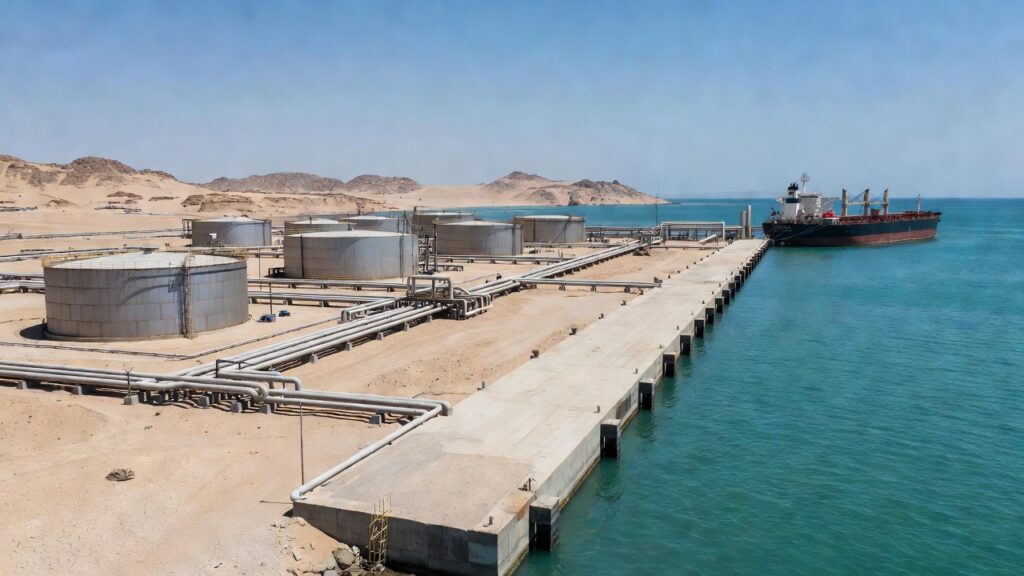
Yemen’s Presidential Leadership Council Chairman Rashad al-Alimi announced in a televised address the government’s intention to resume oil exports by all available means starting that day, ending a suspension in place since late 2022. The chairman urged citizens, tribes and national forces to rally behind state institutions to counter the Houthi coup, according to multiple regional outlets that carried his remarks. Al-Alimi’s statement highlighted ongoing government restraint despite repeated attacks on oil facilities while emphasizing efforts to alleviate civilian suffering through renewed hydrocarbon sales.
Yemen’s ambassador to Kuwait, Dr. Ali bin Safaa, described the restart as a strategic step to restore sovereignty and revive the national economy after years of disruption. Bin Safaa characterized the move as a significant shift against what he termed Houthi blackmail that had targeted one of the state’s primary revenue sources. The ambassador pointed to drone strikes on the Al-Dhaba terminal in Hadramawt governorate and the Al-Nashima port in Shabwa governorate during October and November 2022 that halted roughly 70,000 barrels per day of crude exports.
Those attacks produced direct and indirect losses exceeding $3 billion while driving the budget deficit above 70 percent, Bin Safaa stated. The resulting economic strain triggered depreciation of the Yemeni rial, repeated delays in salary payments for public employees and a weakened ability to maintain basic services including electricity, water and healthcare. In earlier remarks to the Council on Foreign Relations, al-Alimi himself placed lost annual revenues from oil and gas at $1.6 billion, leaving the government operating with only about 30 percent of required resources.
Resumption of exports is projected to increase public revenues and foreign currency reserves held by the Central Bank of Yemen. Such gains would help stabilize the rial’s exchange rate, permit regular payment of civilian and military salaries and supply cash for fuel to run power stations. The improved fiscal position is also expected to support water, health and education sectors while helping ease the cost of living through more stable prices for essential goods.
Bin Safaa assessed the 2022 strikes on export infrastructure as an economic war crime that damaged the livelihoods of Yemenis throughout the country. The Presidential Leadership Council’s decision reflects the legitimate authorities’ focus on placing citizen interests first, he added. Securing sustained oil exports could serve as a cornerstone for repairing the national economy and strengthening the state’s capacity to meet its obligations.
The development arrives against the backdrop of a protracted conflict in which the Houthis control much of northern Yemen while the recognized government administers areas from Aden. Oil and gas exports had historically covered more than two-thirds of the state budget prior to the militia attacks, according to figures repeatedly cited by Yemeni officials. Regional outlets tracking the announcement noted that implementation measures were already under way following al-Alimi’s directive.