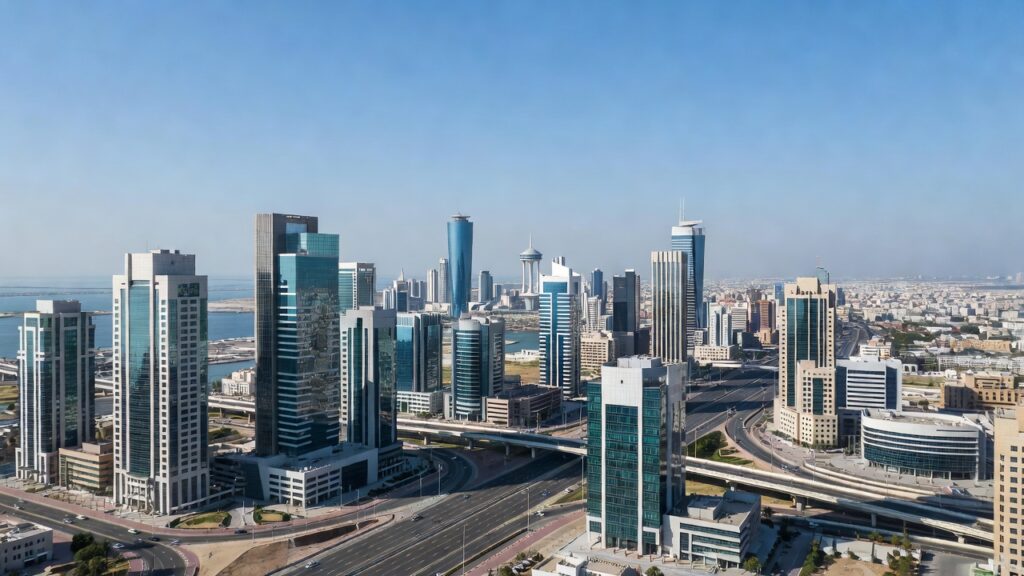
Kuwait has spent KD603 million by the third quarter of its 2025/2026 annual development plan, surpassing 44 percent of the KD1.361 billion budget, the Secretariat General of the Supreme Council for Planning and Development reported on January 25, 2026. The update covers 134 projects in various phases as the Gulf state pursues its New Kuwait 2035 vision to become a financial hub. Officials obtained the figures from the council’s website and highlighted steady implementation across multiple sectors.
The planning body’s report placed 67 projects in the implementation phase while 44 remained in preparation, 13 had yet to start and 10 reached the handover stage. This allocation reflects a focus on converting plans into active execution during the fiscal period. Arab Times reviewed the statistics directly from the council’s published data, which showed an increase from earlier quarters in the same cycle.
The 2025/2026 plan rests on seven main pillars supported by 32 development programs, according to the Secretariat General of the Supreme Council for Planning and Development. Nine priority programs address creation of an international economic zone, privatization initiatives, a vibrant private sector, citizen and institutional capacity building, cohesive government operations, robust infrastructure, environmentally balanced living spaces, health and well-being promotion, and meaningful global contributions. Each program includes defined objectives, policies and execution methods that the council reviews on an annual basis.
The plan aligns with the United Nations 2030 Sustainable Development Goals through five approved pillars that include northern region development, knowledge economy growth, supportive governance, sustainable living standards and citizen empowerment, the council’s documentation stated. Indicators track developmental impact and help close identified gaps while mechanisms such as regulatory reforms, automation, capacity building and combined public-private investment drive progress. The annual framework allows modifications based on performance outcomes or new requirements that emerge during implementation.
Spending in the first quarter of the same plan reached 10 percent, the highest proportion in five years when compared with corresponding periods in earlier schemes, a follow-up report from the Secretariat General of the Supreme Council for Planning and Development issued in October 2025 showed. Economic assessments tied to the planning process project Kuwait’s growth at 2.3 percent for 2025 and 2.9 percent for 2026 after a contraction the previous year. The acceleration in development outlays supports broader efforts to reduce reliance on oil revenues.
Kuwait Vision 2035 aims to establish the country as a regional financial and commercial center with a goal of ranking among the top 35 nations on international indices by 2035, a World Bank country economic framework assessment found. The seven-pillar strategy encompasses sustainable economic diversification, effective civil service reform, coherent living environments and advanced infrastructure among other areas. Progress under the current annual plan feeds directly into these longer-term targets through structured governance applied to every program.
A dedicated governance framework for each program ensures accountability in achieving intended results and policies, the January 2026 planning report explained. The current edition applies stricter criteria for initiative selection and legislative support than previous versions. These steps form part of ongoing measures to elevate Kuwait’s position in global competitiveness rankings.