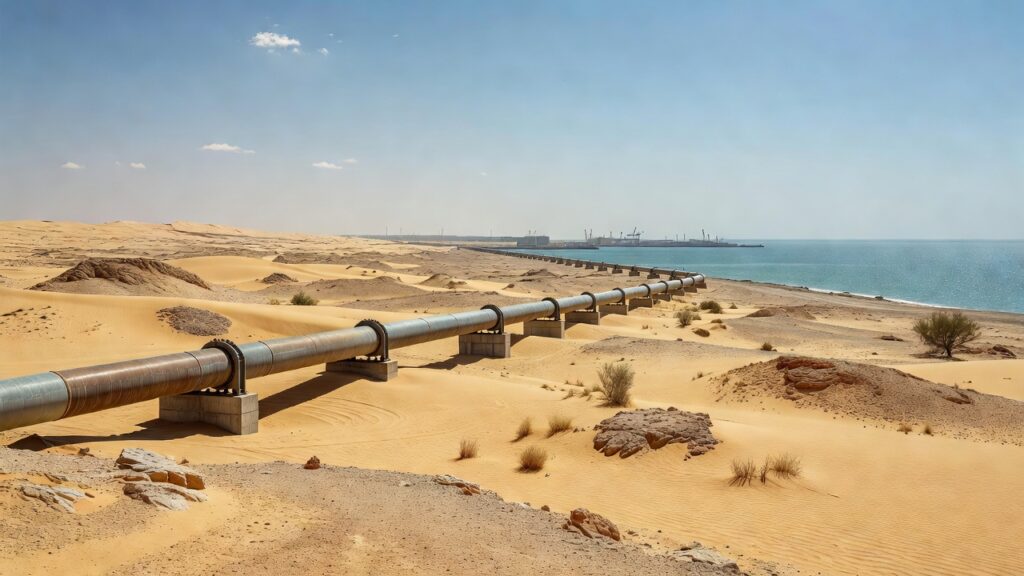
Kuwaiti Oil Minister Tariq Sulaiman Al-Roumi told Japan’s Kyodo news agency that proposed routes under discussion include a link through Saudi Arabia to the Red Sea or to Oman as well as a connection to the UAE’s Fujairah port on the Gulf of Oman. The minister noted that Kuwait’s oil exports had come to a complete stop due to Iran’s effective closure of the strait amid the 2026 crisis. Such infrastructure would offer a strategic alternative for resuming energy shipments according to Al-Roumi. The discussions reflect broader GCC efforts to address vulnerabilities exposed by repeated disruptions in the waterway.
The Strait of Hormuz remains the primary export route for oil produced by Kuwait and several other Gulf states according to International Energy Agency data. The passage accounted for nearly a fifth of global LNG trade in 2025 before geopolitical tensions led to restrictions and a near-closure earlier this year. Only Saudi Arabia and the UAE maintain operational crude pipelines that can redirect flows to bypass the strait with an estimated 3.5 to 5.5 million barrels per day of available capacity. The IEA assessment found that while additional spare capacity exists the necessary logistics for large-scale rerouting have not been fully tested in current conditions.
International Energy Agency figures show the Saudi East-West pipeline to the port of Yanbu on the Red Sea operates with a maximum capacity of around 7 million barrels per day. Of that volume roughly 5 million barrels per day support exports via Yanbu while 2 million barrels per day supply domestic refineries and local consumption along Saudi Arabia’s western coast. The pipeline has emerged as a viable secure corridor for Kuwaiti crude destined for European and African markets. Spare capacity on the line could accommodate additional Kuwaiti volumes once agreements are finalized.
Economic experts have highlighted potential reductions in shipping costs and transit times that would come from using the pipeline instead of the longer route around the Arabian Peninsula. The alternative path would also lower exposure to risks from military operations and geopolitical flare-ups that have affected tanker movements in recent months. Targeting new markets in Europe and Africa rather than relying predominantly on Asian buyers represents a central element of the diversification approach. Such shifts could help stabilize revenue streams for Kuwait over the long term.
Former advisor to the finance minister Mohammad Ramadan stated that the GCC possesses significant geographical and logistical alternatives across Saudi Arabia the UAE and Oman. Ramadan explained that activating these options would reduce the strategic importance of the Strait of Hormuz as the dominant energy transit route. The expert added that a structural change in export paths could limit any one actor’s leverage over global energy flows while preserving the strait for other uses.
Economic and legal expert Salem Al-Kandari described the Saudi East-West pipeline as the optimal logistic and security option for Kuwaiti oil exports to Europe and Africa. He pointed out that the route strengthens integration between Kuwait and Saudi Arabia while shortening distances and mitigating war-related hazards. Al-Kandari noted that the project could pave the way for a more integrated Gulf energy pipeline network in future years.