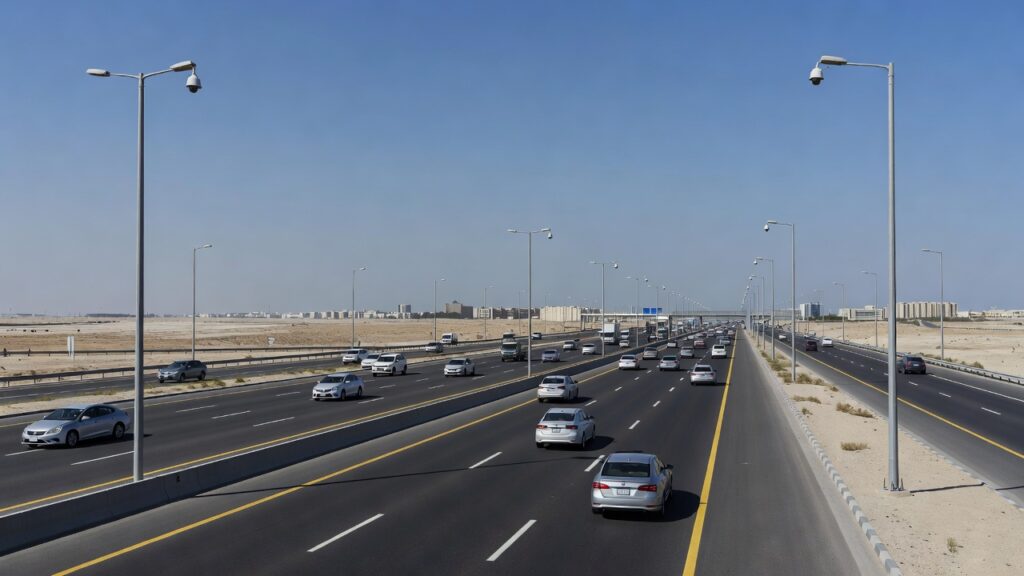
The General Traffic Department under Kuwait’s Ministry of Interior has rolled out a campaign using hidden traps and monitoring points on major roadways to catch drivers committing recklessness, skipping seat belts or using phones at the wheel. According to the department the initiative forms part of broader measures that include automated camera systems installed across the network to improve overall compliance with traffic rules. Officials stressed that these violations rank among the leading causes of crashes, prompting the focused operation that began in late August.
Ministry of Interior figures show that distracted driving and reckless behavior have historically contributed to a large share of the roughly 300 daily traffic accidents recorded nationwide. The traps will result in immediate citations with fines scaled according to updated penalties that now stand at KD 150 for recklessness, KD 30 for seat-belt violations and KD 75 for mobile-phone use while driving. A senior traffic official noted that the campaign aims to change driver habits rather than simply issue penalties.
The deployment of 252 AI-powered cameras specifically calibrated to detect seat-belt and phone infractions has supported the trap operations, the General Traffic Department reported.[[1]](https://www.arabtimesonline.com/news/seat-belt-violation-applies-to-both-driver-and-front-seat-passenger/) These fixed units feed data into a central system that issues electronic tickets, reducing the need for on-site stops in many cases. The technology builds on earlier installations that began in 2024 under directives from the First Deputy Prime Minister and Minister of Interior.
Assistant Undersecretary for Traffic Affairs Maj. Gen. Yousef Al-Khadda previously indicated that 90 percent of accidents stem from distractions, recklessness and speeding, a pattern that has guided the current enforcement priorities.[[2]](https://gulfnews.com/world/gulf/kuwait/kuwait-cameras-to-catch-seat-belt-and-phone-violations-1.1730633162678) The latest campaign extends those efforts by combining physical traps with digital monitoring to cover both urban arteries and highways. Drivers apprehended face graduated sanctions that can include vehicle impoundment for repeat offenders.
Public Relations and Security Media Department statistics at the Ministry of Interior documented a 72 percent drop in overall traffic violations during the first week after stricter rules took effect last year, with seat-belt breaches falling 71 percent and phone-use citations declining sharply.[[3]](https://www.arabtimesonline.com/news/traffic-violations-drop-by-72-in-first-week-of-new-law-implementation/) That reduction followed intensive awareness drives paired with higher fines and clearer enforcement signals. The current trap initiative seeks to sustain that momentum by keeping pressure on the three targeted behaviors.
The General Traffic Department has urged motorists to treat the campaign as a reminder of shared responsibility on the roads rather than a revenue tool. Additional phases are expected to expand coverage to secondary routes and residential areas in the coming months. Authorities confirmed that all operations remain within the framework of the amended traffic law that took full effect in 2025.