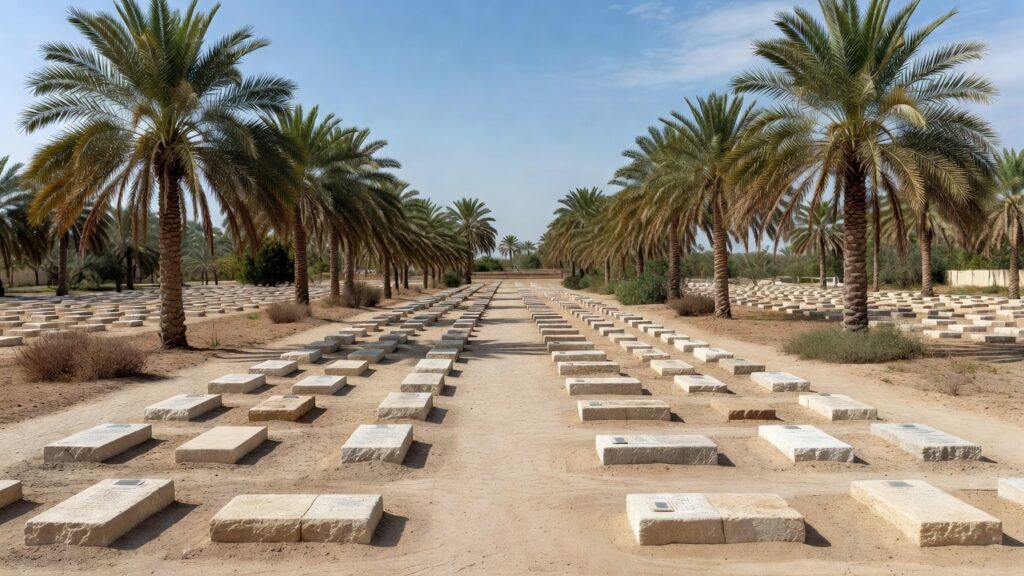
Kuwait Municipality has issued a circular that establishes two fixed daily periods for burials across all cemeteries in the country. Deputy Director General for the Municipal Services Sector Mishal Al-Azmi signed the directive, which sets the morning slot at 9 a.m. and the second slot immediately after the Asr afternoon prayer. The measure seeks to create uniformity in scheduling and simplify arrangements for families of the deceased. According to the circular, cemetery officials must organize operations to match the revised timings and supply all required resources for uninterrupted service.
The directive applies uniformly from Sunday onward and covers every governorate without exception. It builds on the municipality’s practice of periodic schedule reviews to address logistical demands at burial sites. Al Jarida newspaper reported that the circular instructs full adherence by all cemetery administrations to prevent overlaps and support orderly processions.
Kuwait’s network of cemeteries manages burials for a population exceeding 4.8 million, according to the latest Central Statistical Bureau estimates. The standardized slots are designed to reduce peak-hour congestion at facilities that often see multiple ceremonies in a single day. A review of municipal announcements from prior years shows similar adjustments have occurred during both summer heat waves and the month of Ramadan.
The Ministry of Awqaf and Islamic Affairs provided a foundational fatwa in 2001 that permits burials after sunset when necessary, a reference cited in multiple municipal circulars including those distributed in 2025. This religious guidance has enabled flexibility in evening and nighttime operations when daytime conditions prove challenging. Local press outlets have consistently noted that such policies prioritize the comfort of grieving families while maintaining required procedures.
Municipality staff have been directed to coordinate closely with families requesting burials under the new framework. The circular specifies that all preparations, including documentation and site readiness, must align with the designated windows. Kuwait Local news service indicated that the changes reflect accumulated operational feedback aimed at streamlining services without altering core religious rites.
Implementation will begin immediately upon the circular’s activation, with monitoring to ensure consistent application at every location. Previous adjustments, such as those applied during extreme heat periods when temperatures regularly surpass 45 degrees Celsius per meteorological records, have included provisions for lighting at cemeteries for after-dark burials. The current measure maintains a daytime focus while preserving options for coordination on specific cases.