Kuwait International Fair is preparing to bring the perfume business back to Mishref in October, with its current event announcement listing the Perfumes Expo from 20 to 31 October. The exhibition will occupy halls 5, 6, 7 and 8, placing fragrance retail within one of Kuwait’s established settings for direct contact between companies and consumers.
The organiser’s event page identifies KIF as the organising body and directs enquiries to its marketing department. The four-hall allocation is the clearest published indication of the physical programme; the page does not provide a final exhibitor list or an attendance forecast.
The event sits within a trade that connects Kuwait with both European production centres and neighbouring Gulf markets. Official merchandise figures and the histories of local perfume houses provide a more concrete picture of that commercial setting than a forecast of sales at the exhibition itself.
A trade linking Europe and the Gulf
World Bank WITS data drawn from UN Comtrade put Kuwait’s 2024 imports of perfumes and toilet waters at approximately $167.3 million. France was the largest supplier in the table at $63.2 million, followed by the United Arab Emirates at $29.4 million and Saudi Arabia at $18.7 million.
Spain and Italy followed at about $13.1 million and $9.8 million respectively. The mix illustrates the presence of European and Gulf supply relationships within the same product category. It also gives the local exhibition a commercial context that extends well beyond the fairground.
These figures measure gross merchandise imports under customs code 330300. They are not a measure of retail spending, exhibition turnover or the value of every product associated with fragrance. Raw materials, incense and other adjacent goods cannot simply be added to the category without examining their classifications.
The distinction matters when describing the sector. Trade figures establish the value of a defined flow of goods into the country, while an exhibition brings brands, sellers and customers together at a particular place and time. Each reveals a different part of the business.
A Kuwaiti perfume house with international links
One example of the sector’s longer history is Atyab Al Marshoud. The company dates its establishment to 1925, when Sulaiman Al Marshoud founded the business. Its account describes journeys to India and Southeast Asia to source fragrance materials, followed by the transfer of blending knowledge through the family.
The company’s present-day profile combines that heritage with international operations. It identifies stores in London’s Knightsbridge and Marbella’s Puerto Banús, and says its fragrances are manufactured at its factory in France. The history therefore connects Kuwaiti ownership and identity with sourcing, manufacturing and retail relationships abroad.
Its range also shows why the fragrance business is broader than a single bottle format. The company’s website separates perfumes, home fragrance, hair mists, incense, oils and burners. Those categories represent different uses and retail propositions within the same brand.
This is an example of one business rather than a description of every Kuwaiti perfume company. It nevertheless demonstrates how a locally rooted house can maintain a product identity while working across several markets and parts of the supply chain.
Exhibitions remain part of the brand’s customer contact
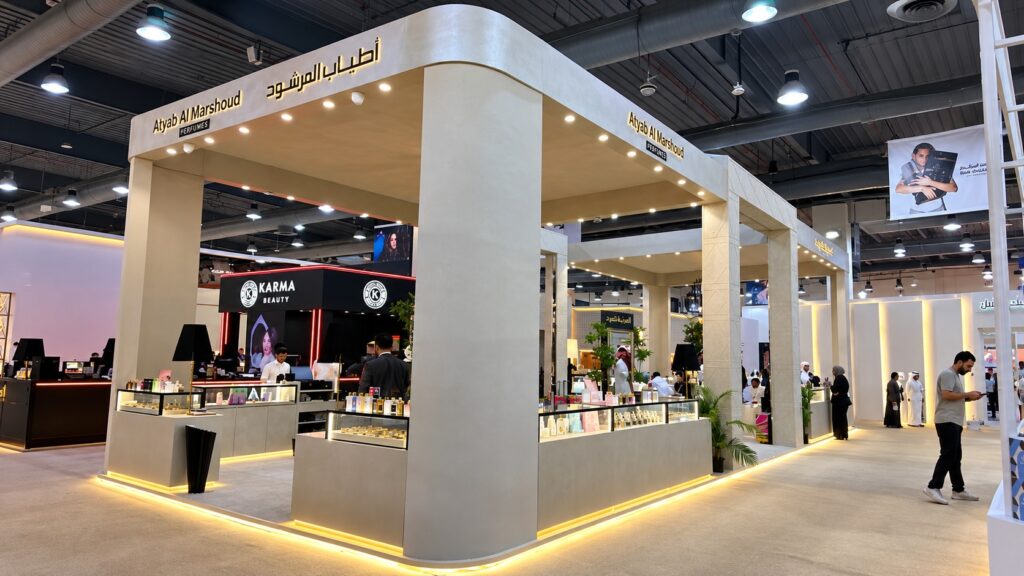
In a separate public account of its Kuwait Perfume Expo participation, Atyab Al Marshoud described the exhibition as a way to maintain contact with customers across generations. The accompanying photograph shows its stand and product counters at an earlier edition.
That record supplies a specific example of how a perfume house has used the exhibition format. It should be distinguished from the forthcoming event: an earlier appearance does not establish a booking for October 2026.
Kuwaiti brands also appear in the region’s wider exhibition circuit. The 2025 exhibitor list for the UAE’s Emirates Perfumes and Oud Exhibition included Kuwait-listed businesses such as Atyab Alsheekh, Ash Oud, Beyond Niche, Blue Oud, Czar and Dar Aldukhun.
The list provides evidence of individual companies participating outside Kuwait, with names, booth references and country entries. It does not measure their exports or establish their share of the regional fragrance market. Its relevance is the visible movement of businesses between national exhibition programmes.
Alongside Kuwait’s import relationships, these appearances show two different forms of regional connection: goods crossing borders and companies presenting their products to audiences in another market. The autumn gathering in Mishref sits within that wider commercial landscape.
Mishref’s established exhibition role
Kuwait International Fair’s company history dates its establishment to 1971 and describes a site covering 650,000 square metres. Its stated role centres on bringing business representatives into direct contact with customers through exhibitions and other events.
The company also describes work with international and Arab exhibitors and identifies membership of UFI, the global exhibition industry association. Its marketing and sales department handles the preparation and supervision of local and international events. Its history also records cooperation on country exhibitions, connecting the operation of the venue with overseas business participation.
For the October perfume exhibition, that infrastructure provides the setting for a familiar commercial activity: presenting a product range in person. The next published edition runs from 20 to 31 October at Mishref. Further announcements from KIF will determine the participating brands and detailed visitor programme for the four halls.