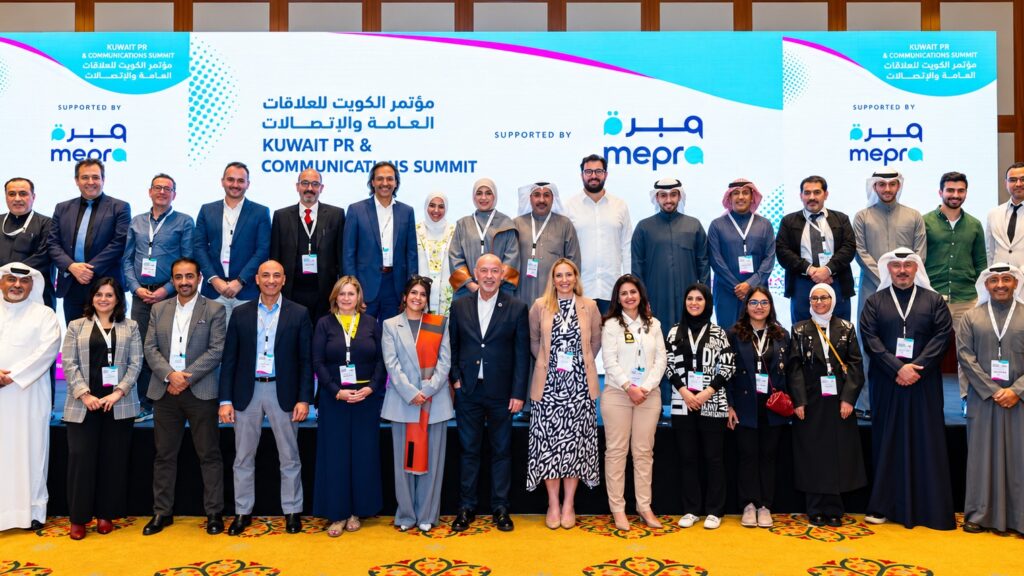
The November gathering will examine corporate reputation, capital-market communication and crisis resilience as the profession sharpens how it measures results.
Kuwait’s PR & Communications Summit will return on 11–12 November 2026 with an agenda that links corporate reputation to investor confidence, crisis response and the behaviour of audiences. The third edition, organised by Kuwait-based 12 Events with support from the Middle East Public Relations Association, is scheduled for the Jumeirah Messilah Beach Hotel.
The announced sessions point to a question with consequences beyond the communications department: what evidence shows that an organisation’s message has been understood and trusted? Coverage and online attention can be counted relatively easily. Explaining whether they changed a stakeholder’s understanding or decision is a different task.
The organiser’s speaker call identifies senior professionals, corporate communications directors and PR strategists as the summit’s audience. Its subsequent announcements place financial messaging, leadership and corporate resilience within that remit, giving the November gathering a business focus extending beyond publicity alone.
Reputation enters the capital conversation
Among the announced speakers is Gregor Riemann, managing partner and co-founder of Mithras Partners. His scheduled session on communications and capital will address reputation, trust and investor confidence in the Gulf, according to 12 Events. The organiser describes a remit covering financial messaging, governance communication and preparation for important capital-market moments.
These subjects require a different kind of communication from a consumer campaign. An investor examining a restructuring or a transaction needs to understand what has changed, which assumptions underpin the announcement and how management explains the implications. An attractive message cannot, by itself, establish the quality of the underlying decision or the completeness of the information supplied.
The distinction also changes how communication is assessed. Reaching a broad audience and answering the questions of a smaller, consequential audience are separate objectives. A campaign’s visibility may be useful evidence of distribution, but it does not establish that investors have understood a financial development or that a particular explanation influenced their assessment.
The summit’s inclusion of capital-market communication is therefore significant as an editorial subject. It brings the evidence supporting a corporate narrative into the same discussion as the narrative itself. The published announcement sets out the session’s intended questions; its conclusions will only be available once the presentation takes place.
Measurement has moved beyond publicity totals
The wider profession has already articulated a framework for this distinction. The International Association for the Measurement and Evaluation of Communication updated its Barcelona Principles to version 4.0 in 2025. The principles require clear objectives, an understanding of stakeholder audiences and evaluation across relevant channels, using both quantitative and qualitative analysis.
They also reject advertising value equivalents, which assign an advertising-style monetary value to editorial coverage. Instead, the framework distinguishes communication outputs from outcomes and wider impact. It explicitly connects measurement with ethics, governance and transparency about data, methodologies and technology.
The implication is that a volume of coverage and a result are not interchangeable. A published article is an output; evidence that an audience understood an issue addresses a different question. Likewise, a change in organisational performance cannot automatically be attributed to communication simply because a campaign preceded it. The link needs to be demonstrated, rather than assumed.
That distinction makes measurement a management issue. Teams deciding what success means before a campaign begins are setting the basis on which budgets and results will later be discussed. Without that agreement, a dashboard may contain numerous indicators while leaving the original business question unresolved.
Fragmented audiences complicate trust
Independent research helps explain the environment in which those decisions are made. The Reuters Institute’s 2025 Digital News Report, covering 48 markets, found continuing movement towards social and video platforms. Across its surveyed markets, consumption of social video news rose from 52% in 2020 to 65% in 2025.
The same research found that 58% of respondents were concerned about distinguishing true from false information online. Trusted news organisations and official sources remained important destinations for checking information. These are findings from an international survey, not Kuwait-specific estimates, and should not be presented as measurements of Kuwaiti audience behaviour.
Their relevance to the summit is the combination of distribution and verification. A message may reach people through a short video, a creator or a social post, while the information used to check it comes from somewhere else. Communication planning consequently involves relationships between channels, rather than a simple choice of one platform over another.
For organisations explaining consequential developments, the question is whether the supporting information remains accessible when audiences encounter a shortened version of the story. Reach indicates that material circulated. It does not establish that the qualification, evidence or context travelled with it.
Crisis response brings the questions together
12 Events has also announced a session by Ollie Lawson, managing director of Ollie Lawson Advisory, on corporate resilience during geopolitical uncertainty. Together with the financial communications discussion, it places reputation in situations where organisations must explain decisions under scrutiny rather than simply attract attention.
Kuwait’s public institutions have participated in earlier editions. The Ministry of Electricity, Water and Renewable Energy documented its attendance at the December 2024 summit, describing exchanges of experience on public relations, social platforms and direct communication with the public. That participation establishes a public-service dimension alongside the event’s corporate audience.
The November programme brings those interests into a common setting: what organisations say, how audiences encounter it and what evidence supports an assessment of the result. The next reporting opportunity will be the actual examples and methods speakers present, including how they separate greater visibility from stronger understanding and demonstrable trust.