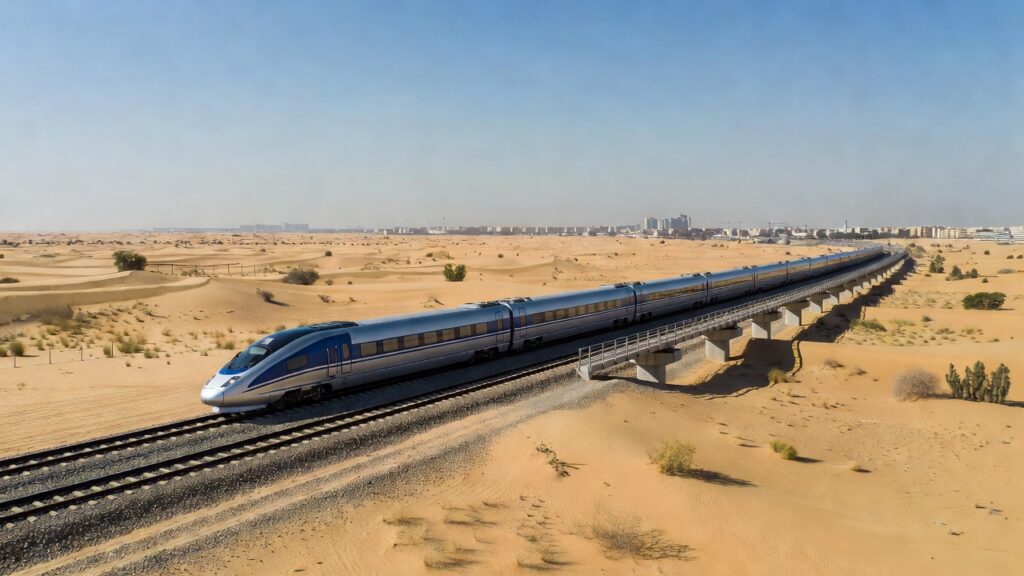
The General Agreement for the GCC Railway Project was signed in Manama on Sunday under the patronage of Bahrain’s Crown Prince and Prime Minister Prince Salman bin Hamad Al Khalifa, with the ceremony attended by GCC Secretary-General Jasem Mohamed Albudaiwi and transport ministers from Kuwait, Saudi Arabia, Bahrain, Qatar, the United Arab Emirates and Oman. According to the GCC General Secretariat, the pact sets a common framework for member states’ commitments on project implementation, technical integration of national networks, operational coordination and cross-border connectivity. The signing took place on the sidelines of the meeting of GCC transport ministers in Bahrain, which currently holds the rotating presidency of the bloc.
GCC Secretary-General Jasem Mohamed Albudaiwi stated that the agreement represents an important step in bolstering Gulf integration in the transport sector while regulating the railway system to operate as a single integrated and interoperable regional network. A statement from the GCC General Secretariat noted that the pact will facilitate the movement of passengers and goods, supporting broader economic development and shared prosperity across the region. Bahrain’s Minister of Transportation and Telecommunications Sheikh Abdulla bin Ahmed Al Khalifa described the project as an investment in the future of the Gulf and its generations, reflecting aspirations for deeper connectivity among the countries.
The GCC railway initiative was first approved by the Supreme Council in 2009, with the GCC Railways Authority later established in Riyadh to coordinate implementation and ensure compatibility with national networks, the General Secretariat reported. Progress on the overall project has reached 55.92 percent, according to figures released by the authority following the signing ceremony. Full operations are targeted for December 2030, although some cross-border sections between neighbouring states may open earlier once completed.
The planned network stretches approximately 2,100 kilometres from Kuwait in the north to Oman in the south, linking all six member states with passenger trains designed for speeds of 200 kilometres per hour and freight services operating between 80 and 120 kilometres per hour. Data from the GCC Railways Authority indicates the system is expected to carry more than eight million passengers and 95 million tonnes of goods annually by 2045 once fully functional. The project aims to enhance the flow of intra-GCC trade, improve logistics efficiency and strengthen the competitiveness of Gulf economies through safer and more environmentally friendly transport options.
Two additional memoranda of understanding were signed alongside the main agreement, one between the GCC and Saudi Arabia on railway cooperation and another with Qatar focused on bilateral land transport and logistics collaboration, according to officials present at the event. These side agreements seek to exchange expertise, build technical capacities and deepen regulatory alignment across the bloc. The GCC Railways Authority will continue to harmonise specifications and provide support to member states as construction advances toward the 2030 target.