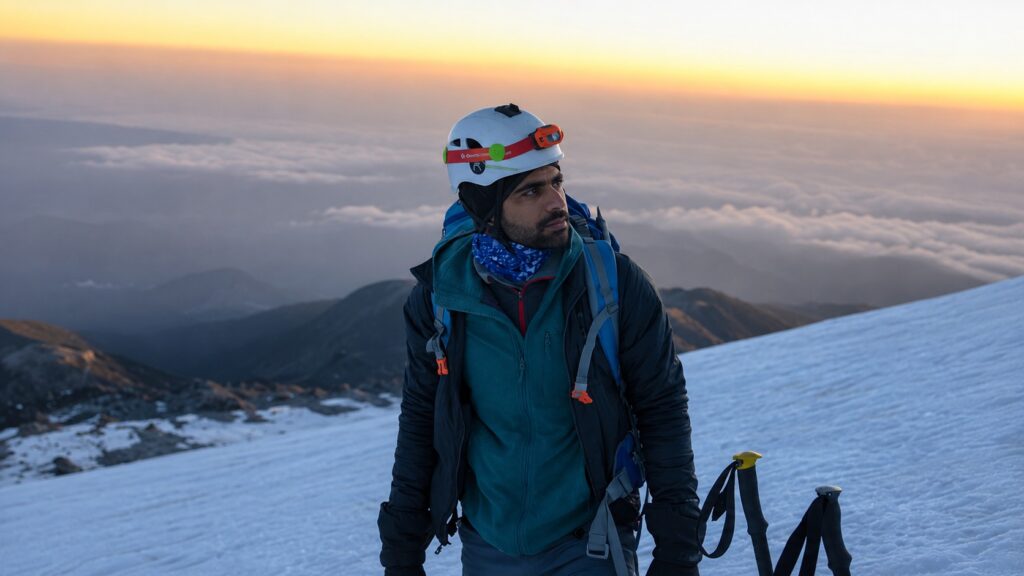
A Kuwaiti climber trained on stairs and treadmills while holding a full-time job, then completed the highest volcanic summit on every continent at just 24. Behind the Guinness title was a journey that took nearly six years.
Yousef Al Refaie’s preparation for some of the world’s most remote mountains included a much more familiar setting: stairs and treadmills in Kuwait. Living far from alpine training grounds, he used what was available to build the endurance his expeditions required.
The destination was extraordinary. On 22 December 2021, the Kuwaiti mountaineer completed the Seven Volcanic Summits on Antarctica’s Mount Sidley. At 24 years and 119 days, he earned the Guinness World Records title for the youngest man to finish the challenge.
His achievement brought Kuwait into a small international circle of climbers who had reached the highest volcano on each continent. The story behind it, however, began with an Instagram post and a first climb, before there was a world record to pursue.
A first climb before a record attempt
In a 2022 interview with Bazaar, Al Refaie explained that an advertisement for climbing Africa’s highest mountain caught his attention in 2015. He signed up, reached Kilimanjaro’s summit and returned wanting to climb again.
The seven-volcano objective came later. He told the publication that he initially climbed without a specific overarching goal, before discovering the challenge through British mountaineer James Stone’s online account of its finishers.
That distinction matters to the shape of his journey. His first expedition was not the opening move in a fully formed record campaign. It became the beginning of one as his interest developed and successive climbs gave him a larger objective.
The official Guinness record documents the progression. Kilimanjaro came in December 2015, followed by Russia’s Elbrus in July 2017 and Papua New Guinea’s Giluwe in July 2018.
He climbed Mexico’s Pico de Orizaba and Iran’s Damavand in 2019, then Ojos del Salado on the Argentina–Chile border in January 2020. Mount Sidley completed the sequence almost two years later. From the first recorded summit to the last, the undertaking stretched across nearly six years.
Training around life in Kuwait
Al Refaie’s account also offers a practical answer to how a climber based in Kuwait prepares for such an undertaking. He described using stairs and treadmills to simulate sustained uphill effort, with endurance central to his training.
At the time of the Bazaar interview, he also held a full-time job. Expedition preparation took place alongside that working life, rather than within the schedule of a full-time professional athlete.
His approach on the mountain was similarly measured. He described conserving energy early in a climb and treating every mountain seriously, regardless of its height or apparent technical difficulty.
These details put the summit photographs in context. The visible achievement was a series of distant peaks; the preparation included repeated exercise at home, managing effort and finding time around work. For readers in Kuwait, that is a more recognisable starting point than an expedition camp in Antarctica.
The final mountain demanded more than altitude
Mount Sidley stands 4,285 metres above sea level, but height alone does not explain its difficulty. Its position in Antarctica’s Marie Byrd Land makes reaching the mountain an expedition in itself.
Antarctic Logistics & Expeditions, which organises climbs there, describes a mountain surrounded by the polar ice sheet, with blue-ice slopes and a caldera approximately five kilometres wide. Its account dates the first ascent to 1990 and the second to an ALE-guided expedition in 2010.
That history gives a sense of how infrequently the mountain was visited. Sidley’s challenge involves access and isolation as well as the climb. Getting to its base is a substantial part of the undertaking, before any attempt on the summit begins.
In his account to KUNA, reported in January 2022, Al Refaie described spending six days trying to reach Antarctica. The expedition then progressed through Union Glacier before heading towards Sidley.
He described camps at roughly 2,225 metres and 3,000 metres, followed by a seven-hour summit effort. Temperatures fell to around minus 35 degrees Celsius at the top.
The Antarctic summer brought another complication. Prolonged daylight allowed more time for climbing, but also made sleeping difficult. Conditions that helped one part of the expedition could complicate another.
Twenty-seven meals and a shared workload
Al Refaie’s account to Guinness World Records makes the physical burden more tangible. Each team member carried 27 meals, with food alone weighing about 10 kilograms. The meals were largely dehydrated and high in calories.
Climbing also involved carrying a large backpack and pulling a loaded sledge. Supplies that made the expedition possible had to be moved across the same terrain the climbers were attempting to cross.
The workload extended beyond walking uphill. Al Refaie described dividing responsibilities within the group, including digging, cooking and setting up camp. A record awarded to one person depended on the organisation and cooperation of an expedition team.
He also described a steep difference in costs between destinations. His account put Damavand at around $1,000, while the Sidley expedition involved a figure of approximately $60,000. Those were his reported expedition costs, rather than a current price list, but they illustrate how different the logistical demands were across the circuit.
From volcanic peaks to desert crossings
After completing the volcanic summits, Al Refaie’s exploration interests turned towards deserts. His own website lists a Tabernas Desert crossing in July 2022 and an Empty Quarter expedition in December that year.
He connects that interest directly to his Kuwaiti background, describing growing up in a small desert country as part of his motivation to explore deserts elsewhere. His stated wider ambition is to cross the largest desert on each continent and draw attention to water scarcity.
That remains a separate undertaking from the completed volcanic record. The documented mountain achievement has a precise endpoint: Mount Sidley, 22 December 2021. What followed took him from the highest points of a seven-continent circuit towards the long distances between them.