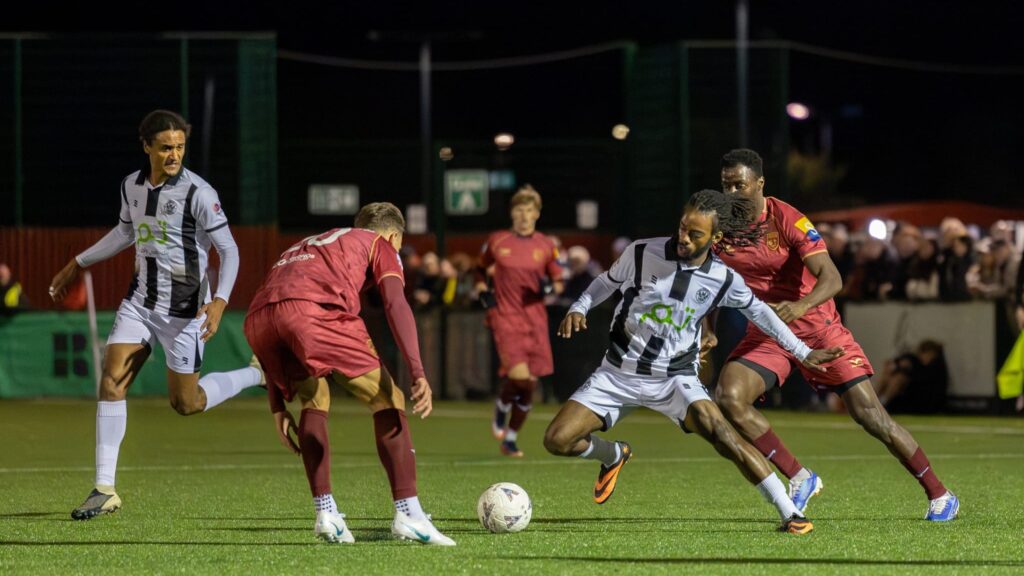
Ali Al Hamad’s club has reached the FA Cup second round, weeks after taking its players to Kuwait and strengthening a football connection stretching from Wiltshire to the Gulf.
Kuwaiti-owned Salisbury FC beat Sholing 6–0 in their FA Cup first-round tie at the Raymond McEnhill Stadium on Saturday, securing another milestone in the current club’s history.
For supporters following from Kuwait, the significance extends beyond a commanding scoreline. Salisbury are now one further victory away from the third round, the stage at which Premier League and Championship clubs enter the competition.
That possibility gives this cup run a straightforward appeal: a club owned by Kuwaiti businessman Ali Al Hamad is moving closer to the point where English football’s smallest surviving sides can be drawn against its biggest names. Victory over Sholing has brought that prospect closer, with a second-round tie now standing between Salisbury and a place alongside them in the draw.
Three goals turn the tie
Salisbury took control through a concentrated burst of first-half scoring. Nathan Odokonyero opened the scoring in the 31st minute, Josh Hedges converted a penalty two minutes later and Jeremy Sivi added a third in the 39th minute.
The sequence changed the shape of the afternoon. After more than half an hour without a goal, Salisbury went into the interval with a three-goal advantage against opponents who had already produced a notable upset during qualifying.
Odokonyero scored again in the 53rd minute, taking his personal contribution to two goals. Salisbury continued to extend their advantage after the interval, completing a six-goal victory and keeping another clean sheet in the competition.
The performance followed emphatic wins in the preceding qualifying rounds. Salisbury had beaten Dulwich Hamlet 5–0 and Eastbourne Borough 3–0 to reach the first round proper. Adding the Sholing result gives them 14 goals without conceding across those three cup fixtures.
Sholing’s own official match preview underlined why their visit deserved attention. The Southampton club had eliminated National League South leaders Ebbsfleet United on the way to its first appearance in the first round proper. Salisbury were facing a side that had already demonstrated its ability to beat higher-ranked opposition.
The result ended Sholing’s historic run while extending Salisbury’s. For Brian Dutton’s side, an afternoon that began with a place in the second round at stake finished with that place secured emphatically.
A Kuwait connection beyond ownership
The cup run comes shortly after Salisbury arranged an unusual overseas visit for a club competing in England’s sixth tier.
In its announcement of the Kuwait trip, Salisbury scheduled its first-team players and staff to travel between 27 September and 1 October, with a friendly against Al-Qadsia at the Mohammad Al-Hamad Stadium on 30 September.
The timing placed the visit between a league fixture against Folkestone Invicta and the FA Cup qualifying match against Dulwich Hamlet. Kuwait was therefore part of the club’s competitive-season programme, rather than simply a destination for a summer tour.
The announcement also identified a practical commercial purpose. Salisbury said all commercial profits and ticket-sale proceeds from the trip would go to the club. Alongside that objective, it described the visit as an opportunity for players and coaches to experience football in different surroundings.
Al Hamad had already sought to connect that English football operation with young players in Kuwait. In a September interview, he described summer trials that attracted interest from 450 players, with three prospects selected for an expenses-paid opportunity to train with Salisbury’s first team.
Those initiatives explain why a non-league cup tie in Wiltshire has a distinct Kuwaiti audience. The connection includes ownership, player development and a first-team visit, giving supporters several routes into following the club’s progress.
A new chapter for a rebuilt club
Salisbury’s present-day story also rests on the work of its local supporters.
The current organisation was formed in December 2014 following the demise of Salisbury City. The club’s official history records how its founders acquired the predecessor’s remaining assets and secured a new lease on the Raymond McEnhill Stadium.
The ground had been closed for a year. Volunteers helped bring it back into use, allowing football to return with a friendly against AFC Totton in April 2015, watched by 729 spectators.
Competitive football resumed in the Wessex League later that year. Salisbury won the league in its first season, beginning the climb that eventually brought the club into National League South.
That background gives the current cup campaign a significance separate from its international connections. For those who helped restore the ground and followed the team through the lower divisions, reaching the second round represents another step in a rebuilding process that began almost 12 years ago.
Al Hamad’s ownership and the Kuwait links now form part of that continuing story. The FA Cup brings the different strands together around an immediate sporting objective: keeping Salisbury in the competition.
The next date to watch
Attention now turns to the second-round draw. The Football Association has scheduled it for Monday, 9 November, at approximately 6.45pm GMT, equivalent to 9.45pm in Kuwait. Salisbury will be represented by ball number 40.
Second-round fixtures are scheduled for the weekend of 5 December, with the third round following in January.
The victory over Sholing has given Salisbury another cup date and its supporters another opponent to anticipate. For those watching from Kuwait, the route towards a possible meeting with one of English football’s leading clubs is now one match shorter.