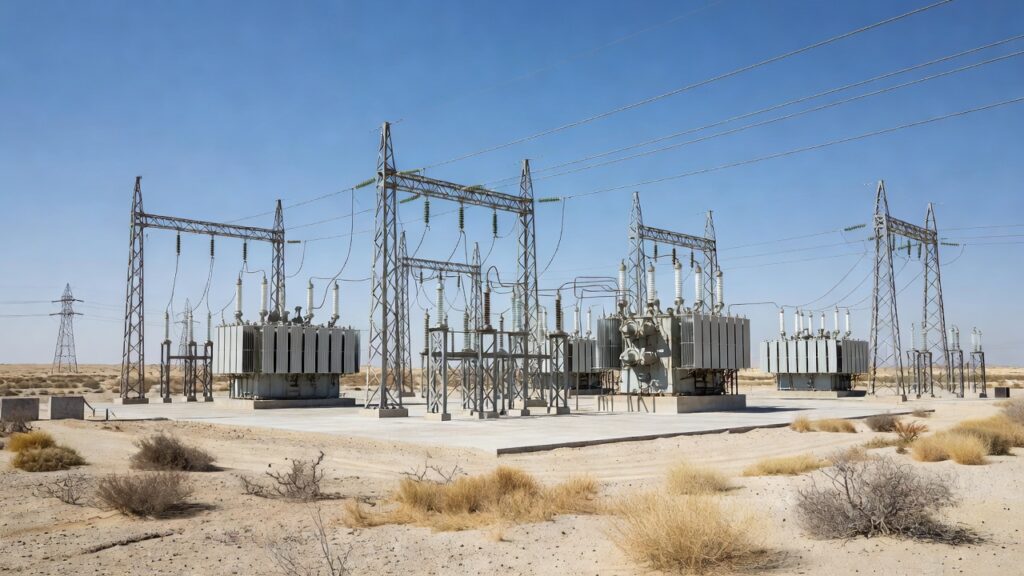
Kuwait’s Ministry of Electricity, Water and Renewable Energy reported a power outage in Shuwaikh Block 6 on June 24, 2026, triggered by a technical fault in three 33 kV transformers at the Shuwaikh (A) main substation. The malfunction was linked to high temperatures and rising electrical demand, the ministry said in a statement. Emergency teams have been mobilized to restore electricity to the affected area promptly.
The ministry’s statement detailed that the outage impacted only a limited section of the Shuwaikh area rather than a widespread zone. According to the announcement, the transformers went offline unexpectedly, leading to activation of emergency response protocols at the site. Restoration efforts aim to return service with minimal further disruption to residents and operations in the vicinity.
This event forms part of recurring summer challenges for Kuwait’s power infrastructure as extreme heat drives air-conditioning use. Al-Monitor reported that the ministry scheduled cuts in 2024 when demand exceeded power plant capacity during record temperatures.[[1]](https://www.al-monitor.com/originals/2024/06/kuwait-announces-power-cuts-demand-spikes-summer-heat) A separate account placed peak load that year above 13,500 megawatts, illustrating the strain that continues into 2026.[[2]](https://www.facebook.com/StartupPakistanSP/posts/kuwait-has-announced-its-first-ever-power-outages-due-to-soaring-temperatures-an/856414559855855/)
The Ministry of Electricity, Water and Renewable Energy has expanded maintenance programs and renewable integration to address rising consumption. Its official portal outlines projects that add capacity and improve grid monitoring across Kuwait. Data from the Kuwait Institute for Scientific Research projects electricity generation capacity will reach 32 gigawatts by 2035 to meet long-term demand growth.[[3]](https://www.kisr.edu.kw/en/gi/1/details/)
Residents in the affected block can contact the ministry hotline at 152 for real-time updates on restoration. The ministry’s statement stressed that the fault was isolated and technical teams remained on site throughout the incident. Comparable transformer outages occurred earlier in Jahra, where similar rapid-response measures were applied, according to prior ministry releases.
Studies on regional heatwaves indicate that higher temperatures can raise outage frequency by approximately 4 percent while extending their average duration. The Ministry of Electricity, Water and Renewable Energy continues to track such patterns through its operational data. These insights inform ongoing investments in transformer resilience and network upgrades to handle peak loads more effectively.