Abdulaziz Al-Foudari, Talal Al-Foudari and Mohammad Al-Dosari’s victory in Tunisia highlights a sport that brings competitive flying, technical knowledge and engineering together.
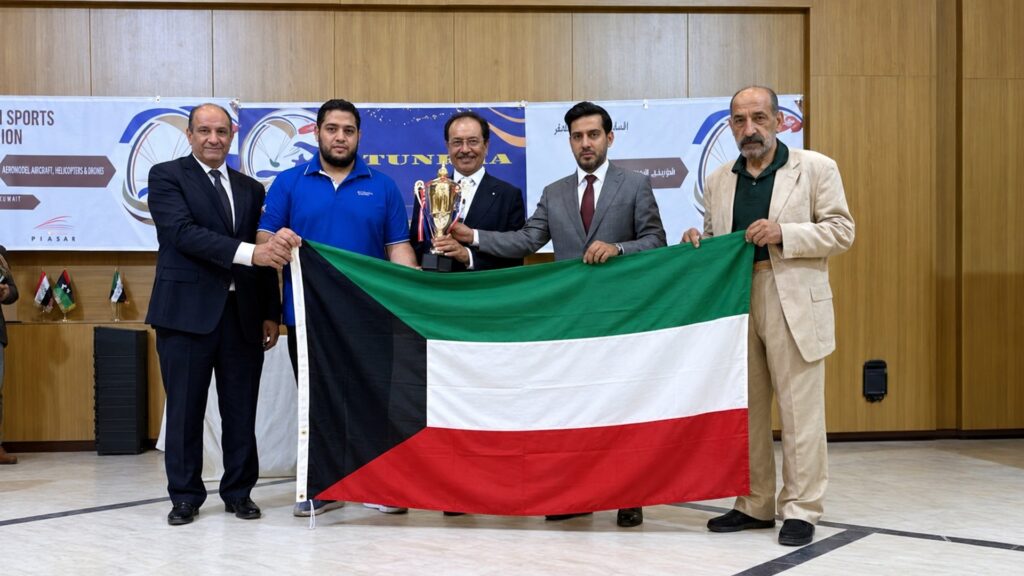
Kuwait has won Arab sporting gold with three pilots who remained on the ground. Abdulaziz Al-Foudari, Talal Al-Foudari and Mohammad Al-Dosari finished first in aeromodelling at the fourth Arab Model Aircraft Championship in Tunisia, with the team honoured at the closing ceremony of the third Arab Air Sports Games.
The result, announced by KUNA, draws attention to a discipline in which a small aircraft carries substantial technical demands. Competitors must understand the machine they are controlling, judge its movement from a distance and deliver a flight that can withstand comparison with those of other national teams.
For Kuwait, the achievement also opens a window onto the overlap between sport and practical science. Aeromodelling brings design, construction and flying into the same activity, with international competitions providing a measurable test of what participants can do with that knowledge.
An Arab meeting of flying disciplines
The Tunisian games brought together participants from 11 Arab countries, including Kuwait, Saudi Arabia, the UAE, Egypt and the host nation. Organised through the Arab Air Sports Federation and the Tunisian Air Sports Federation, the programme combined model-aircraft competition with paragliding, bringing distinct branches of aviation sport into one regional gathering.
The settings reflected those differences. KUNA’s coverage of the opening placed the model-aircraft competition at the airstrip in Soliman, in Nabeul governorate, while paragliding was assigned to the natural heights of Beni Aouf in Bizerte. In one discipline, competitors controlled aircraft remotely; in the other, they took to the air themselves.
Ahmad Mouhej Al-Shalahi, chairman of the Kuwait Air Sports Club and head of the delegation, told KUNA that the championship had given Kuwaiti competitors valuable experience. He also emphasised the relationships formed among participants from across the Arab world. His assessment places the medal within a wider purpose for international competition: testing national teams while bringing experienced practitioners together.
The precision behind the flight
Aeromodelling covers several forms of competition, each with its own demands. The World Air Sports Federation’s explanation of radio-controlled aerobatics offers a useful illustration of the precision involved. Competitors fly defined manoeuvres before judges, who award marks from zero to ten and apply difficulty factors according to the complexity of each figure.
A flight therefore has to be assessed in parts. Completing a manoeuvre is only the beginning; errors affect the score, and more demanding figures carry different weight. The operator’s transmitter sends commands to equipment aboard the model, which moves its control surfaces. What spectators see in the sky is the visible outcome of those instructions.
In F3A, one established aerobatic class, aircraft typically have a fuselage no longer than two metres and must weigh no more than five kilograms. These figures illustrate the scale of international competition rather than specifications confirmed for Kuwait’s aircraft in Tunisia. Aeromodelling has multiple classes, and the championship announcement did not identify the Kuwaiti team’s equipment or detailed scoring category.
A model-flying medal recognises performance within a sporting system. Its rules and technical demands give the result meaning beyond the aircraft’s small size.
A sport with an engineering history
The connection between model aircraft and technical learning predates modern radio controls. The FAI’s overview of aeromodelling describes how aviation pioneers used models to test their ideas, and how the activity expanded from the 1930s before radio control became more developed in the 1950s.
That history helps explain why the sport encompasses such different machines, including gliders, powered aeroplanes, helicopters and space models. The federation cites an estimate of more than one million enthusiasts worldwide. It is a broad estimate rather than a dated participation census, but it conveys the scale of a community that extends well beyond championship teams.
A recent example makes the educational connection concrete. In May, the FAI profiled 2026 aeromodelling scholarship winner Oleksii Kosylo, a 19-year-old Ukrainian competitor studying aircraft engineering. He described progressing from simple models and ready-made designs to his own ideas and manufacturing techniques.
“Aeromodelling led me into science,” he told the federation. His experience is one athlete’s account, rather than evidence of a guaranteed career outcome, but it shows how competitive flying and technical study can develop together. It also gives a practical meaning to a sport often encountered first through photographs of small aircraft.
Bringing the experience home
There is an established Kuwaiti connection to that international community. The FAI lists the Kuwait Science Club as an active member, while the delegation in Tunisia was led by the Kuwait Air Sports Club. They are distinct organisations, but their presence shows how aviation activities in Kuwait span both scientific and sporting institutions.
The international framework also includes support for younger competitors. The FAI’s aeromodelling scholarship, established in 2011, awards CHF2,500 to a pilot aged 16 to 21. National member organisations submit nominations, with candidates assessed on both their flying achievements and educational plans. The programme makes the link between sporting development and education an explicit part of the federation’s work.
Al-Foudari, Al-Foudari and Al-Dosari leave the competition with a first-place finish and experience gained alongside regional teams. The next part of their story lies in the work behind it: their aircraft, their preparation and the decisions that shaped their winning flights. Those details would show aspiring Kuwaiti flyers what competing at this level actually requires.