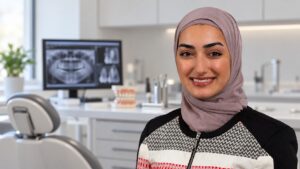
The Kuwaiti founder’s ODONTYN platform addresses a question that sits beneath digital booking: how people retain access to the history of their own treatment.
Booking an appointment is only one part of a dental visit. The less visible part is the information that comes with it: earlier treatment, scans and the records that explain what has already been done. For Kuwaiti prosthodontist Dr Noor AlQabandi, that history became the starting point for ODONTYN.
The platform combines finding a dentist and arranging care with storing and sharing dental files. Its significance lies in the second task. A booking service helps organise the next appointment; access to a treatment history concerns the relationship between that appointment and the ones that came before it.
According to ODONTYN’s account of its development, AlQabandi began working on the idea during her specialist training, introduced it at a hackathon in 2019 and released the first version of the web platform in 2023. The company identifies her background in prosthodontics and public health, two fields that meet in a question about both individual treatment and how a health service is organised.
The information between appointments
ODONTYN’s patient platform says users can upload and share records and X-rays, retain appointment summaries and search for clinicians through filters. These are descriptions of the service’s functions. They do not establish that every clinic contributes a complete record or that a file transferred through the platform is automatically incorporated into another provider’s clinical system.
That distinction is important in understanding portable health information. A patient being able to open a file is one level of access. A receiving clinician being able to interpret its contents and place them within the treatment history is another. The value of the record depends partly on what it contains, when it was created and whether its origin is clear.
Dental care makes that issue particularly tangible because an image can outlast the appointment at which it was taken. The public conversation about digital services often focuses on speed and convenience. Record access asks a more enduring question: what information remains available when the patient’s relationship with a provider changes?
A founder’s perspective across health systems
AlQabandi’s professional background gives the project a specific starting point. Her company biography records dental education in Malta, work in Kuwait and further training at Tufts in the United States. The relevance is the experience of different clinical settings, rather than an assumption that studying abroad confers an answer to every local health-system problem.
In a published interview about ODONTYN, the founder discussed patient access to health history alongside her work in prosthodontics. The connection is understandable: a specialty concerned with restoring oral function also has to consider the history and condition of the mouth being treated. The platform takes that information question beyond a single consultation.
It also opens a broader distinction between a clinician’s expertise and a technology company’s evidence. A founder’s professional experience can explain why a problem was selected. Demonstrating the impact of a digital service requires a different kind of reporting, including how it is used and whether it improves the processes it was designed to address.
Digital health is becoming a system question
The wider policy direction makes the subject timely. In May 2025, the World Health Assembly extended the global digital health strategy to 2027 and called for work on a subsequent strategy. WHO reported that 129 countries had established national digital health strategies, reflecting the extent to which digital services are now part of health-system planning.
The policy emphasis is broader than the number of apps available. It includes governance, interoperability and whether technology serves people’s needs. Applied to dental records, this provides a useful analytical framework: a service has to be considered in relation to patients, clinicians and the systems through which information is already created and retained.
For a private platform, that also makes precise language necessary. Making information accessible to a patient is not the same as establishing legal ownership over every clinical record. Security statements are not interchangeable with a published independent audit. Describing what the service enables is more informative than allowing broad claims about control or compliance to stand in for evidence.
The record is also a chronological object. A scan without its date or a summary without the treatment it describes can be less informative than the file format suggests. That is why continuity is best understood as preserving context as well as storing bytes, an information question that sits underneath the platform’s patient-facing functions.
Why the dental record belongs in the health discussion
The World Health Organization’s oral-health overview estimates that oral diseases affect nearly 3.7 billion people globally. It also places prevention and early treatment at the centre of the response. That scale provides context for treating dentistry as part of health care, rather than reducing its digital development to cosmetic appointments or consumer convenience.
For Kuwait, ODONTYN offers a local founder story within that wider issue. The company lists an office in Salmiya, while presenting a service intended to work across providers. Its public materials establish the proposition and its origins. They do not yet provide a basis here for quantifying how many repeat tests, missed appointments or treatment delays the platform has prevented.
The more durable question is what patients can carry forward from each episode of care. AlQabandi’s project puts the record itself at the centre of that discussion. As dental services become easier to find and book, continuity will depend on whether the information needed to understand a patient’s history remains available when the next appointment begins.