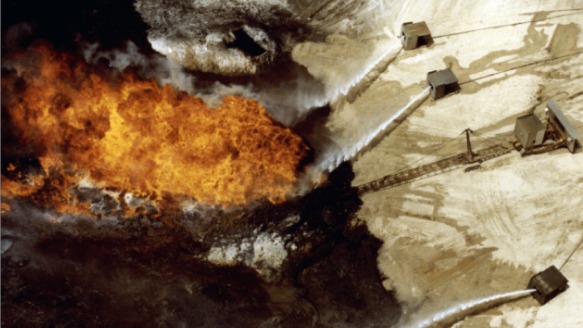
Thirty-five years after Kuwait extinguished its last burning oil well, the achievement of its own firefighting team deserves a closer look, alongside the international operation that helped restore the country.
When the last burning well at Burgan was extinguished on 6 November 1991, Kuwait reached a milestone that liberation alone had not delivered. The occupation had ended months earlier, but the fires left behind were still consuming the country’s oil and prolonging its environmental emergency.
The late Amir Sheikh Jaber Al-Ahmad Al-Jaber Al-Sabah attended the ceremony at Burgan No. 118. The moment became one of the defining images of Kuwait’s recovery, marking the conclusion of an operation involving Kuwaiti personnel and international firefighting specialists.
Within that much larger effort sits a remarkable national contribution. Kuwait Petroleum Corporation’s historical account records that Kuwaiti firefighting teams capped 41 wells in 54 days. On the 35th anniversary, those figures offer a way to look beyond the final ceremony and recognise the people, skills and infrastructure that made it possible.
The different skills behind one team
The Kuwait Wild Well Killers team was formed on 9 September 1991. Its members brought together several professions: firefighters, drilling operators, petroleum engineers, safety engineers and support personnel.
That combination mattered because controlling a burning oil well required more than extinguishing the visible flame. According to KOC’s account of the operation, work included clearing mines and obstructions, dealing with nearby oil accumulations, inspecting damaged wellheads and preparing equipment before the well could be secured.
KOC records 14-hour working days and credits practical and theoretical training, including simulated well fires, with helping the team perform its work. These details give substance to an achievement often remembered through a single number.
The crew’s contribution belonged within a wider international response. Recognising the Kuwaiti team does not diminish the specialists who came from abroad. It shows how local knowledge and technical experience became part of the same operation, with people from different disciplines working towards a measurable result: another well brought under control.
The work beyond the flames
The firefighting campaign also depended on an enormous supporting operation. Equipment needed access to damaged fields. Water had to reach working sites. Roads, communications and production facilities had to be made usable again.
In its 2010 historical review, KOC distinguishes between Al-Awda, the return phase focused on unexploded ordnance clearance and extinguishing the fires, and Al-Ta’meer, the reconstruction phase aimed at restoring production.
The review records more than 400 kilometres of special access roads, 2,000 kilometres of new pipelines and 353 excavated water lagoons among the recovery programme’s results. It also describes the rebuilding of offshore export piers and repairs to gathering centres, storage tanks and other facilities.
These were the less photographed components of recovery. They explain why the last flame could mark an ending without meaning that every consequence of the destruction had been resolved.
For an oil-producing country, the task was to restore an interconnected system. A controlled well, a functioning pipeline and an export terminal each represented a different part of that work. The anniversary therefore belongs to the crews at the wells and to those who made their work possible.
An anniversary that reached the United Nations
Kuwait’s experience subsequently became part of a wider international discussion about what war leaves behind in the natural environment.
The United Nations observes 6 November as the International Day for Preventing the Exploitation of the Environment in War and Armed Conflict. In remarks delivered in Kuwait in 2024, the UN Resident Coordinator recalled that Kuwait had submitted the resolution to designate the date in 2001.
That connection gives the anniversary a significance beyond the petroleum industry. Damage to land, water and ecosystems can outlast the fighting that caused it, affecting the people who return and the generations who follow.
The same UN remarks linked Kuwait’s recovery experience with its subsequent advocacy on environmental protection during conflict. The country had lived through the problem it was asking the international community to recognise.
For readers encountering the oil fires mainly through archive photographs, this provides another part of the story: Kuwait carried the memory of the disaster into a continuing international observance concerned with preventing and addressing similar damage.
Keeping the people in the record
There are also concrete examples of efforts to bring the story to audiences too young to remember 1991.
For the 34th anniversary in November 2025, KOC organised a commemoration with the Scientific Center attended by members of the Kuwaiti firefighting team. The programme included a film about their work, a firefighting demonstration and public activities.
Director David Douglas returned to Kuwait for the occasion and was honoured in connection with Fires of Kuwait. KOC’s account describes a screening of the film in its new IMAX version, placing footage of the operation before another generation of viewers.
Combining the archive with the presence of those who took part gives the history something a commemorative statistic cannot provide on its own. It connects the scale of the disaster with identifiable people and the practical work they performed.
Thirty-five years after Burgan No. 118, the final well remains an essential national milestone. The 41 wells capped by Kuwaiti crews in 54 days deserve their own place beside it, as a record of the contribution Kuwait’s people made to reclaiming their country.