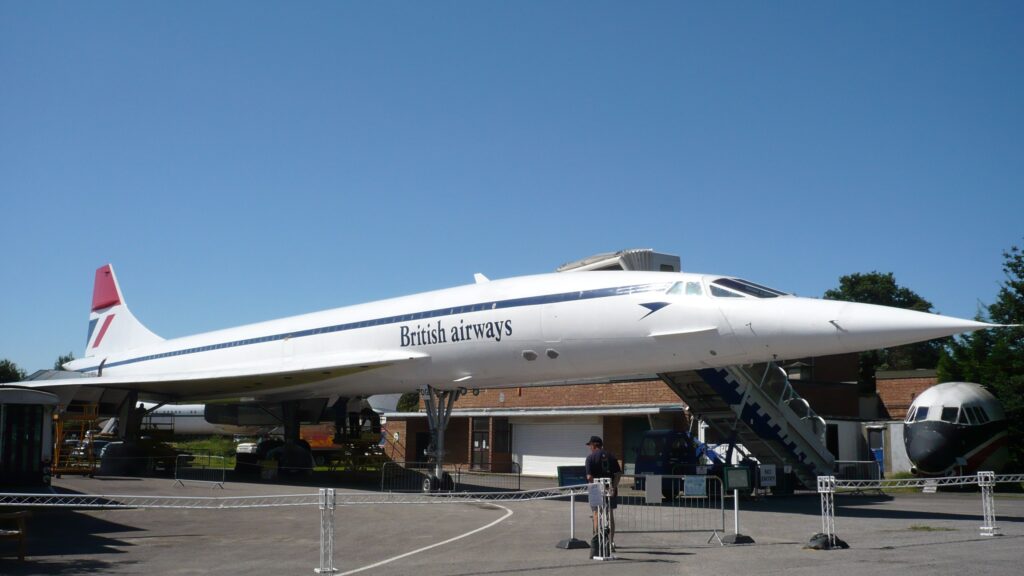
As Concorde marks 50 years since entering passenger service, its history includes a demanding assignment in Kuwait: measuring take-off performance in temperatures an engineer recalled reaching 48°C.
Before Concorde became synonymous with fast Atlantic crossings and famous passengers, its engineers needed to establish how it would perform in some of the conditions airlines would encounter. In August 1974, that work brought the supersonic aircraft to Kuwait.
The aircraft was G-BBDG, known as Delta Golf, the first British production Concorde. Its development programme included measured take-offs in Kuwait’s summer heat, an episode that places the country within the practical engineering story behind one of aviation’s most recognisable aircraft.
That connection deserves renewed attention in 2026, the 50th anniversary of Concorde’s entry into commercial service. While the anniversary celebrates the start of passenger flights, Kuwait’s part came earlier, when the aircraft was still accumulating the evidence required to operate them.
Waiting for Kuwait to get hotter
The aircraft’s published chronology records a flight to Kuwait on 19 August 1974 to measure take-off performance in an ambient temperature of 46°C. It was a specific test assignment within a wider programme that also took the aircraft around the Gulf and onwards to Singapore.
Former British Aircraft Corporation engineer Richard Harris supplied a more personal account in the February 2021 edition of Mach 2, a magazine dedicated to Concorde. He recalled flying to Kuwait on three successive days, refuelling and waiting for temperatures to reach what the team believed would be their daily maximum.
Harris remembered readings of 45°C, 46°C and then 48°C. While they waited, the aircraft’s wing provided their shelter.
His first-person account describes Kuwait as the location for measured-performance take-offs, with the aircraft returning to the programme’s base in Bahrain. The distinction matters: Kuwait hosted a particular part of the work, rather than the entire Gulf testing operation.
For the engineers, the heat was the reason to be there. Conditions that made waiting beside the aircraft uncomfortable were precisely the conditions they had travelled to measure.
The work behind the speed
Concorde’s reputation rests heavily on what happened after take-off. British Airways records a cruising speed of around 1,350mph and a typical London–New York journey of slightly less than three and a half hours.
But reaching those speeds was only one part of preparing an aircraft for passenger service. According to British Airways’ historical account, Concorde underwent 5,000 hours of testing before its initial certification for passenger flights.
The airline also describes the unusual engineering demands of supersonic travel. Heating caused the airframe to lengthen in flight, while specially developed white paint helped dissipate heat. Its four engines used reheat to provide additional power for take-off and the transition to supersonic flight.
The Kuwait trials concerned a different operating condition: taking off in exceptionally hot weather. Together, these details show why the development programme extended well beyond demonstrating that an aircraft could travel at twice the speed of sound.
Kuwait’s contribution belongs to that less visible history. The country provided conditions in which the team could collect performance measurements before the aircraft became an established passenger service.
A Gulf chapter before the Atlantic years
Concorde’s Middle Eastern history was wider than a single series of tests. Brooklands Museum’s timeline records Delta Golf making demonstration visits around the region in 1974, including Kuwait, Abu Dhabi, Qatar, Muscat and Dubai.
The Gulf therefore featured in both the technical programme and efforts to introduce the aircraft to potential customers. Those were related activities, but they served different purposes: measuring performance established what the aircraft could do, while demonstrations showed it to people who might buy or operate it.
The region also featured at the beginning of commercial operations. British Airways’ first scheduled Concorde service flew from London Heathrow to Bahrain on 21 January 1976.
This anniversary has prompted new commemorations. In January 2026, the Royal Mint unveiled a Concorde 50p coin, developed in partnership with British Airways and Airbus. Its design depicts the aircraft against a departure-board background.
For a Kuwaiti audience, the anniversary offers a reason to look beyond Concorde’s familiar association with London and New York. Before those routes defined its public image, the aircraft had already spent time being tested and demonstrated across the Gulf.
From a royal arrival to a preserved aircraft
Concorde returned to Kuwait in a very different role in 1979, carrying Queen Elizabeth II at the start of her regional tour. Photographs released from British Airways’ heritage collection document that arrival, connecting the aircraft with a prominent moment in Kuwait’s diplomatic history.
The royal visit and the 1974 tests were separate episodes. One brought an internationally recognisable passenger; the other brought engineers seeking performance data. Together, they explain why Concorde appears in Kuwait’s history as both a ceremonial visitor and a working test aircraft.
Delta Golf itself never entered commercial airline service. According to Brooklands Museum, it completed 663 flights between February 1974 and December 1981, including 374 at supersonic speeds.
British Airways later acquired it as a source of spare parts. Its surviving structure was subsequently transferred to Brooklands, where a two-year restoration led to its opening to the public in July 2006.
The aircraft that visited Kuwait is therefore still physically accessible, preserved in Surrey rather than surviving only in photographs. Its history connects the museum’s exhibit to a demanding summer assignment more than half a century ago: waiting on a Kuwaiti apron for the temperature to climb high enough to conduct the next test.