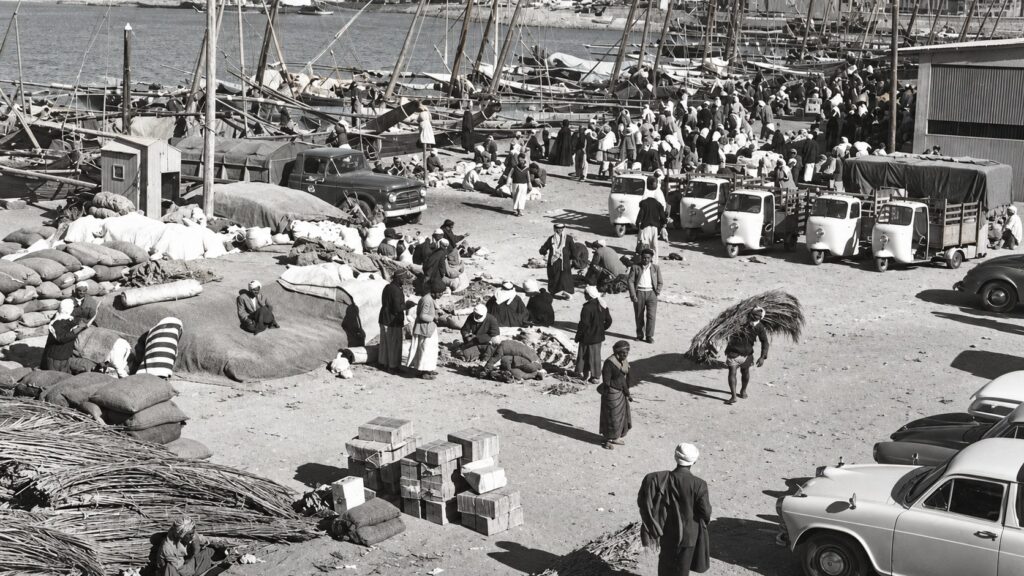
Long before the dinar became part of everyday life, Kuwait traded in Indian rupees. The story connects its waterfront markets with India’s ports, a short-lived Gulf currency and the creation of a national monetary system in 1961.
The currency that changed hands in Kuwait was once the Indian rupee. It belonged to a commercial world in which wooden dhows connected the country’s merchants with markets across the Arabian Sea, carrying goods between ports whose relationships had developed over generations.
For anyone accustomed to prices in dinars and fils, that history can feel surprisingly distant. Yet the change came within living memory. Kuwait’s first dinar banknotes entered circulation on 1 April 1961, replacing the rupee and establishing the currency that would accompany the country’s modern development.
There is also an often-overlooked chapter between the familiar Indian rupee and the Kuwaiti dinar: the Gulf rupee, a special issue introduced by India in 1959 for use outside its own domestic economy.
Together, these currencies tell a story larger than the designs printed on banknotes. They trace how Kuwait’s trading relationships shaped its money, and how the country eventually took responsibility for issuing its own.
A currency carried by trade
The rupee’s presence in Kuwait grew out of longstanding economic connections with India. Before the development of oil, Kuwait’s economy depended heavily on maritime activities, including shipbuilding, fishing, pearl diving and overseas trade.
The Indian Embassy’s account of bilateral relations describes dhows carrying dates, Arabian horses and pearls to India, where they were traded for timber, cereals, clothing and spices. These were connections that supplied everyday needs as well as supporting merchants and seafarers.
Money circulated within that network alongside the goods. A currency already familiar to trading partners had practical value in an economy connected so closely to overseas markets. The embassy records that the Indian rupee remained legal tender in Kuwait until 1961.
That history places the relationship between the two countries well before the modern movement of workers, oil shipments and remittances. India was already part of Kuwait’s commercial life when the harbour and the souq were central to its economy.
The rupee was therefore more than a foreign currency passing through. It formed part of the monetary system on which local trade depended.
The brief life of the Gulf rupee
The final years of rupee use require an important distinction. In 1959, India introduced a separate currency issue for the Gulf, commonly known as the Gulf rupee.
An IMF study of currency arrangements in the Arabian Peninsula connects the change to measures addressing the gold trade. The new arrangement separated currency circulating in the Gulf from India’s domestic rupee circulation.
The Reserve Bank of India’s museum also records the production of special notes for Gulf territories, including Kuwait, Bahrain, Qatar and the Trucial States, now part of the United Arab Emirates.
This is why historical accounts may refer either to Indian rupees or Gulf rupees when describing Kuwait before the dinar. The broader Indian currency connection lasted far longer; the separate Gulf issue belonged to its final phase.
For Kuwait, that phase was brief. Within roughly two years of the Gulf rupee’s introduction, the country began replacing it with a national currency. The transition was therefore the culmination of a monetary history with several stages, rather than a single overnight break from an unchanged system.
When the first dinars arrived
The legal foundation came in 1960. Amiri Decree No. 41 established the Kuwaiti dinar as the national monetary unit and created the Kuwaiti Currency Board.
According to the Central Bank of Kuwait’s history of the first issue, the board was chaired by Sheikh Jaber Al-Ahmad Al-Jaber Al-Sabah, then minister of finance and economy. The first banknotes entered circulation on 1 April 1961.
There were five denominations: a quarter dinar, half a dinar, one dinar, five dinars and ten dinars. The 20-dinar note familiar today was not part of that original series.
The change gave Kuwait its own unit for expressing prices, settling payments and recording monetary values. It also established a local institution responsible for issuing the currency.
The first notes had a long life beyond their launch. The central bank records that their withdrawal took effect in February 1982 and that they ceased to be legal tender at the end of May that year.
What one dinar was worth
At the changeover, one rupee was equivalent to 75 fils. Since a dinar contained 1,000 fils, that meant one dinar equalled 13⅓ rupees, often rounded to 13.33.
Research published by the Johns Hopkins Institute for Applied Economics, drawing on the Currency Board’s annual reports, records the conversion arrangement and the dinar’s initial parity with one pound sterling.
The arithmetic helps explain the practical scale of the change: 100 rupees converted to 7.5 dinars. A smaller number in the new currency did not, by itself, mean that someone’s money had lost value. The unit in which it was counted had changed.
The replacement also required a transition period. The same research records that the rupee ceased to be legal tender in Kuwait on 12 May 1961, while exchange into dinars at the official rate continued until 17 May.
From the Currency Board to the central bank
The institution that introduced the dinar was the Currency Board, rather than today’s Central Bank of Kuwait.
As banking expanded during the 1960s, Kuwait developed a broader monetary institution. The central bank was established under legislation in 1968 and began operations on 1 April 1969, succeeding the board.
The central bank’s payment-system history places subsequent milestones along that longer path: the first ATM and bank card in 1979, the establishment of KNET in 1992 and the introduction of online banking in 1998.
Those developments changed how people accessed and transferred money. The dinar remained the unit underneath them.
Looking back at the rupee years brings another Kuwait into view: a country whose commercial relationships were visible in the money used in its markets. The dinar’s arrival marked the creation of a national currency, while the rupee it replaced preserved the imprint of the sea routes that had helped sustain the country.