A chance stop in Arizona brought an Italian-style dessert brand to Kuwait in 2013. Its journey since then runs through shopping malls, local flavours and seasonal leisure destinations.
Haitham Alghunaim was on his way to an Apple Store in Tucson when a gelato shop caught his attention. The Kuwaiti businessman was nearing the end of a winter holiday in Arizona. A stop for something sweet would eventually lead to a franchise agreement and a new name arriving in Kuwait’s dessert counters.
That name was Frost. More than a decade after its Kuwait debut, the brand’s footprint connects large shopping centres with seasonal destinations, taking a product associated with Italian streets into different settings for a Kuwaiti day out.
The route was unusually indirect: an Italian dessert, an American business and a Kuwaiti customer who decided to bring the experience home. Behind it lies a story about how food travels, and what changes when it reaches another country.
A discovery that became a business
The Arizona Daily Star’s reporting in June 2013 traced Alghunaim’s discovery to a visit to La Encantada during a five-day holiday the previous winter. He already knew gelato from travelling in Italy, but had reservations about finding an American interpretation of it.
After trying Frost, he entered discussions with co-founders Jeffrey Kaiserman and Stephen Ochoa. The process involved more than securing the name. The founders travelled to Kuwait to look at locations, while Alghunaim returned to Tucson to train with the team.
A subsequent report dated November 1, 2013, announced the opening of the Kuwait operation. What began as an unplanned purchase had become a business connecting two cities separated by thousands of kilometres.
The practical detail is revealing. Before a customer in Kuwait could order a scoop, there were premises to select, staff to prepare and a production process to transfer. The holiday encounter supplied the idea; reproducing the dessert required a separate undertaking.
An Italian idea with an American address
Frost’s own beginnings followed a similar pattern of discovery abroad. In the company’s account of its origins, its founders encountered gelato while looking for something cold during a hot day in Rome.
Back in the United States, they sought out suppliers of Italian ingredients and enrolled in gelato training. Equipment and products were subsequently imported from Italy to establish the business in Tucson.
That history helps explain why describing Frost simply as an Italian or American brand leaves something out. The business developed in Arizona around a dessert and production tradition associated with Italy, before a Kuwaiti franchisee brought it to another market.
The company also identifies Bologna-born Nazario Melchionda as its corporate chef. Its account of his career includes teaching and training in Europe and Asia, illustrating how the expertise behind the product had already travelled internationally before Frost reached Kuwait.
The resulting business was built around transferring a method as well as a menu. Customers see the finished display; the less visible part is the knowledge needed to reproduce its contents.
What happens behind the counter
Frost describes daily production as central to its operation. On its gelateria information page, the company says it sources ingredients from Italy, with milk, sugar and fruit excluded from that import policy. It also describes using Italian equipment and display cases.
These are company statements about its production model, rather than an independent assessment of every outlet. They nevertheless explain the distinction Frost makes between operating a gelateria and simply selling a finished frozen product delivered from elsewhere.
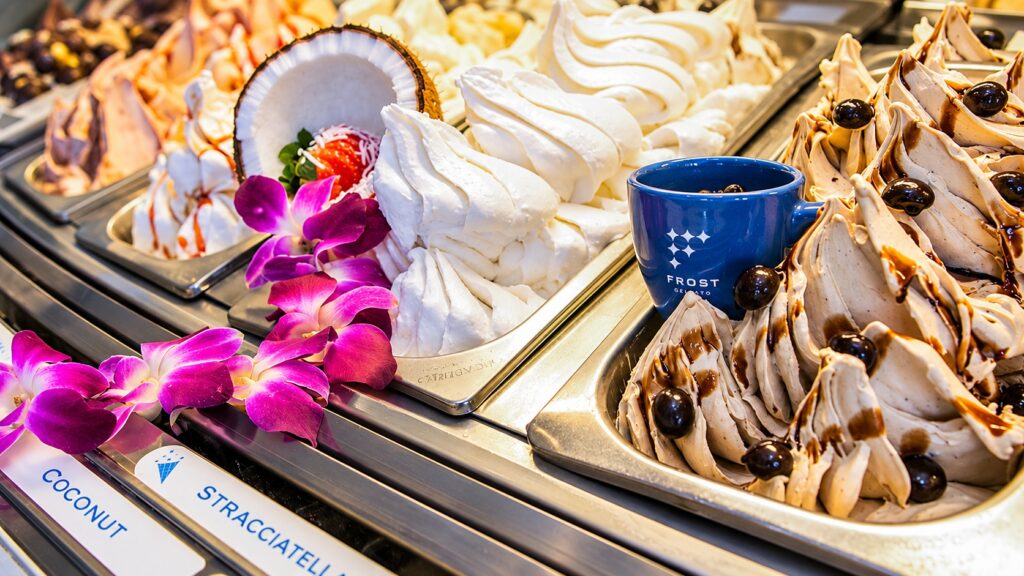
Making the dessert involves decisions about ingredients, processing and the amount of air incorporated into the mixture. Display equipment then becomes part of how that product reaches the customer, alongside the visible arrangement of flavours behind the glass.
For a business operating across countries, this creates a particular challenge: retaining a recognisable product while placing production in different hands. Recipes alone cannot accomplish that. Equipment, training and everyday preparation all form part of the process that must travel with the brand.
Where Kuwait enters the recipe
The Kuwait operation’s story extends beyond reproducing an overseas menu. A 2021 feature in Kuwait’s bazaar magazine documented flavours including ashta and saffron alongside chocolate and vanilla, showing how the offering had incorporated tastes familiar to the region.
The same feature described formats designed for sharing and taking home, including a Chalet Box, gelato cakes and chocolate-covered bites. Those details belong to the documented offering at that time, rather than a guarantee of today’s menu.
They are nevertheless useful evidence of adaptation. A scoop eaten beside a shop counter and a box taken to a gathering serve different occasions, even when the underlying product is similar.
Saffron is particularly telling in that context. Its presence connects the gelato format with a flavour already familiar in regional sweets. The change does not require abandoning the original product; it gives that product another point of recognition.
This is where the Kuwait chapter becomes more than a story about an imported sign above a shop. The menu and serving formats show how a franchise can acquire local characteristics.
From shopping trips to seasonal outings
Frost’s published location directory lists Kuwait outlets at The Avenues and Assima Mall, alongside Sultan Center at Kazma Club in Adailiya. It also identifies seasonal locations at Zahra Farm in Abdali, Blajat Beach and Winter Wonderland.
The seasonal designation matters. These entries should not be read as confirmation that every location operates throughout the year, or that a particular season has already begun.
Together, however, the listings describe a presence across several kinds of outing: shopping, entertainment and visits to outdoor destinations. They provide a more concrete picture of the Kuwait business than an unsupported claim about market leadership or popularity.
The distance from that first Arizona encounter is now measured in more than geography. A dessert discovered during a holiday has become available within Kuwait’s own shopping and leisure settings, with a documented history of local flavours and formats along the way.