Kuwait’s three operators built a network that reaches 97 percent of the country and a market whose total revenue is forecast to go nowhere. The 5G-Advanced and AI roadmap CITRA signed with Huawei is an argument for what the network sells next.
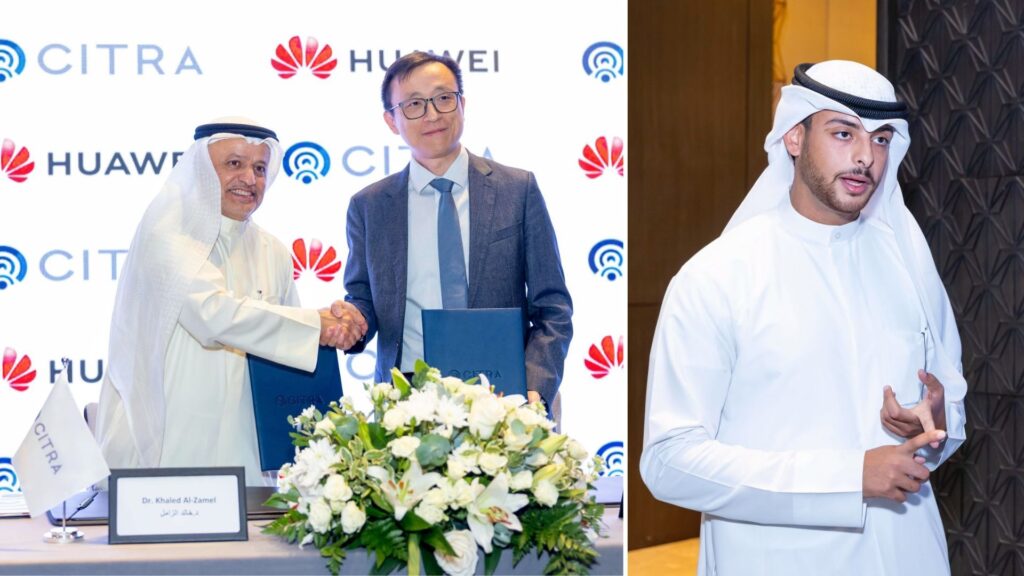
The document CITRA and Huawei released on 12 July does not read like a regulatory milestone. The Kuwait 5G-Advanced & AI Era Strategic Whitepaper names its priorities as 5G-Advanced evolution, indoor connectivity, network intelligence, industry digitalisation, and the responsible adoption of emerging technologies. Strip the framing and it is a thesis about revenue, aimed at a sector that has run out of the easy kind.
The problem it addresses is visible in the numbers Kuwait’s operators already report. Zain, stc and Ooredoo each hold roughly a third of a market of about 4.9 million people, and by ResearchAndMarkets’ forecast total telecom service revenue in Kuwait is essentially flat through 2029, as mobile data and fixed broadband gains cancel out the decline in voice. The country has nationwide 5G-Advanced, activated by CITRA in 2025 and rolled out by Huawei with local contractor Knetco across all three operators. Median mobile download speeds hit 399.9 Mbps in January 2026, third-fastest in the world by Ookla’s measure. The engineering is finished. What the market lacks is a way to be paid for it.
The pivot the roadmap is really about
That is the gap the whitepaper is built around, and it maps onto a thesis Huawei has been selling globally. At MWC Barcelona in March, the company’s Li Peng framed the carrier opportunity as a ten-trillion-dollar shift, arguing that networks will soon connect not people but hundreds of billions of AI agents, each with its own compute and latency demands, and proposing “5G-A x AI” as the upgrade path that lets an operator monetise more than raw traffic. The Kuwait document imports that logic wholesale. Its emphasis on network intelligence and industry digitalisation is the local translation of a single idea: sell guaranteed performance and embedded AI, not gigabytes. Sami AlQaddoumi, a product manager for industry solutions at Huawei who was in the room for the signing, put the underlying premise more to the point. “AI doesn’t run on thin air,” he wrote, “It runs on the network, and the network we’re building today is what will carry the personal AI agents, smart industries, and smarter public services of tomorrow.” What stayed with him, he added, “wasn’t the milestones on the cover,” but the sense in the room “that all of this is infrastructure for something bigger.”
The mechanism already exists in Kuwait. All three operators activated 5G standalone cores in 2025, which lets them slice the network into virtual tiers that guarantee latency and throughput for a specific application, the technical basis for selling an autonomous drilling rig or a mission-critical video feed a contracted service level rather than a flat data bundle. Capital is already moving that way: operators reported double-digit jumps in IT and software spending in 2025 while radio upgrades plateaued after coverage was completed. The whitepaper is the policy scaffolding around a shift the balance sheets had started without it.
What separates a roadmap from a headline
Where the document is more than aspiration is on the parts of the network Kuwait has not finished. Indoor connectivity is named as a priority for a reason: mobile speeds rank third globally, but fixed broadband sits 24th at a median 226.2 Mbps, and 5G-Advanced experience inside buildings, malls and industrial sites is where the premium-tier promise is won or lost. A roadmap that pushes operators from outdoor coverage to indoor and industrial density is aimed squarely at the layer where slicing becomes sellable.
The honest limit is who is holding the pen. The roadmap’s technology partner is also the vendor that built the network it describes, and the “infrastructure for something bigger” framing comes from that vendor’s own staff. Kuwait’s US commercial guide notes that Chinese firms keep winning the country’s digital infrastructure contracts on aggressive pricing, at a moment when data-localisation rules make the choice of who runs sovereign infrastructure a live question. A whitepaper co-authored by the equipment supplier is a strategy and a sales document at once. That does not make its diagnosis wrong. Flat revenue and a finished network are facts independent of who names them; the roadmap’s usefulness rests on execution by three operators competing hard enough that the AI upsell reaches customers, not just slide decks.
The last time Kuwait’s operators had an easy growth story, it was selling data to a population buying its first smartphones. That story is over, and the flat-revenue forecast is what the end of it looks like. The whitepaper is a wager that the next story is selling intelligence to machines. On current evidence, the network to run it is already live; the business model is the part still being written.