Ten years after Jedareyat began, the initiative’s origins, Al Rodhan’s illustrated tourist guide and the work of design studio WEFT offer a way to examine how people encounter Kuwait’s public spaces and cultural stories.
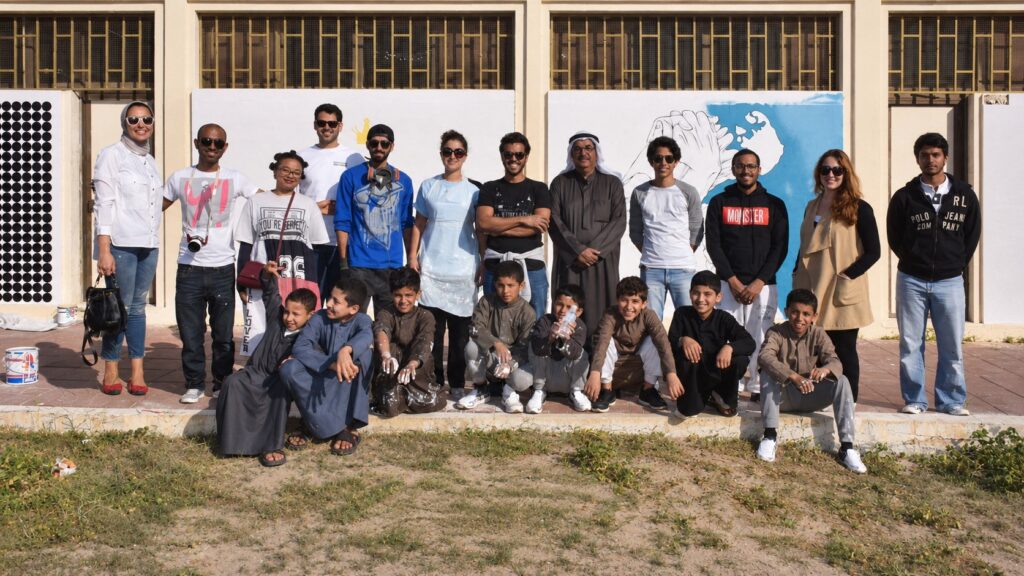
A wall outside a government building provided the starting point. Sulaiman Al Rodhan had arrived for a meeting when he noticed offensive graffiti and shared what he had seen on social media. The response helped turn an observation into a volunteer initiative.
According to an account published by Mohammed bin Rashid Al Maktoum Global Initiatives, the images reached then social affairs minister Hind Al Sabeeh. She encouraged the formation of a group that could bring young artists together to transform such walls. Jedareyat began in January 2016.
Its tenth anniversary year offers a useful point from which to examine a broader connection in Al Rodhan’s work. Alongside public art, his record includes an illustrated visitor guide, while his public profile identifies him as a founding partner of WEFT, a studio working across architecture, interiors and cultural projects. Each involves a different way of helping people engage with a place.
Making room for artists
In his 2016 interview with the Arab Gulf States Institute, Al Rodhan described Jedareyat as a collaborative undertaking. The founding team included Abdulaziz Alreshoud, Hind Francis and Ameena Almutawa, with artists recruited to develop the work.
The process involved finding a wall, considering its surroundings and agreeing a theme. Artists prepared sketches, with approval sought from the building owner where necessary. Paint and other supplies had to be sourced before the visible work could begin.
This gave the initiative an organisational role as well as a cultural one. Its contribution included connecting artistic talent with surfaces, permissions and materials. The artists remained the makers of the murals, able to sign their work and develop recognition through it.
Al Rodhan also explained that enquiries about private commissions could be directed to participating artists, while sponsorship supported the volunteer projects’ supplies. The distinction preserved a community purpose while allowing the public work to introduce artists to people who might commission them separately.
A mural consequently served more than one audience: those who passed it in the street, the artists producing it and the people who could make further work possible.
Looking at Kuwait through a visitor’s eyes
A later project approached the city through navigation. In the October 2019 edition of the Kuwait Industries Union’s Al Senaie magazine, Al Rodhan described creating a tourist guide after noticing the practical information available to travellers in other countries.
He worked with artist friends on a map presenting places to visit in Kuwait, including an itinerary connected with Mubarakiya. He said more than 20,000 copies had been distributed across over 40 locations. Those figures were his account at the time, rather than a current measure of circulation.
The significance of the project lies partly in its format. A map asks its makers to choose what a newcomer needs to see, how places connect and which details help someone explore independently. Familiar surroundings have to be explained to a person who does not already know their significance.
That gives the guide a clear relationship with Jedareyat, without making them the same kind of undertaking. The mural changes what is visible at a location; the map helps someone find and understand a route through it. Both make choices about how a place is presented.
A museum built around a life
WEFT’s documented work brings another form of interpretation into the picture. Its Sheikh Jaber Museum project, completed in 2021, tells the story of Sheikh Jaber Al Abdullah Al Jaber Al Sabah through an exhibition inside the international tennis complex bearing his name.
The studio’s project account describes brass display structures inspired by drawings of his birthplace: a traditional Kuwaiti house organised around a liwan and arched openings. Desert sand was incorporated around the central display, referring to his childhood and Kuwait’s pre-oil environment.
Here, architectural elements carry part of the biographical narrative. The arches are connected to a remembered home, while the material surrounding the display refers to the conditions of an earlier Kuwait.
The project’s published design commentary is attributed to Ricardas Blazukas, WEFT’s founder and design director. Al Rodhan’s founding-partner role should therefore be understood alongside the studio’s credited creative leadership and collective work, rather than as a claim that he personally designed the exhibition.
The museum also differs fundamentally from a street mural: visitors enter a dedicated space where displays, lighting and movement can be arranged around a particular life story.
Culture within commercial spaces
WEFT’s commercial projects show how the studio works with a different set of subjects and audiences. Its merchandise pop-up for the BBT and Looney Tunes collaboration, documented in 2022, used four modified shipping containers on the rooftop of BBT Hilltop in Kuwait City.
Painted red and joined into an open layout, the containers housed displays and garment conveyors. Customers could activate the conveyors to move clothing around a loop, turning the act of browsing into part of the installation.
Pattie Pattie, another WEFT project, drew on the visual language of American fast-food restaurants. Interior Design’s 2023 coverage described a compact Kuwait restaurant with custom furniture, talk tubes, a play area and a prominent cantilevered canopy.
The canopy also performed a practical function, protecting the interior from the sun while allowing extensive glazing. Its recognisable appearance was tied to the conditions of the site and the needs of the building.
These projects involve different clients, creators and purposes. Their connection is visible in the attention given to how a place is encountered: through a mural, a walking route, a biographical display or a restaurant’s architecture.
Taken together, the record moves from arranging access to a wall to interpreting a city and designing spaces within it. It also makes the collaborative nature of that work clear. Artists, organisers, designers and building owners each shape what the visitor eventually sees. Jedareyat’s first wall remains a concrete example of how those roles can come together around an existing place.