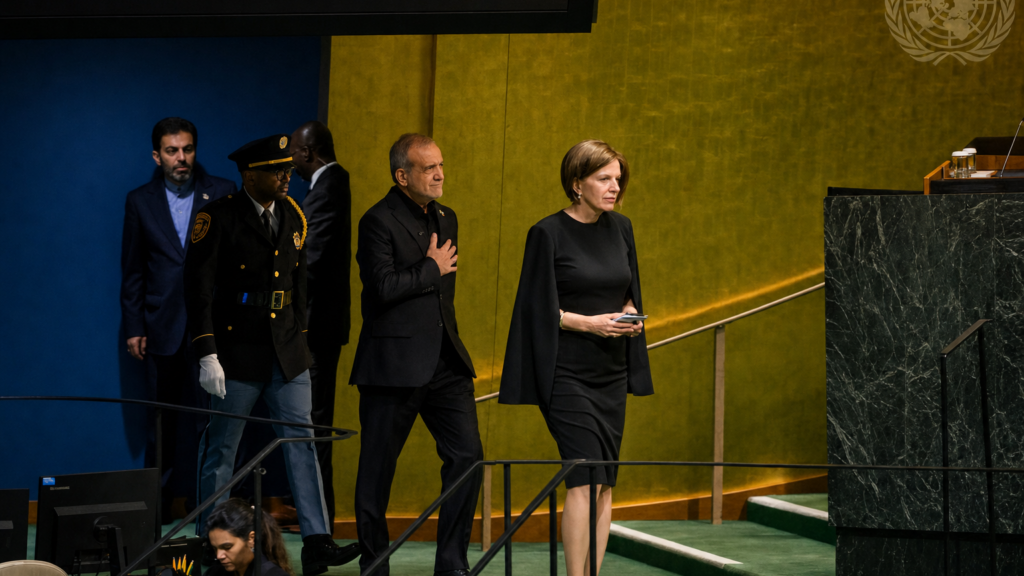
President Masoud Pezeshkian used his address to the 81st session of the United Nations General Assembly to underscore that Iran’s nuclear program serves development and that the nation will not surrender its access to peaceful nuclear technology. He described nuclear energy as a source of medical treatment for patients, food security for agriculture, industrial advancement and stable electricity supplies for the future. Pezeshkian told delegates that Iran rejects any notion of nuclear expertise as the exclusive privilege of a handful of countries, according to the official record of his remarks distributed by the Iranian state news agency Shana.
The president stated explicitly that his country pursues no atomic weapons and will not accept deprivation of its nuclear knowledge, framing the program as an inherent right tied to national progress. He called for an agreement that delivers credible international assurances the program remains peaceful while safeguarding Iranian rights, adding that the issue cannot be resolved on the battlefield. Pezeshkian accused Israel of applying double standards by possessing nuclear arms outside the Nuclear Non-Proliferation Treaty while demanding inspections of Iran, a point he tied to broader calls for justice in the region.
Foreign Minister Abbas Araghchi reinforced the same stance weeks earlier, declaring Iran’s position on enrichment unshakable especially after recent conflicts and confirming that enrichment activities would continue without yielding to external pressure. Araghchi told reporters that the right of the Iranian people to enrichment could not be erased through war or sanctions, according to accounts published by Tasnim news agency. The minister noted that while certain technical aspects might be subject to negotiation, the fundamental right itself remained non-negotiable.
Supreme Leader Ayatollah Seyyed Ali Khamenei has issued parallel declarations over recent months, describing American objections to Iranian enrichment as nonsense and insisting the Islamic Republic pursues its established policies without seeking external permission. In one set of remarks carried on his official X account, Khamenei questioned why the United States, itself possessing atomic bombs, claimed any say over whether Iran should maintain a nuclear industry. He added that enrichment has become an indigenous science in Iran, supported by dozens of experts, and that past attacks on nuclear sites had failed to halt progress.
A statement issued by the Iranian parliament in May 2025, read one day after Khamenei’s comments, reaffirmed that the country will never relinquish its nuclear rights as a member of the Nuclear Non-Proliferation Treaty. Lawmakers stressed that all enrichment activities remain legal, monitored by the International Atomic Energy Agency and directed solely toward peaceful applications in medicine, agriculture and industry. The parliamentary text highlighted that enrichment levels are determined by national needs rather than arbitrary foreign-imposed caps below 20 percent.
President Pezeshkian had earlier told Oman TV during a May 2025 visit that a religious fatwa from the supreme leader guarantees Iran harbours no intention of producing nuclear weapons, offering that assurance to the international community. He told interviewers that resilience on the enrichment issue represents an honour for the Islamic Republic and that no external actor can deny a nation the right to scientific advancement. Those comments, released via the president’s official website, aligned with repeated assertions across Iranian state institutions that the program supports civilian objectives exclusively.