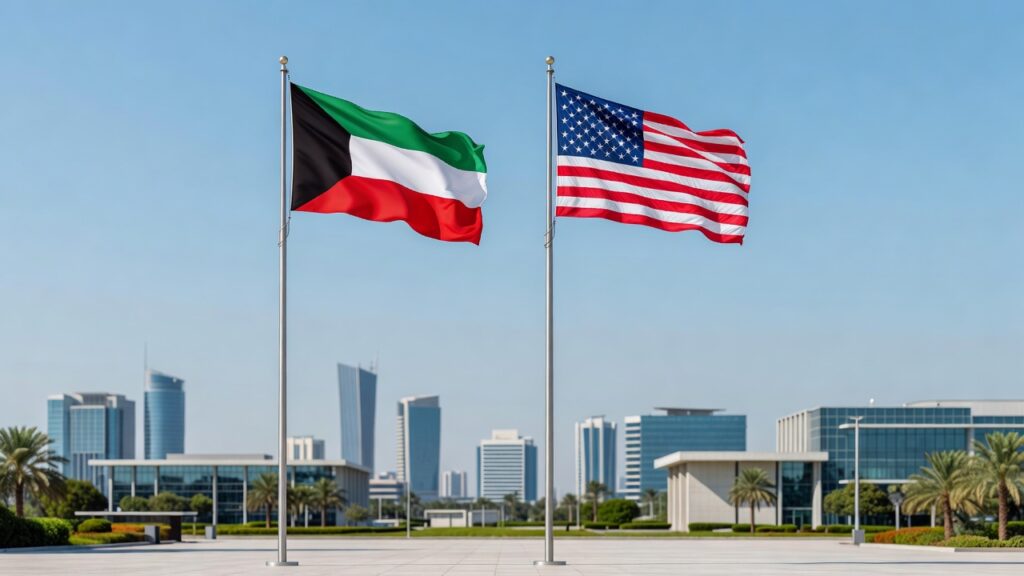
The Kuwait News Agency reported that His Highness the Amir Sheikh Meshal Al-Ahmad Al-Jaber Al-Sabah extended sincere congratulations to President Trump on the milestone occasion. The message emphasized the deep-rooted historical and strategic relations that bind Kuwait and the United States. It further affirmed both sides’ mutual commitment to strengthening bilateral ties and broadening cooperation across multiple sectors while conveying wishes for the president’s good health and for continued American progress and prosperity.
Similar cables of congratulations were sent by other top Kuwaiti officials on the same day, according to the state news agency. Crown Prince Sheikh Sabah Khaled Al-Hamad Al-Sabah, Prime Minister Sheikh Ahmad Abdullah Al-Ahmad Al-Sabah and Defense Minister Sheikh Abdullah Ali Abdullah Al-Salem Al-Sabah each dispatched messages to their American counterparts. The defense minister addressed his note to both President Trump and US Secretary of Defense Pete Hegseth, maintaining the consistent tone of goodwill and partnership seen in the Amir’s communication.
Kuwait and the United States have maintained diplomatic relations since 1961, a framework the US Department of State has characterized as grounded in shared values, democratic practices and close institutional links. The relationship deepened dramatically after Iraqi forces invaded Kuwait in 1990, when a US-led international coalition liberated the country in 1991. Kuwait subsequently provided essential logistical support for US and coalition operations in Iraq from 2003 onward and later hosted headquarters for the campaign against ISIS as a member of the Global Coalition to Defeat ISIS.
A Congressional Research Service report from early 2026 placed the number of US troops in Kuwait at approximately 13,500, primarily at Camp Arifjan and Ali al-Salem Air Base, a presence exceeded only by that in Germany, Japan and South Korea when rotational forces are counted. Kuwait contributes financially to the costs of hosting these personnel and commands, including US Army Central and the Combined Joint Task Force-Operation Inherent Resolve. The arrangement operates under a bilateral Defense Cooperation Agreement supplemented by an Acquisition and Cross-Servicing Agreement that has sustained joint military activities for years.
Bilateral trade data compiled by US authorities showed exports to Kuwait valued at $2.41 billion and imports from Kuwait at $1.64 billion in 2024, underscoring the commercial dimension of the relationship. The two countries signed a Trade and Investment Framework Agreement in 2004 that established a regular channel to resolve trade issues and advance economic reforms. Kuwait stands among the larger markets in the Middle East for American goods and services, a position reinforced by ongoing investment discussions within the Gulf Cooperation Council framework.
Institute of International Education figures indicate that roughly 5,100 Kuwaiti students were pursuing higher education in the United States as of 2024, reflecting sustained people-to-people ties that complement the governmental partnership. These educational exchanges have formed a consistent element of bilateral engagement since the early decades of diplomatic relations. The latest round of official congratulations fits within a longstanding tradition of marking each other’s national occasions with messages that restate the depth of the alliance.