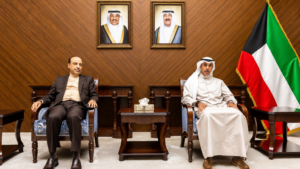
Prime Minister Sheikh Ahmed Al-Abdullah Al-Ahmed Al-Sabah presided over the session at Bayan Palace that examined methods to intensify efforts toward better exploitation of state lands in the district. The discussions sought to secure maximum benefit from the area’s strategic sites while ensuring consistency with the state’s overall developmental orientation. Senior officials in attendance included Minister of Public Works Dr. Nora Al-Mashaan, Minister of State for Municipal Affairs and Housing Abdul Latif Al-Mishari, Minister of Justice Nasser Al-Sumait, Minister of Electricity Water and Renewable Energy Dr. Sabeeh Al-Mukhaizim, Minister of Finance Dr. Yaqoub Al-Rifai and Kuwait Municipality Director General Manal Al-Asfour along with the acting head of the Prime Minister’s Diwan.
Al-Rai reported that the meeting forms part of a sustained government focus on reorganizing Jleeb Al-Shuyoukh after years of accumulated urban and regulatory challenges. The Prime Minister’s involvement highlights the priority placed on coordinated action across ministries to align land use with long-term urban planning objectives. Municipal and ministerial teams have conducted prior assessments that identified infrastructure weaknesses and density issues requiring such high-level intervention.
Kuwait Municipality has previously endorsed eight recommendations from environmental workshops to confront pollution, sewage failures and real estate misuse in the area, according to records from late 2024. Those proposals called for joint operations involving the Public Authority for Environment, Ministry of Health and Ministry of Public Works to survey conditions and accelerate repairs. Officials have described the district’s geographic advantages near the airport, university and stadium as assets that demand urgent reorganization to match their potential.
Council of Ministers decisions from 2024 directed the allocation of land for six new labor cities in locations including Al-Sabiya, Al-Salmi and Al-Mutlaa to ease pressure on Jleeb by relocating segments of the workforce. Earlier data tied to those plans placed the area’s population at approximately 266,000 across eight square kilometers with Kuwaitis comprising only a small fraction of residents. Interior Ministry campaigns conducted through mid-2026 targeted violations and illegal structures as an initial phase before full redevelopment could proceed.
The latest gathering also featured the acting director of the Prime Minister’s Diwan Sheikh Khaled Mohammad Al-Khaled Al-Sabah, legal advisor Salah Al-Majed and other technical leads responsible for translating policy into executable projects. Their participation ensures that any resulting directives will address legal, financial and infrastructural dimensions in tandem. Follow-up actions are expected to integrate input from all represented bodies to maintain momentum on the state’s urban renewal agenda for the district.