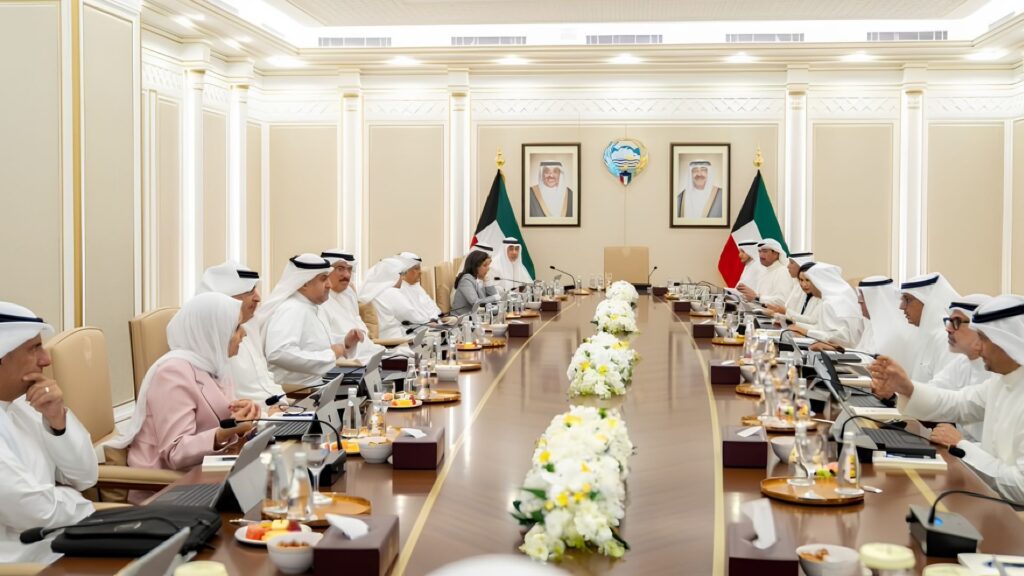
Kuwait’s Cabinet on Wednesday welcomed a framework agreement between the United States and Iran aimed at ending their recent war, expressing hope it would promote lasting peace and stability in the region and beyond. Chaired by Acting Prime Minister and Interior Minister Sheikh Fahad Al-Yousef Al-Sabah, the weekly session looked forward to the immediate cessation of military operations and the guarantee of free and safe navigation in the Strait of Hormuz, a Kuwait Times report citing KUNA said. The Cabinet acknowledged the mediation efforts of Pakistan and Qatar in bridging the positions of the two sides ahead of the signing ceremony scheduled for Friday in Geneva.
The Cabinet further hoped the agreement would produce sustainable solutions to all remaining issues between Tehran and Washington while underscoring mutual respect, non-interference in internal affairs and the rejection of force as foundational elements for security. According to the report, these principles were seen as vital not only for the Gulf but for global stability as well. This stance comes after the war that erupted on Feb. 28, 2026 led to attacks across the region, including on Kuwaiti infrastructure, as detailed by Al Jazeera.
US Energy Information Administration figures show that oil flows through the Strait of Hormuz averaged 20.9 million barrels per day in the first half of 2025, accounting for about 20 percent of global petroleum liquids consumption. The recent conflict caused these volumes to drop nearly 30 percent in the first quarter of 2026, the EIA assessment found. Kuwait’s emphasis on reopening the waterway reflects its vulnerability to disruptions in energy trade routes that have historically affected its economy.
Kuwait has historically positioned itself as a mediator in Gulf disputes, with its diplomacy in the 2017 crisis and Iran-related tensions cited in studies from the Washington Institute for Near East Policy. The foreign ministry had previously issued a statement welcoming the memorandum of understanding and praising the mediators involved, Kuwait Times reported via its official Facebook page. This Cabinet position reinforces that earlier expression of support for peaceful resolutions in line with international law.
Qatar, a fellow mediator, expressed cautious optimism that the agreement would advance regional security and lead to further discussions on Iran’s nuclear program, according to statements carried by The Guardian. French President Emmanuel Macron welcomed the breakthrough and called for the unconditional reopening of the Strait of Hormuz, Al Jazeera English reported. Negotiations are expected to continue for 60 days following the Geneva signing to address nuclear issues and sanctions relief, officials told AFP.
Experts have noted that while the deal pauses hostilities and allows Iran to resume oil sales after the lifting of a US naval blockade, challenges remain regarding Iran’s nuclear ambitions and commitments to non-interference with neighbors, a review by the Middle East Institute indicated. The agreement forms a 60-day memorandum of understanding that paves the way for a final accord, as reported by The New York Times. Kuwait’s reaction aligns with those of other Gulf states that have stressed the need for good neighborliness in any final accord, according to an analysis from the Observer Research Foundation.