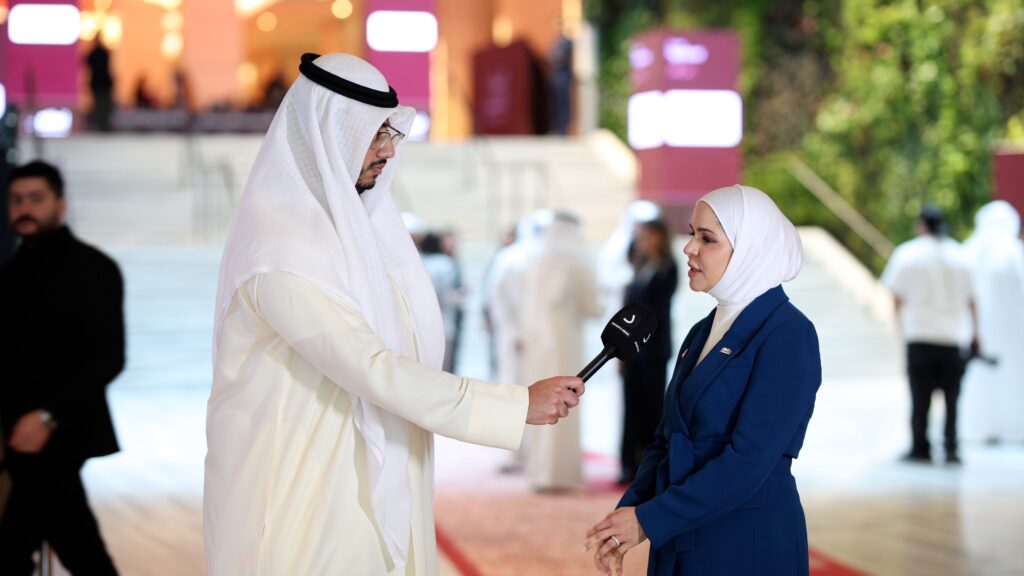
Amal Al-Duwaisan, head of Weyay, tells Diwaniya Media that curiosity, technological knowledge and resilience can help women prepare for new opportunities as the workplace changes.
Women starting their careers should pay attention to the opportunities emerging from technological change, according to Amal Al-Duwaisan, head of Weyay, Kuwait’s first digital bank by the National Bank of Kuwait.
Speaking to Diwaniya Media following a panel discussion, Al-Duwaisan said the conversation had explored how changes in technology could create opportunities for women and what they needed to do to prepare for new roles. Her advice connected career progression with a willingness to keep learning as the work itself evolves.
“I would say be very curious,” she said. “The pace of change is massive, specifically in technology, yet it brings a lot of opportunities with it.”
Her comments bring a practical dimension to discussions about women in leadership. For someone entering the workforce today, preparing for a senior position also means understanding how technology may change the responsibilities, skills and decisions that position involves.
Preparing for roles that are still taking shape
Al-Duwaisan described readiness for new roles as one of the most interesting subjects raised during her panel. The discussion, she said, considered both the opportunities technological change could bring and the approach women could take to benefit from them.
That question has become increasingly relevant as employers reconsider the skills they need. The World Economic Forum’s Future of Jobs Report 2025 found that employers expect 39% of workers’ existing skills to change or become outdated between 2025 and 2030. Its findings draw on more than 1,000 employers representing over 14 million workers across 55 economies.
The figure is a global projection, rather than a forecast specifically for Kuwait. It nevertheless provides context for Al-Duwaisan’s emphasis on continued learning: career development is taking place alongside substantial changes in the knowledge employers expect people to bring to their roles.
Her advice was directed at women seeking to advance professionally, without limiting that ambition to a particular technical occupation. The emphasis was on understanding new technologies and remaining engaged with the changes around them, including the possibilities those changes might create.
Why curiosity belongs in the leadership conversation
The World Economic Forum identifies curiosity and lifelong learning among the skills expected to rise in importance through 2030, alongside technological literacy, creative thinking and resilience. That combination closely reflects the qualities Al-Duwaisan highlighted in the interview.
“So I would advise women to be curious, learn the new technologies, and continue being resilient no matter how difficult the journey is,” she said.
Taken together, those recommendations describe an ongoing approach to professional development. Learning a new system is one part of it; maintaining the willingness to ask questions and understand the next development is another. Her reference to resilience also recognises that building a career can require persistence over an extended period.
For women considering their next step, the relevance of her message extends beyond an immediate promotion. It raises the question of which emerging responsibilities they want to prepare for and how their existing experience might connect with new areas of work.
Al-Duwaisan did not prescribe a particular qualification or training programme. Her advice centred on habits that can continue throughout a career, even as the tools and technologies involved change.
Connecting individual ambition with opportunities to learn
The wider discussion about women and technology also reaches back into education. UNESCO reports that women account for 35% of STEM graduates globally, a share it says has remained unchanged for a decade. STEM covers science, technology, engineering and mathematics.
That global measure does not describe women’s participation in Kuwait specifically, nor does it capture every route into a technology-related career. It does, however, show why access to technical learning remains part of the international conversation about women’s future employment.
UNESCO’s work in this area addresses participation in education, the visibility of women in scientific fields and the factors that influence whether girls continue into related careers. These issues sit alongside the workplace learning Al-Duwaisan encouraged.
Within NBK, leadership development has also taken a structured form. The bank describes NBK RISE as a nine-month programme intended to advance women into higher leadership roles, developed with organisations including IE Business School, INSEAD and FranklinCovey.
The initiative provides relevant institutional context for the interview. Al-Duwaisan’s own comments focused on what women can do to prepare, while programmes of this kind address the learning opportunities organisations can make available.
A perspective from digital banking
Al-Duwaisan’s role places these questions within a business built around technology. Weyay describes itself as Kuwait’s first digital bank, developed by NBK, with account opening and banking services available through its mobile platform.
When asked about innovation at Weyay, she connected it to the organisation’s culture and ways of working. Those internal practices, she said, help bring innovation into the products it launches.
That connection between people, working methods and technology gives context to her career advice. Her interview addressed both how an organisation develops new services and how individuals prepare to contribute as their industry changes.
For women looking towards senior positions, the question she raised was therefore a specific one: how to be ready for the new roles being created. Her answer began with curiosity and continued through learning and resilience, three qualities she urged women to carry into the next stage of their careers.