Reports of toxic plants have prompted coordination between health and environmental authorities, with families urged to keep children away.
Kuwait’s health and environmental authorities are warning residents about poisonous Datura plants reported in residential areas and public spaces, bringing attention to a plant whose flowers can conceal a serious risk if it is eaten or handled unsafely.
Dr Abdullatif Al-Omi, head of the Kuwait Poison Control Center at Al-Amiri Hospital, told KUNA that the centre had recently treated severe poisoning cases involving toxic plants such as Datura. The Public Authority for Agriculture Affairs and Fish Resources has proposed a national programme prioritising schools, parks and other places used by children.
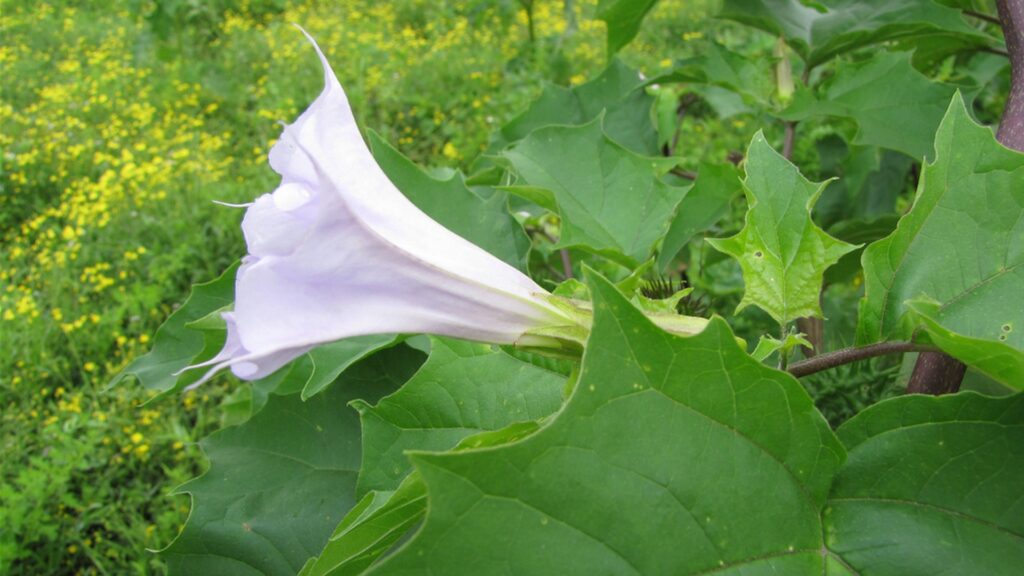
The warning raises two practical questions for households: how to recognise a potentially dangerous plant, and when a possible exposure needs medical attention. A photograph can help with identification, but it cannot establish whether someone has been poisoned or how serious their condition may be.
A familiar-looking flower with toxic parts
Datura belongs to the nightshade family. One species, Datura stramonium, is also known as jimsonweed or thornapple. North Carolina State University’s plant guide describes an upright, branching plant with dark green leaves, trumpet-shaped flowers and spiny seed capsules. The flowers can be white or tinged with purple, opening at night and fading the following day.
Its ability to grow outside cultivated gardens helps explain why sightings can occur in everyday surroundings. The university lists roadsides, open ground and disturbed land among its habitats. Once established, the plant can tolerate dry conditions, while its numerous seeds can remain viable in the soil for years.
Those characteristics matter when assessing a site after plants have been removed. Seeds left behind can remain a source of future growth, so the disappearance of visible stems and flowers does not necessarily mean a location will stay clear. The same guide identifies risks to pets and livestock as well as people, and warns that every part is toxic if swallowed.
Why eating the plant can become an emergency
The danger extends beyond the spiny seed pods. Germany’s Federal Institute for Risk Assessment identifies toxic compounds called tropane alkaloids throughout Datura stramonium, including in its leaves, roots and seeds. Its guidance describes possible effects after oral contact or ingestion, including agitation, confusion, thirst, raised body temperature and hallucinations.
Australia’s Queensland Poisons Information Centre classifies the species as extremely toxic. It lists difficulty speaking or swallowing, dilated pupils, seizures and coma among possible symptoms, and notes that deaths have occurred. These are possible consequences of poisoning, not a claim that every exposure produces the same outcome.
Contact also requires care. Queensland’s guidance warns that sap entering the eyes can cause pupil dilation and temporary loss of vision, and recommends medical assistance for all ingestions and eye exposures. That makes picking a flower or examining a seed pod by hand an unsuitable way for a member of the public to confirm what they have found.
Kuwait’s response brings health and environment teams together
An Environment Public Authority statement dated 24 September documents coordination with the Kuwait Poison Control Center over reports of poisonous plants near public places. The meeting involved Al-Omi and representatives of the authority’s biodiversity department, with discussion covering information sharing, contact points and arrangements for responding to reports.
The statement also identifies cooperation with the agriculture authority in following up affected locations. This gives the response a wider remit than treating individual patients: the agencies also need to establish where potentially harmful plants are growing and decide how those sites should be managed.
The proposed national programme would include field surveys, safe removal and disposal, public awareness and follow-up monitoring. It remains a proposal, rather than evidence that a nationwide clearance operation has been completed.
Keeping children away starts with everyday habits
For families, prevention does not depend on children learning a botanical description. The National Capital Poison Center’s guidance on poisonous plants recommends supervising young children outdoors, keeping indoor plants beyond their reach and teaching them to ask an adult before eating or drinking something unfamiliar.
The centre also stresses the importance of knowing which plants are in the home and garden. An accurate identification helps specialists assess an exposure; a general description such as a white flower or green berry may leave too much uncertainty. Its illustrated lists are a guide, rather than a substitute for advice about a particular incident.
The same caution applies during picnics and other outdoor activities. Plants should not be assumed edible because they grow naturally or resemble something familiar. The centre warns that mistaken identification has caused fatal poisonings. For adults supervising children, the practical lesson is to prevent tasting or collecting unknown plants in the first place.
Suspected ingestion needs prompt advice
Anyone who suspects that Datura has been swallowed should seek medical advice immediately, without waiting for symptoms to become severe. Kuwait’s Poison Control Center provides round-the-clock advice on 1804774.
Do not induce vomiting. Poison Control’s emergency guidance advises getting expert help, with the response depending on the substance, amount, symptoms and person affected. Collapse, seizures, breathing difficulties or an inability to wake the person require emergency assistance.
A clear photograph can help identify the plant without collecting it. Residents who encounter a suspected Datura plant should keep children away and report its location to the relevant authorities, leaving assessment and removal to the responsible teams.