The Kuwaiti photographer’s second-place finish in Dubai follows a sports-photography practice documented in local exhibitions and Gulf photography events.
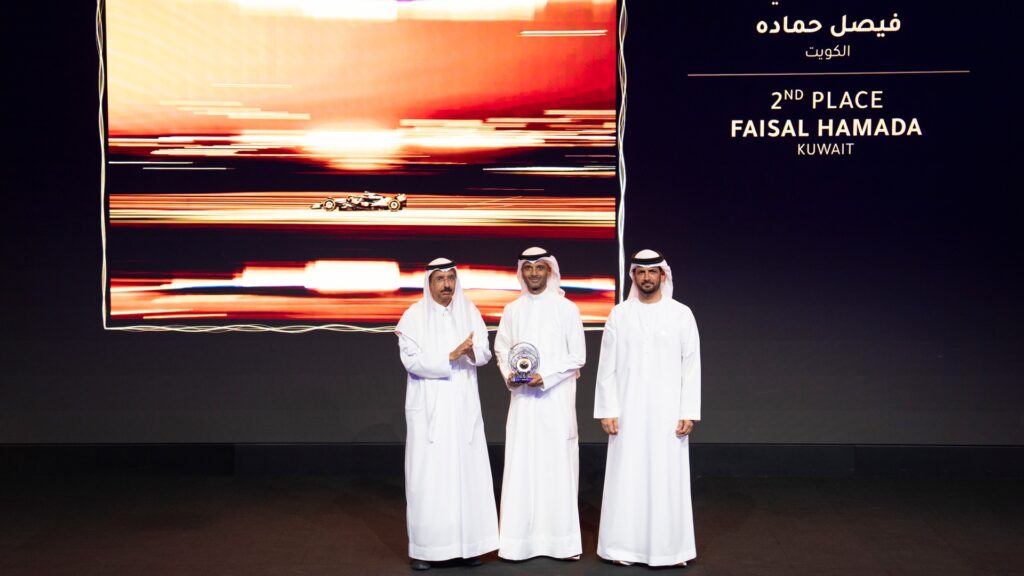
An orange Formula 1 car cuts across bands of gold, red and black. Its wheels and body remain recognisable while the surrounding scene stretches into horizontal trails. In Faisal Hamada’s photograph, the sensation of speed comes from the whole frame.
The image has earned the Kuwaiti photographer second place in Sports Photography at the Hamdan bin Mohammed bin Rashid Al Maktoum International Photography Award, known as HIPA. The result was announced at the competition’s fifteenth-season ceremony at Dubai’s Museum of the Future on 10 November.
Emirates News Agency confirmed that China’s Hongbin Wu took first place in the category, followed by Hamada and Russia’s Kirill Kudryavtsev. For Hamada, the award adds an international result to a sports-photography practice documented in Kuwait long before this winning frame.
Making speed visible
The car occupies a relatively small part of Hamada’s image. Long bands of light run above and below it, giving the viewer a direction to follow. The orange bodywork connects visually with the surrounding colours, while the darker space around the vehicle helps separate it from the streaks.
That balance allows the photograph to work at two distances. Viewed as a whole, it is a composition of colour and movement. Look more closely and the racing car becomes the focal point. The frame gives substantial space to the environment through which it is travelling.
The image has the visual characteristics associated with panning. In Canon’s explanation of the technique, a photographer follows a moving subject while using a sufficiently slow shutter speed to record movement in the background. Matching the camera’s movement to the subject can keep the subject comparatively sharp.
The balance is demanding: a faster exposure can reduce the impression of movement, while a slower one makes maintaining detail in the subject more difficult. Hamada’s precise camera settings have not been published with the award information. The observable result is a car held within a scene that appears to rush past it.
A sports-photography practice rooted in Kuwait
Hamada’s involvement in exhibiting sports images stretches back at least to 2011. In September that year, Al Anba reported on the second Photo Frenzy exhibition at Kuwait’s Tilal Gallery, where he showed work alongside Abdulaziz Al-Asousi, Ali Al-Zaidi and Saad Al-Farhan.
The exhibition brought together sports photographs taken inside and outside Kuwait. Hamada contributed 13 images. In the newspaper’s account, he described the value of exhibiting alongside fellow photographers, with the pictures strengthening one another and much of the work engaging with international sporting activity.
That earlier exhibition gives the HIPA result a specific local history. Sports photography was already being presented in a Kuwaiti gallery as work to be viewed, compared and discussed, with motion itself forming part of the exhibition’s appeal.
His public photography profile, published under the spelling Faisal Hamadah, also identifies sports, landscapes and portraits among his interests. Those subjects involve different relationships between people and their surroundings. In the winning Formula 1 photograph, the surroundings occupy most of the frame and carry much of its visual energy.
Sharing photography beyond the exhibition wall
More recent reporting places Hamada in a teaching role within the Gulf’s photography community. Qatar News Agency’s coverage of the Doha Photography Festival in November 2025 lists him as the presenter of a lecture whose Arabic title translates as “A Lens That Defies the Rules”.
The programme also included a session on camera and focus fundamentals and a workshop on journeys through the lens. It brought practical instruction into a festival that combined exhibitions, awards and displays by photography companies.
The festival’s award programme received 31,681 works from 5,206 photographers in 101 countries, according to QNA. Its lectures therefore sat alongside an international competition, giving the event a role in both displaying photographs and discussing how they are made.
The two documented appearances show different parts of Hamada’s practice: presenting finished images to gallery visitors in Kuwait and taking part in photographic instruction in Doha.
His HIPA image now offers another accessible starting point for that discussion. Even without knowing the race result or the driver, a viewer can examine how a recognisable subject, its position in the frame and the movement around it combine to communicate speed.
A Kuwaiti result within an international field
HIPA’s fifteenth season carried the theme Family, with separate categories for Sports Photography, Portfolio, General and Dreams Through AI. Hamada’s placing belongs specifically to the sports category.
In its announcement concluding the season’s judging, HIPA said its archive had exceeded one million photographs from more than 500,000 photographers across 209 countries. These are cumulative figures for the award’s wider platform, rather than entry totals for the 2026 sports category.
The ceremony distributed $1 million across competition categories and special awards. Within that broader programme, Hamada’s result gives Kuwaiti sports photography a place among the season’s recognised work.
The connection between his earlier exhibition and the latest award is visible in their shared subject: movement. In Kuwait in 2011, his photographs appeared in a group exhibition exploring sporting activity and its visual possibilities. In Dubai in 2026, one Formula 1 frame received an individual award.
The photograph can be read without a race classification or a lap time. Its subject is the experience of speed, communicated through colour, light and the placement of a single car.