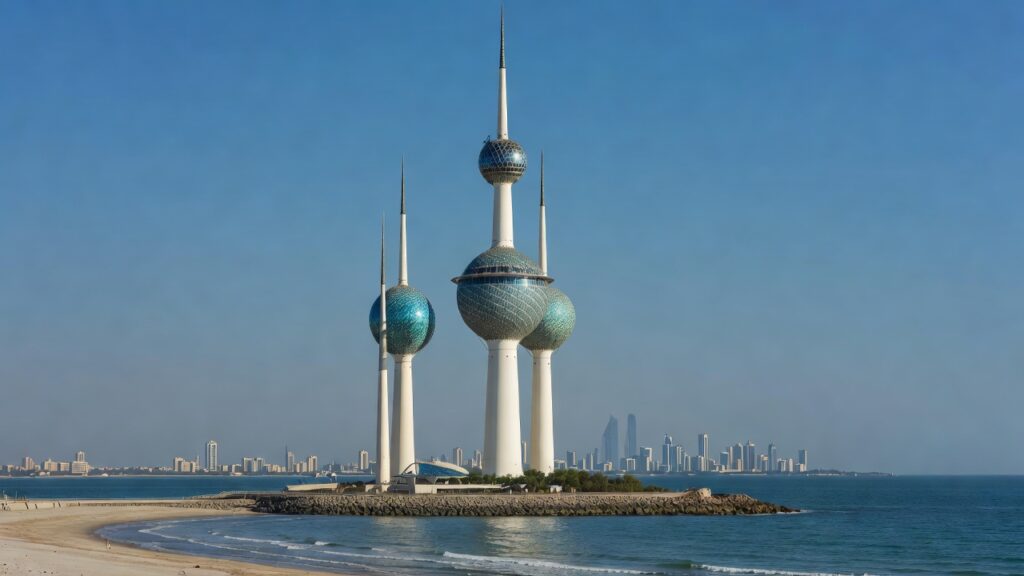
Education Minister Jalal Al-Tabtabaei joined Minister of State for Communications and Information Technology and Acting Minister of Information and Culture Omar Al-Omar along with Minister of State for Municipal Affairs and Minister of State for Housing Affairs Abdullatif Al-Meshari for the Thursday meeting, the Education Ministry said in a statement. Participants assessed technical and procedural components of the file while considering international standards and requirements for World Heritage inclusion. The session also explored improved coordination between Kuwaiti authorities and the visiting advisory mission that arrived on Nov. 9 and concluded its work on Nov. 12.
The Education Ministry statement indicated that discussions centered on finalizing the dossier to better showcase the towers’ historical, architectural and cultural importance as a national symbol of urban growth. Officials emphasized the need for a cohesive governmental strategy to fulfill UNESCO expectations and maintain the location’s exceptional universal value alongside ongoing development priorities. The gathering formed part of sustained national initiatives to protect the landmark and advance its international recognition.
UNESCO documentation places the Kuwait Towers on the tentative World Heritage List following a submission by the National Council for Culture, Arts and Letters on June 12, 2014, under cultural criteria i and ii. The file presents the complex as a notable example of 20th-century architectural creativity that embodies Kuwait’s post-independence modernization through innovative engineering and design. The towers rise along a peninsula in Kuwait City overlooking the Arabian Gulf and integrate water storage functions with aesthetic and symbolic elements.
Swedish architects Sune Lindström and Malene Bjørn designed the structures that were built between 1971 and 1976 before their official inauguration in 1979, according to records from the National Council for Culture, Arts and Letters. The main tower reaches 187 meters and houses an observation platform and dining facility while its spheres feature more than 55,000 colored steel plates that echo surrounding sea and sky tones. The complex belongs to a larger system of water towers constructed to support the nation’s desalination infrastructure and urban expansion.
Director of the Culture Department at the Arab League Educational, Cultural and Scientific Organization Hamid Al-Nofli announced in August 2025 that the towers had been incorporated into ALECSO’s Arab Heritage List within the modern architecture category, the Kuwait News Agency reported. Al-Nofli highlighted their distinctive engineering, creative vision and visual appeal that qualified them for the organization’s Register of Architectural and Urban Heritage in Arab Countries. The register applies specialized criteria focused on Arab creative achievements and differs from UNESCO or ISESCO frameworks by encompassing both historic and contemporary examples.
The ALECSO addition followed evaluation by a panel of Arab specialists who reviewed Kuwait’s official nomination from a preliminary national inventory, according to the organization’s explanation. This recognition supports broader goals of conserving regional heritage, increasing public awareness and linking such sites to economic and tourism strategies for sustainable growth. The towers’ dual listing progress reflects continued collaboration among Kuwaiti cultural and governmental institutions on heritage files.