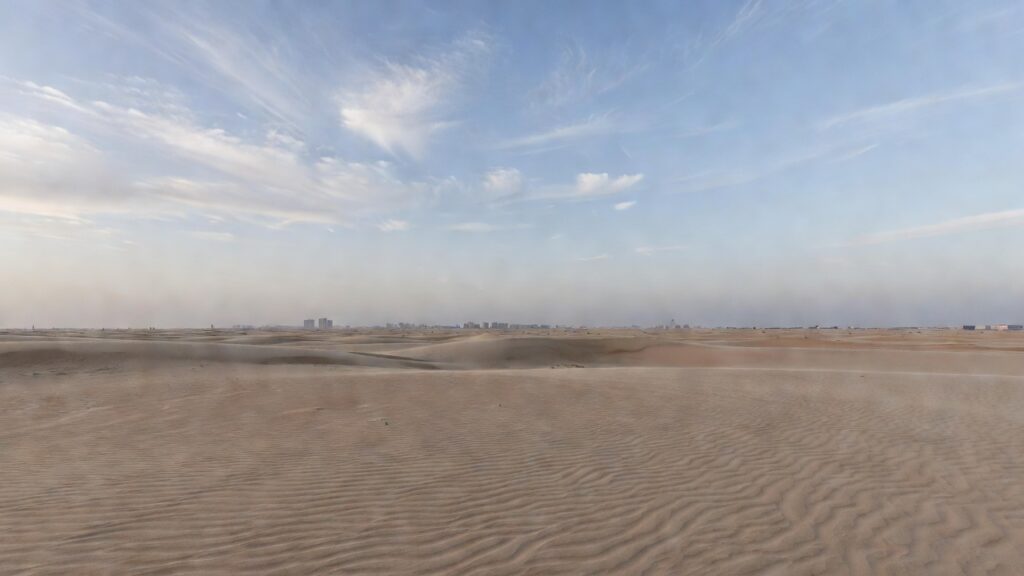
The Meteorological Department has forecast that a cold air mass will influence Kuwait starting November 24, marking the first significant winter front with minimum temperatures falling to 10 degrees Celsius in several areas including the capital and desert regions. Daytime highs are expected to reach 27 to 30 degrees with light variable winds between 6 and 22 kilometers per hour and some high clouds forming. Sea conditions will remain slight with waves of 1 to 2 feet according to the department’s four-day outlook issued this week. The forecast aligns with observed patterns in recent years where November cold snaps have preceded deeper winter systems in December.
This development corresponds to the traditional Al-Ajiri astronomical calendar under which November 24 signals entry into the Zabana station, the first of the winter mansions that lasts 13 days. Local experts following the system describe it as bringing increased nighttime cold along with northwesterly winds while daytime weather stays relatively moderate. The Al-Ajiri Scientific Center has highlighted that nights will exceed 13 hours during this period followed by the Iklil station.
Kuwait’s Meteorological Department data from previous seasons shows that early winter fronts in late November often produce minimum temperatures 4 to 5 degrees below the monthly average of around 15 degrees. Acting Director Darrar Al-Ali has noted in past briefings that such systems driven by northwestern high pressure lead to dry air masses and noticeable temperature drops especially after sunset. The current outlook follows a period of milder conditions earlier in the month with maximums in the upper 20s.
Meteorologist Essa Ramadan has documented similar early polar highs in November that temporarily lower temperatures before a brief rebound ahead of stronger December cold waves. His analysis of meteorological station readings has placed recent minima at 7 degrees in areas such as Salmi in comparable periods. Ramadan’s updates emphasize that extreme weather variability has become more pronounced in the region over recent decades.
Residents in open and agricultural zones are likely to feel the greatest impact from the nighttime chill with potential for localized fog formation according to the department. The authority has advised motorists and farmers to exercise caution during the early morning hours when visibility may be reduced. Public Authority for Civil Information statistics indicate that Kuwait’s population distribution places a significant portion in urban areas where the temperature contrast between day and night will be most evident.
The forecast comes amid broader regional patterns in which Gulf countries have experienced fluctuating winter conditions in recent years with occasional strong cold fronts. Kuwait’s department maintains a network of monitoring stations that recorded no rainfall in the past 24 hours as of the latest update but anticipates possible changes in subsequent periods. Further details on the evolving situation will be provided in the department’s regular evening bulletins.